

Description
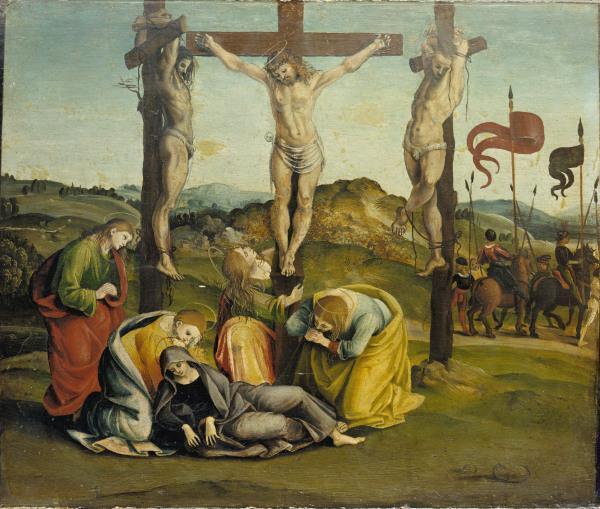
The painting depicts the Crucifixion of Christ in an open landscape, centered on three crosses rising above the composition. Jesus appears on the central cross, his arms outstretched and a light-colored cloth wrapped around his waist; on either side, two crucified figures complete the episode’s dramatic vertical axis. Below them, several people kneel or bend over a body stretched out on the ground. Their green, red, blue, gray and yellow garments form a compact group in mourning, while in the background on the right, a procession of riders, horses, banners and staffs extends the scene into the public space of the execution. Low hills, vegetation and distant buildings enclose the horizon.
The episode belongs to the central narrative of Christ’s Passion and depicts the moment of his death on Mount Calvary. The traditional arrangement places Jesus on the central cross and the two condemned men at his sides, a structure that the work makes immediately clear. The figures gathered at the foot of the crosses convey the human response to the event: grief, piety and contemplation. The procession reminds us that the Crucifixion is not only an intimate experience, but also a public execution witnessed by soldiers, attendants and onlookers. In the Christian narrative, the scene precedes the Resurrection and concentrates the tragic meaning of the Passion.
The central cross serves as the theological and visual core, separating the elevated realm of sacrifice from the grieving group occupying the ground. The two side crosses create a tense symmetry around Christ, while the kneeling figures turn the foreground into a place of contemplation. The banners and poles in the background introduce a note of authority and organized violence, contrasting with the widespread stillness of the landscape. The broad hills and the line of distant buildings place the tragedy in an inhabited world, although the serenity of the setting, by contrast, heightens the gravity of what has happened. The body lying in the lower center reinforces the physical, painful dimension of the scene.
The composition is clearly organized into three planes. Above, the crosses dominate the sky and establish a series of vertical lines; in the center and below, the group of figures creates a more broken rhythm of inclinations, folds, and gestures. The largest cross aligns with the central axis, guiding the eye from the figure of Christ to the outstretched body and then toward the terrain opening onto the horizon. The greens and ochres of the landscape provide an earthy foundation for the dark reds, golden yellows, and grayish blues of the garments. The soft, pervasive daylight does not dispel the drama; it makes it more restrained and renders the contrast between the bright sky, the crosses, and the gathering of mourners especially effective.
The work can be situated within an Italian Renaissance sensibility associated with Luca Signorelli, recognizable here in the monumental presence of the figures, the attention paid to their bodies, and a narrative shaped by strong spatial clarity. The religious episode is not confined to the three crosses: it unfolds through the landscape, the procession, and the responses of those who remain on the ground. As you view it, follow the path that begins at the central cross, descends toward the group in mourning, then recedes toward the horsemen and the hills. This movement brings sacrifice, witness, and landscape together in a single choral drama.
Have questions about our oil painting reproductions? See our frequently asked questions.