

Description
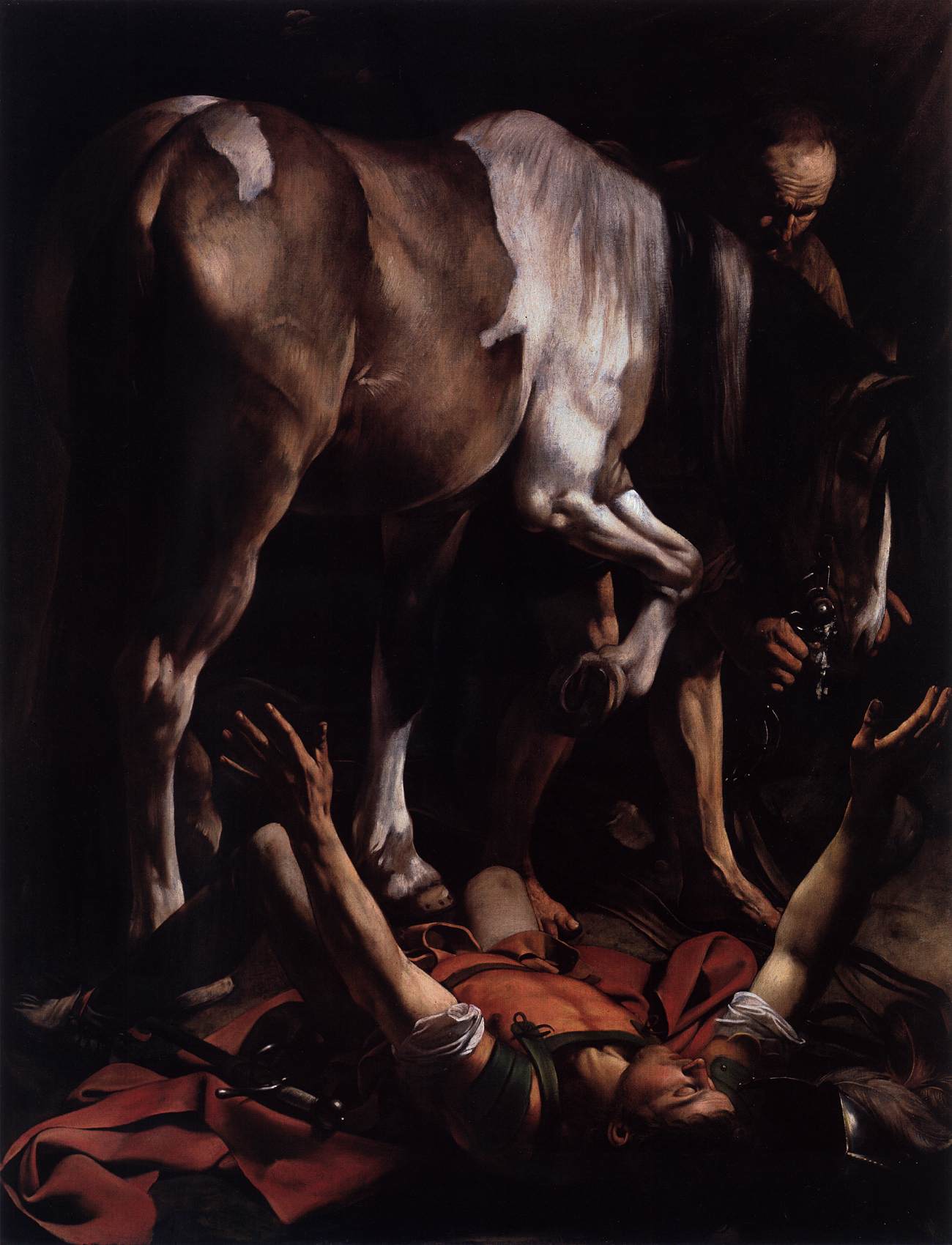
The painting depicts the conversion of Saint Paul on the way to Damascus as a moment of intense physical and spiritual tension. A large horse dominates the central and upper parts of the scene, its head lowered toward the figures lying beneath its legs. Bodies, raised arms, red garments, straps and dark objects crowd the foreground, while an upright figure on the right watches or assists. Darkness envelops almost the entire space, drawing attention to the animal, the hands and the faces emerging from the shadows.
The episode comes from Christian tradition and is recounted in the Acts of the Apostles. Saul was traveling to Damascus as a persecutor of Christians when a divine intervention caused him to fall and radically transformed his life. From then on, he would be known as Paul, one of the central figures of Christianity. The painting shows neither the city nor a recognizable landscape; instead, it condenses the story into the decisive moment of the fall, when Saul’s former life is interrupted and his conversion begins.
The figure lying beneath the horse turns the physical fall into an image of spiritual rupture and transformation. The arms and hands reaching up from the ground convey gestures of aid, bewilderment and response to an extraordinary event. The animal’s monumental scale underscores the protagonist’s vulnerability, reducing him to a fragile presence among legs, fabrics and shadows. The figure on the right serves as a human and narrative counterpoint: his upright posture offers another perspective on the confusion of the episode. The red garments heighten the visual intensity and add pulses of color to the scene.
The vertical composition is structured around descending diagonals: the horse’s neck guides the eye toward Paul’s body, while its legs extend that movement down to the hands in the foreground. The space seems compressed around the figures, with no architecture to distract from the central drama. The blacks and browns absorb the contours at the edges; by contrast, the horse’s silvery grays and the deep reds of the fabrics create points of intensity. The theatrical lighting is not distributed evenly; instead, it defines volumes and makes some bodies appear suddenly before the viewer. In this way, light shapes both the narrative reading and the painting’s emotional rhythm.
In this work by Caravaggio, tenebrism, the physical presence of the figures, and the immediacy of the religious event turn a sacred story into an immediate, human experience. The monumental horse is not merely an incidental element: it establishes the scale of the crisis and visually dominates the moment of transformation. Notice how the animal’s lowered head, the arms reaching upward, and the fallen body form an axis of tension between strength, vulnerability, and revelation. The conversion becomes visible not through a grand scene, but through the collision of a body thrown to the ground, several bewildered figures, and a light that breaks into the darkness.
Have questions about our oil painting reproductions? See our frequently asked questions.