

Description
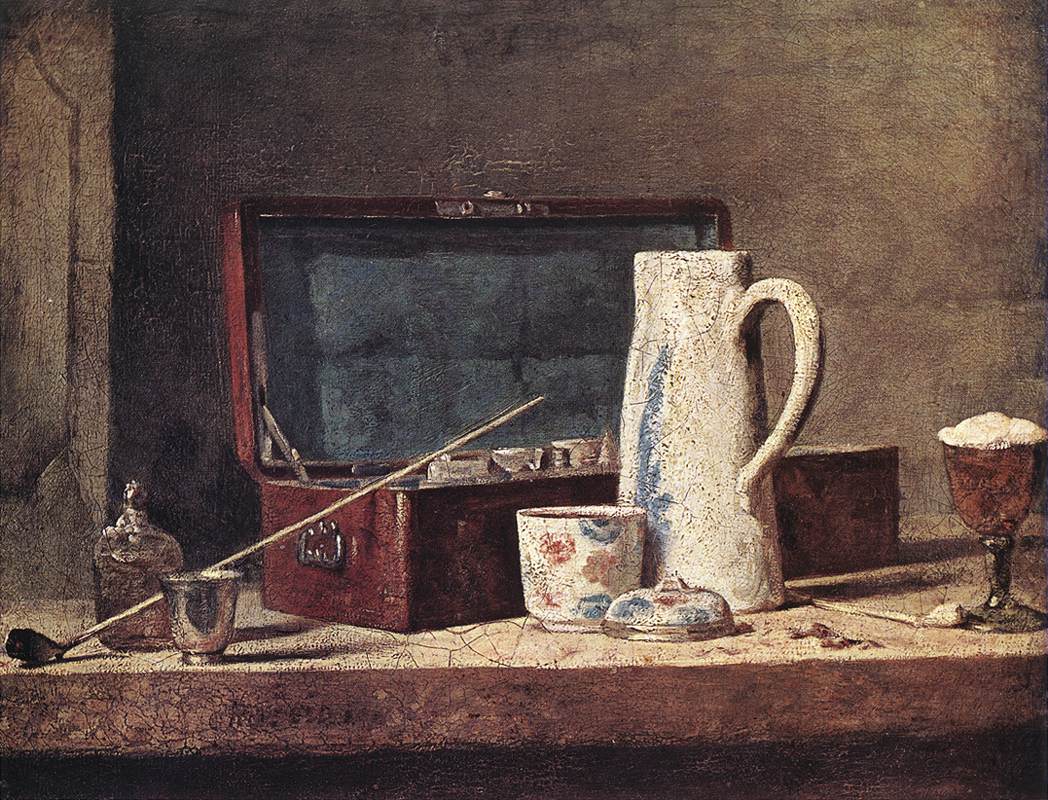
The painting depicts a domestic still life arranged on a broad, worn table. At center-right, a tall white ceramic jug rises as the dominant element, while in front of it is a cup or small bowl decorated with reddish and bluish patches. Around it are vessels of various shapes, an open wooden box, a small metal container and a pipe resting diagonally. The dark, timeworn background features a rectangular panel and accentuates the presence of the light-colored objects. Each item has its place in a quiet interior, with no human figures or narrative action.
As a still life, the work does not tell a figurative story; instead, it focuses attention on everyday objects and the way they coexist on a single surface. The pipe suggests a pause and domestic leisure, while the jug and other vessels evoke a material life shaped by utensils, habits and repeated gestures. This focus on familiar things gives the scene an intimate, contemplative quality. Jean-Baptiste-Siméon Chardin's painting thus turns an ordinary arrangement into a subject worthy of prolonged observation, in which the passage of time is visible in the stains, cracks and weathered surfaces of the table.
The composition's expressive power comes from the tension between light and dark. The white jug serves as a serene visual center against the bluish, brown and black background, and its brightness makes it possible to discern clearly its volume, handle and ceramic surface. The reddish objects—the box and cup—add warm accents that keep the composition from becoming uniform. By crossing the table diagonally, the pipe introduces a line of movement into an otherwise stable arrangement. Rather than illustrating a fixed meaning, these objects invite reflection on materiality, everyday use and the stillness of a suspended moment.
The horizontal composition arranges the elements across different planes without sacrificing unity. The jug establishes a dominant vertical; the box and the panel in the background form a second layer; and the small vessels in the foreground lead the eye toward the edges of the table. The diagonal of the pipe links these areas and creates a visual rhythm that balances the solidity of the larger forms. The subdued light shapes the volumes through restrained contrasts, without bright effects or abrupt shadows. The palette of sepias, grays, creamy whites, and rusty reds reinforces the tactile quality of the wood, ceramic, and metal.
The work belongs to Chardin’s still lifes, recognizable for their highly focused domestic compositions, sober light, restrained palette, and attention to the visual weight of each object. Here, the simplicity of the subject becomes an experience of contemplation: the jug provides stability and clarity, the pipe introduces a pause transformed into a line, and the secondary vessels enrich the texture of the whole. Notice how the eye moves from the dominant vertical form to the small objects in the foreground; along this path, the painting reveals that its true subject is not merely what lies on the table, but the quiet density of everyday life.
Have questions about our oil painting reproductions? See our frequently asked questions.