




Description
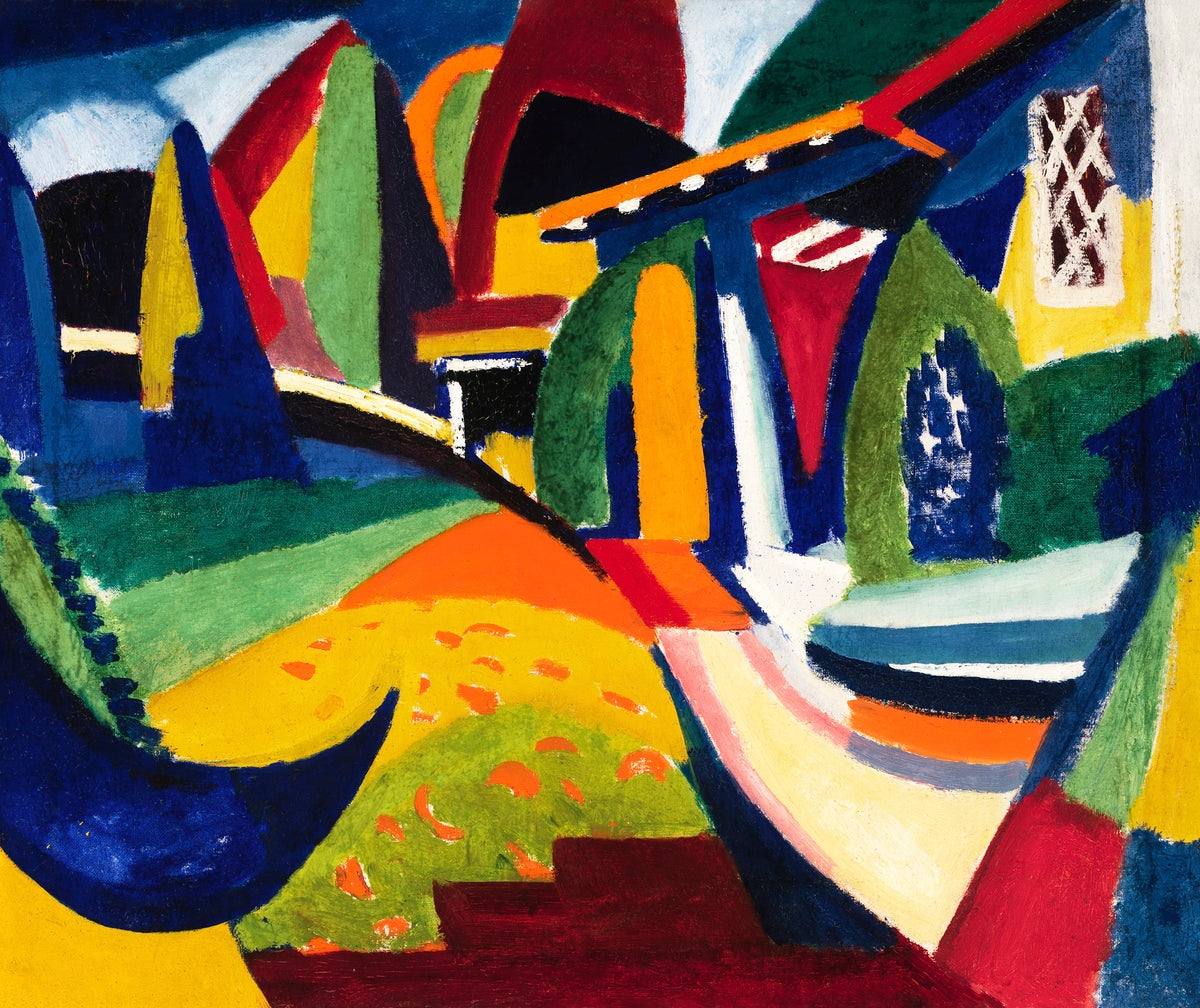
The painting shows a landscaped architectural scene composed of angular forms, vivid colors, and overlapping planes. Green gardens, yellow and orange paths, masses of bluish vegetation, and a succession of slender trees organize the scene from one end to the other. Among the trees are several buildings with light-colored façades and sloping roofs in red, blue, yellow, and black. In the upper right, a light-colored opening with a grid pattern adds an almost graphic detail, while the paths draw the eye from the center toward the foreground. The work is titled Scheherazade and, in Henry Lyman Sayen’s work, the landscape functions more as an imaginary setting than as a naturalistic view.
Scheherazade is the central storyteller in The Thousand and One Nights. According to the traditional tale, she tells stories to Sultan Shahriar to avoid execution, keeping each night open-ended with new episodes and interwoven tales. This tradition makes her name a reference to imagination, the narrative voice, and the ability to transform a desperate situation into a world of possibilities. Here, the connection to the title does not depend on a visible human figure or a specific literary scene: it is concentrated in the creation of a space that seems to contain successive stories. The gardens, buildings, and fragmented pathways suggest a storybook setting, suspended between recognizable architecture and fantasy.
The work’s iconography arises from the tension between shelter, journey, and discovery. Curving and diagonal paths connect different parts of the garden as if leading from one episode to another, while the partially overlapping structures seem to conceal interiors and scenes yet to be told. The vertical vegetation acts as a sequence of chromatic signs: blue, yellow, red, and green trees mark pauses and shifts in rhythm within the landscape. The bluish band crossing the right side heightens the sense of movement and balance, in dialogue with the green surfaces and dark rooftops. Rather than depicting a specific place, the composition transforms the setting into a fantastical world, where each plane can be read as a new entrance to the story.
Formally, the painting is built around a horizontal structure crossed by pronounced diagonals. A yellow and orange path opens up the lower-left foreground, while another light band descends from the center, extending the movement toward the lower edge. These lines keep the eye from resting on a single point, drawing it in a circuit among the gardens, trees, and architectural forms. Color establishes direct contrasts: greens and blues provide depth and calm, while reds, yellows, and oranges introduce energy and luminous accents. The compact forms, defined contours, and deliberately irregular perspective create a theatrical sense of space, as if several scenes were unfolding simultaneously across a flat surface.
Without relying on a central figure, Scheherazade builds its narrative character through the arrangement of space. The intensity of the colors makes the garden seem to shimmer, while the fragmented architecture preserves the promise of rooms, encounters, and stories hidden behind each plane. Rather than imitating a view, Henry Lyman Sayen presents a composite world: a landscape where geometry orders fantasy and the paths keep the eye moving. Notice how the visual journey begins along the paths in the foreground, rises toward the buildings, and then disperses among the trees; this movement holds the key to the work, transforming a garden of brilliant forms into an experience of visual storytelling.
Have questions about our oil painting reproductions? See our frequently asked questions.