

Description
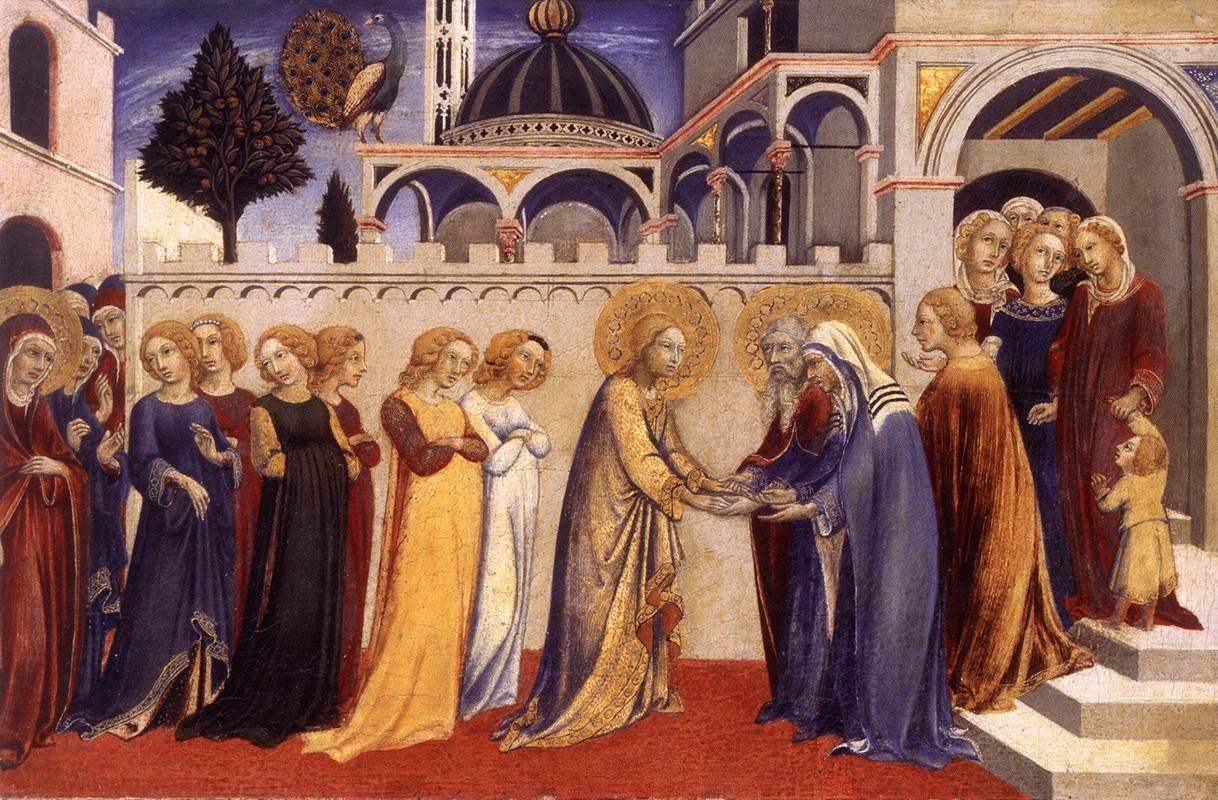
The painting depicts the return of the Virgin in a monumental enclosure, surrounded by a group of haloed figures arranged before galleries, arcades, domes, and battlemented walls. At the center, a figure in a gold tunic reaches out toward an elderly, bearded man dressed in a dark blue cloak, while a veiled figure in blue and white leans beside him. On either side, women and attendants dressed in red, blue, black, and gold complete the ceremonial scene. A child figure appears on the staircase at the far right. Rising above the architecture are a leafy tree, a cypress, and a bird with an elaborately ornamented tail, elements that extend the narrative space into a symbolic, courtly realm.
The scene belongs to the tradition of Christian religious painting, in which the Virgin Mary holds a central place as the mother of Jesus and a fundamental figure of devotion. The title presents the episode as a solemn return or arrival, and the composition brings the figures together around an encounter marked by restrained gestures. The architecture serves as a sacred enclosure: its columns, arches, and dome provide a stable setting for the gathering of holy figures. The golden halos repeated around many of the figures are not mere decorations, but conventional signs of holiness or sacred status that transform the scene into a devotional vision.
The veiled figure is central to much of the Marian interpretation. The blue, the veil, and the contemplative pose are elements frequently associated with depictions of the Virgin, and here they establish a visual connection between her presence and the group receiving her. The exchange of hands between the two central figures introduces a sense of recognition and welcome, while the figures at the sides act as witnesses to the scene. The bird with its circular, decorated tail adds a touch of luxury and fantasy beside the tree; its presence heightens the symbolic character of the setting without shifting the human focus. The staircase suggests passage and a connection between the earthly realm and sacred architecture.
The horizontal composition organizes the gaze into clearly legible tiers. The architectural band occupies the upper part, with the central dome as its axis, while the figures form a rhythmic mass in the lower plane. Attention first settles on the central figure’s intense gold, then shifts to the gestural exchange with the elderly man and the veiled figure. The halos repeat luminous circles around the heads, creating a cadence that unites the figures. The earthy red of the ground provides a firm base for the blue, black, and gold garments; against it, the violet background and ivory-white buildings create a flat, decorative, almost unreal illumination. Depth is created through overlapping forms, steps, arcades, and changes in scale rather than through a naturalistic landscape.
The work is consistent with Sano di Pietro’s style and with 15th-century Sienese religious painting: stylized, delicate figures, vivid colors, a prominent use of gold, and a narrative arranged with a ceremonial quality. Its richness depends on the interplay of the central gestures, the repetition of the halos, and the architecture encompassing the entire assembly. The scene transforms the return into an image with an almost processional rhythm: each figure turns toward the center, while the arches, dome, and staircase guide the eye toward the meeting between the Virgin and those waiting for her.
Have questions about our oil painting reproductions? See our frequently asked questions.