

Description
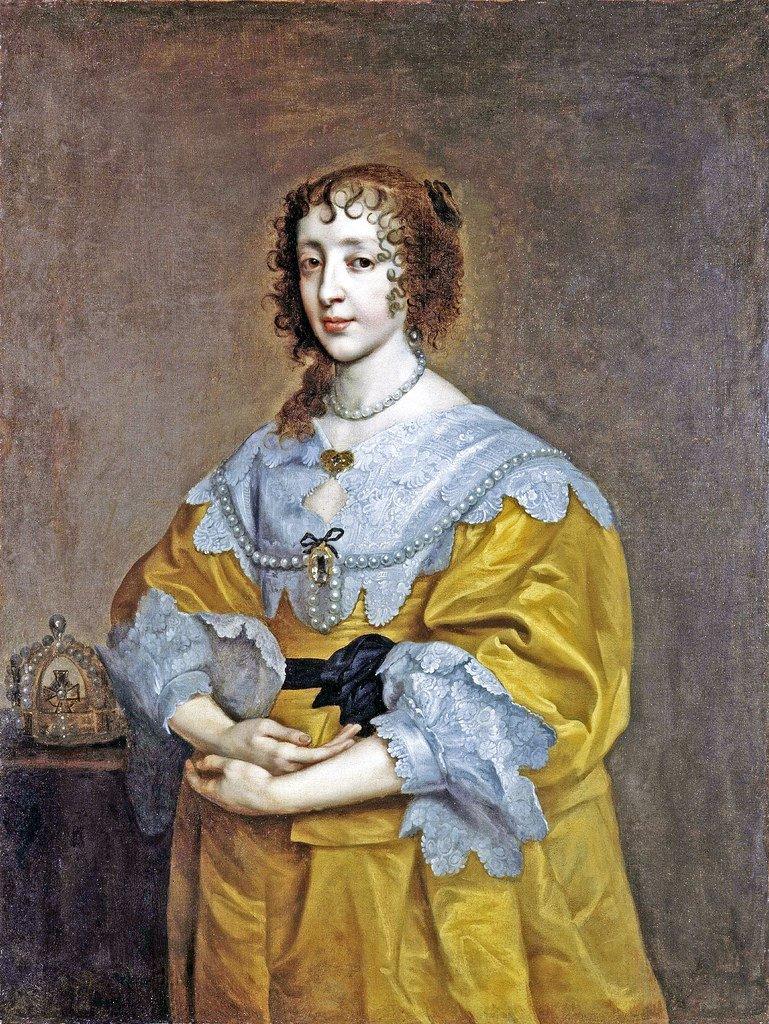
The painting shows Queen Henrietta Maria in a three-quarter portrait, portrayed with the serene bearing of a woman of great dignity. She occupies the center and right of the composition, her face turned slightly toward the viewer and her hands clasped in front of her torso. Her golden-yellow gown, with its wide sleeves, contrasts with the dark blue sash and the large light-blue lace collar, adorned with floral embroidery and beaded edging. Jewels are arranged around her neck and across her chest, while her reddish-brown hair, curled and carefully adorned, frames her face. At the lower left, a small ornamental cage rests on a dark surface, visually balancing the figure’s presence.
Henrietta Maria was Queen Consort of England through her marriage to Charles I, and was the daughter of Henry IV of France and Marie de’ Medici. Seventeenth-century court portraiture used elements such as clothing, jewelry, and posture to make social rank visible. Here, royal identity is conveyed not through a crown or a monumental setting, but through rich fabrics, the poised bearing of the figure, and the attention paid to every detail of her attire. The scene thus combines public representation with domestic intimacy: the queen appears alone against a neutral background, close to the viewer, with no narrative elements to distract from her presence.
The gold dress acts as a visual extension of authority, while the blue of the belt, collar and cuffs introduces a chromatic structure that organizes the entire figure. The lace, arranged around the collar and hands, softens the ceremonial image with a network of light, ornamental forms. The crossed hands convey serenity, self-control and restrained dignity; their position also guides the eye towards the centre of the painting, where the jewels and the folds of the dress converge. The small cage adds a refined, domestic note, and its presence offers a delicate counterpoint to the sitter’s monumental scale.
The composition rests on the contrast between the luminous figure and the smooth, quiet greyish-brown background. The lighting focuses attention on the face, hands and pale surfaces of the lace, while the brown and navy tones lend depth around the body. The curves of the collar, sleeves and hair create an enveloping rhythm that contrasts with the stillness of the pose. The ample dress occupies much of the lower area, making the gold colour a stable visual foundation; opposite it, the cage and the dark surface introduce a horizontal pause at the far left.
The work reflects Sir Anthony Van Dyck’s renowned expertise in aristocratic portraiture: courtly elegance, a refined attention to fabrics and jewels, restrained poses and lighting that enhances the sitter’s social presence. The result is not merely a depiction of a queen, but the carefully balanced construction of a presence: gold conveys splendour, lace articulates delicacy and the hands lend a serene humanity. It is worth observing how these elements, together with the ornamental cage and sober background, transform the portrait into an image of royal authority nuanced by quiet intimacy.
Have questions about our oil painting reproductions? See our frequently asked questions.