

Description
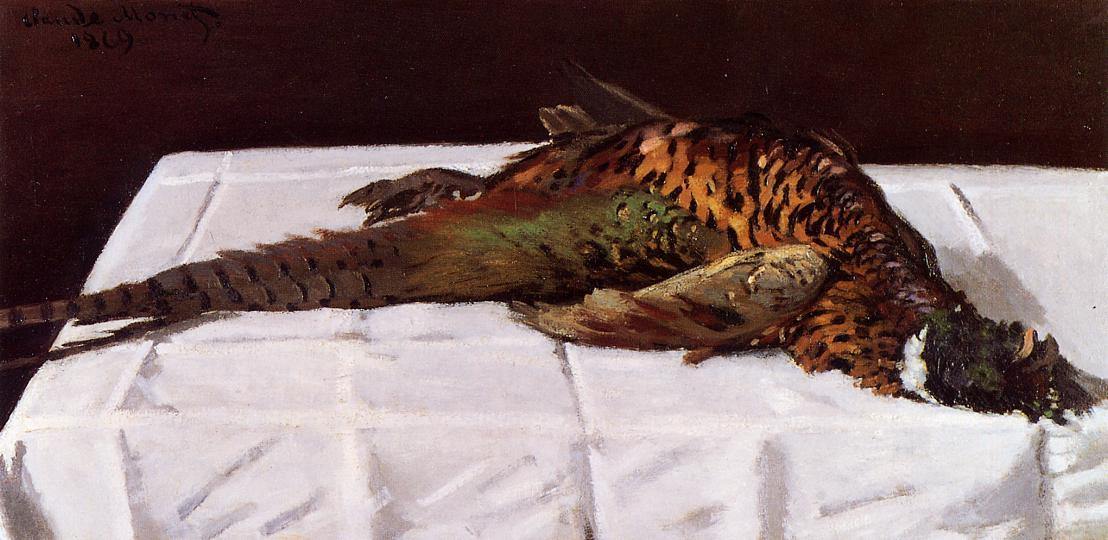
The painting shows a dead pheasant lying on a table covered with a white tablecloth, against a dark brown background. The bird fills almost the entire width of the canvas: its long, striped tail extends to the left, while its head, with an iridescent green neck and white ring, rests at the far right. The copper-colored plumage, speckled with black, contrasts with the pronounced folds of the tablecloth, and the painter’s signature and the date can be seen in the upper-left corner. The Pheasant is a highly restrained still life centered on a single subject.
The subject belongs to the tradition of game still lifes, which has featured prominently in European painting since the 17th century. In his early years, Claude Monet painted still lifes of birds and game on several occasions, a genre that allowed him to study textures, colors, and light through an immobile subject. Here, he dispenses with any accessories: there are no fruits, utensils, or stage setting, only the bird and the cloth supporting it.
Game still lifes evoke the abundance of the table and country life, but also transience: the splendor of the plumage coexists with the stillness of death. The composition’s spareness intensifies this reading and turns the pheasant into an object of contemplation rather than a mere trophy.
The horizontal composition is arranged in bands: the dark background above, the luminous tablecloth below, and the bird’s body forming a gentle diagonal between them. Light falls on the fabric, animating its whites with gray and blue nuances, while the plumage concentrates the warm tones—copper, ochre, and chestnut—and the green accents of the head and wings.
The brushwork is loose and assured, with strokes that build up the feathers and folds without excessive detail—a freedom that anticipates Monet’s Impressionist style. This hand-painted oil reproduction on canvas captures that painterly texture: the impasto of the tablecloth, the contrasts in color temperature, and the rhythm of the brushstrokes that bring the plumage to life.
Have questions about our oil painting reproductions? See our frequently asked questions.