

Description
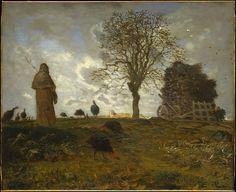
Haystacks: Autumn presents a rural landscape immersed in the changing light of late day. A large tree with a sturdy trunk and spreading branches dominates the center, rising above a field of earthy tones, muted greens, and ochres. On the left, an upright human figure in dark clothing stands silhouetted against the horizon; in the foreground, another bent figure brings the human presence close to the ground and vegetation. On the other side of the composition, a rustic fence crosses the terrain and leads the eye toward a dense cluster of trees and shrubs. The low forms of the field and the haystacks incorporate agricultural activity into a scene in which the landscape remains the focus.
The work belongs to the tradition of depicting peasant life and agricultural landscapes, a subject closely associated with Jean-François Millet. Rather than recounting a specific episode, the painting brings together the essential elements of a life bound to the land: cultivated ground, simple rural structures, vegetation, and human figures integrated into their surroundings. Autumn emerges as an overall quality of the scene, conveyed through the muted palette, the density of the soil, and the low light. The human presence does not turn the landscape into an anecdote; instead, it connects it with the everyday rhythm of rural labor and a direct relationship between body, matter, and territory.
The central tree serves as a visual axis and a symbol of permanence in a space shaped by the cycles of the seasons. Its branches spread across the sky like a structure that brings together the different parts of the field. The upright figure and the bent figure introduce a quiet human scale, suggesting the proximity of agricultural work without depicting any specific action. The fence marks the boundaries of the land and reinforces the sense of a lived-in, cultivated landscape. Against the expanse of the sky, these elements create a tension between openness and enclosure, between the continuity of nature and the modest interventions of rural life.
The horizontal composition is arranged through a balance of visual weight: the tree draws attention to the center, the upright figure anchors the left third, and the fence forms a diagonal line that leads the eye toward the right background. The ground occupies a considerable part of the surface and is rendered with patches, uneven contours, and low vegetation, so that depth arises more from overlapping forms than from rigid perspective. The cloudy sky creates bright areas around the branches and contrasts with the dark masses of the field. Browns, olive greens, bluish grays, and pale yellows form a restrained harmony, while the deep shadows make the light seem to filter slowly through the clouds.
The work reflects Jean-François Millet’s widely recognized interest in peasant life and rural landscapes, rendered with an earthy palette, solid forms, and a restrained, contemplative atmosphere. Its strength does not depend on a dramatic scene, but on the way an apparently simple agricultural landscape takes on emotional intensity through silence, scale, and light. Notice how the tree, fence, and figures form a visual chain that holds the entire field together: in this composition, autumn ceases to be merely a season and becomes an experience of stillness, labor, and permanence.
Have questions about our oil painting reproductions? See our frequently asked questions.