

Description
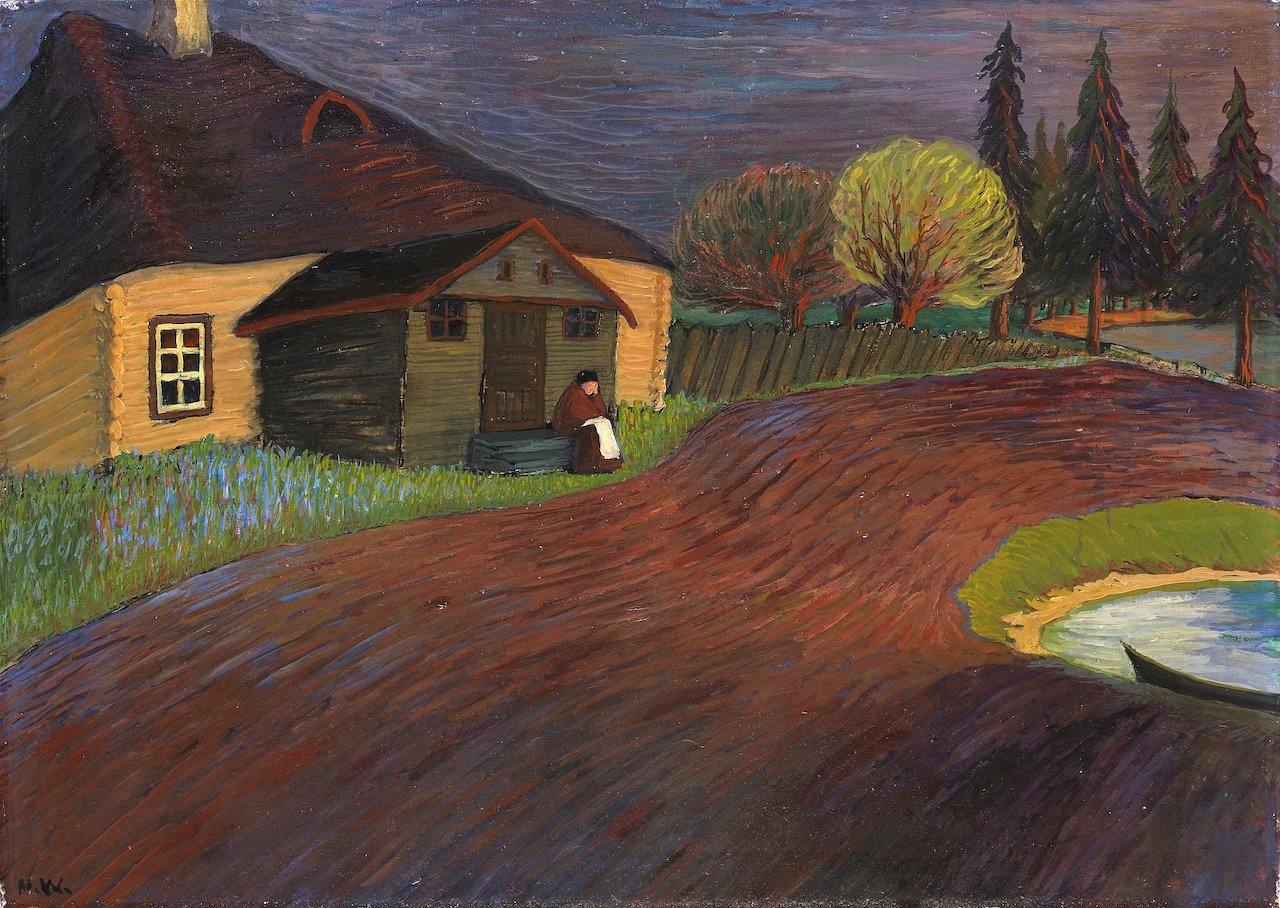
The painting shows a quiet rural landscape beneath a heavy sky, with a wooden dwelling drawing attention to the left of center. Beside the entrance, a small human figure bends or sits, integrated into the everyday scale of the house and the land. A dark annex extends the building to the left, while plank fences cross the middle ground and separate the dwelling from the field. In the foreground, a broad expanse of freshly ploughed earth stretches out, crossed by diagonal and curved furrows. In the background, leafy trees and conifers cluster together, and a small pond brings a bright spot to the lower-right corner. The grass and bluish flowers near the house offer a delicate counterpoint to the density of the earth.
As a rural landscape, Memory does not depict a specific historical, religious, or mythological scene. Its subject belongs to the experience of an inhabited place: a house, a person, and land transformed by agricultural work. The solitary figure links the vastness of the field with an intimate human presence, while the dwelling serves as an anchor of permanence in an environment subject to cycles and change. The title directs contemplation toward memory and the traces of time, yet the work retains the openness characteristic of a landscape: it does not recount a specific episode, but instead evokes a feeling of stillness, rootedness, and distance.
The furrows in the field create an insistent rhythm that may evoke labor, the repetition of the seasons, and the marks left by the passage of time. In contrast, the house and fences establish a sense of protection and belonging, though the dark sky introduces a note of introspection. The solitary figure concentrates the scene’s contemplative dimension without dominating it; its small size makes the individual experience seem inseparable from the land. The pond, with its bluish reflections and vegetated bank, acts as a bright, reflective counterpoint to the reddish browns of the soil. Thus, the memory suggested by the title is shaped through visual relationships between permanence, labor, and silence.
The composition distributes visual weight clearly. The house and figure form the focal point in the left third, while the open diagonal of the field leads the eye toward the foreground and prevents the scene from closing in around the architecture. The fence and tree line organize the depth into successive bands; the vertical conifers balance the horizontal expanse of the terrain. The palette combines reddish browns, dark greens, ochre yellows, and purplish blues, so that the light seems to filter through the clouds without fully brightening the landscape. Vigorous outlines, simplified areas of color, and the tension between broad planes and small details give the composition a restrained energy.
In relation to Marianne von Werefkin, the work is consistent with an Expressionist sensibility that uses color intensely and not strictly naturalistically, simplifies forms, and imbues the landscape with atmospheric emotion. The yellowish house, the fiery earth, and the violet sky do more than simply depict a place: they turn its concrete elements into an inner experience of gravity and permanence. It is worth noting how the figure is suspended between the intimacy of the dwelling and the expanse of the field, while the pond brings a note of clarity to the lower edge. In this balance between the domestic and the vast, Memory transforms an everyday landscape into a visual meditation on the traces that endure.
Have questions about our oil painting reproductions? See our frequently asked questions.