

Description
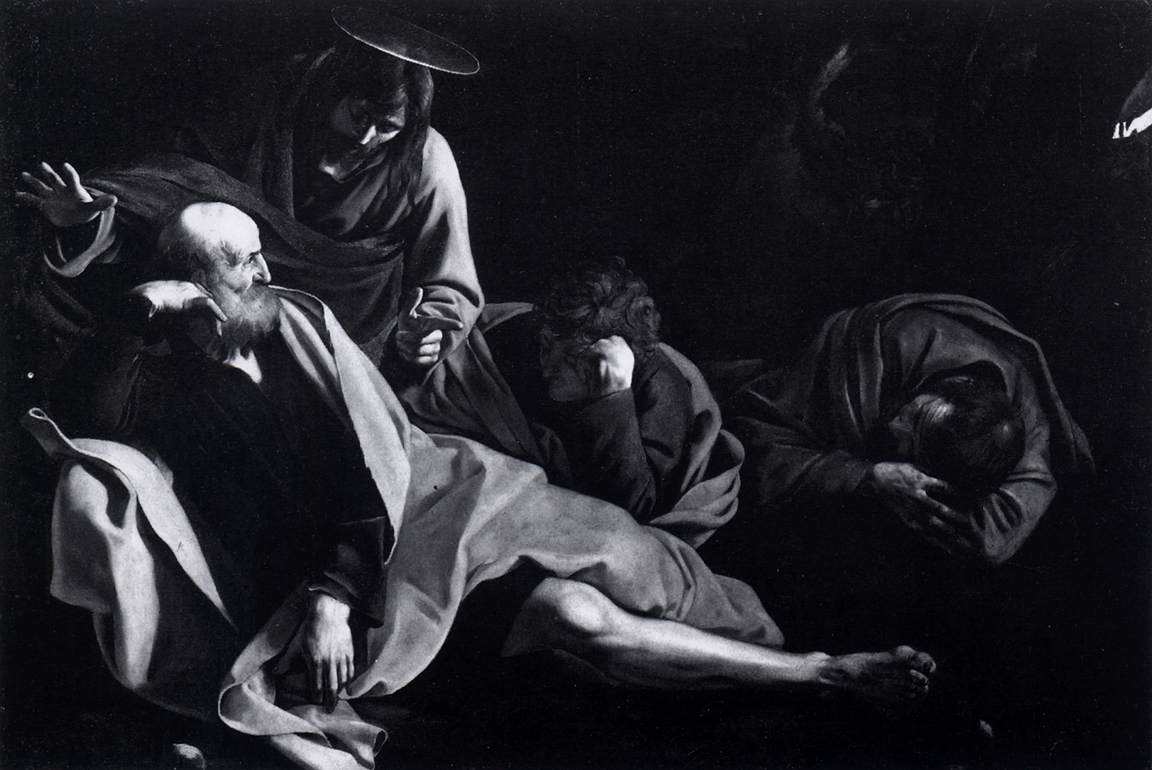
The painting depicts Christ in the Garden of Gethsemane, surrounded by several human figures in a scene of intense dramatic concentration. The central figure, with a bald head and beard, occupies the foreground amid light and dark garments, his body positioned diagonally. A bare leg extends horizontally to the right, while an illuminated hand hangs down among the folds of the cloth. In the background on the left, a figure stands with an arm outstretched; behind the central figure, others lean forward, recline or bow their heads. A luminous oval appears above the figure in the upper-left area, accentuating the sacred dimension of the scene. The setting is absorbed into an almost black background, with no landscape elements to distract from the bodies, gestures and light.
Gethsemane is the garden in Jerusalem traditionally associated with Jesus’s prayer before his arrest. Within the Passion of Christ, this episode brings together anguish, prayer and surrender in the face of the suffering to come. The presence of the companions adds a human dimension to the scene: those around Christ share in the waiting, yet also seem overcome by weariness and tension. Thus, the garden is presented not as a descriptive landscape but as a compressed spiritual space, where the figures’ physical closeness makes the emotional weight of the moment visible.
The iconography is built around a network of gestures and contrasts. The figures’ bowed postures evoke contemplation, grief, and exhaustion, while Christ’s outstretched pose conveys a palpable physical vulnerability. The luminous oval above the figure in the background serves as a sign of sacred presence and creates a vertical counterpoint to the diagonal of the central figure’s body. Set apart from the background by small patches of light, the hands take on particular expressive significance: one reaches out, another falls among the drapery, and a third projects from the group on the right. The scene turns these subtle gestures into signs of waiting, contact, and abandonment.
The composition relies on extreme chiaroscuro. Black dominates the upper portion and the edges, while light is concentrated on faces, hands, folds, and the outstretched leg. This selective lighting guides the eye in fragments: first toward Christ’s face, then along the line of the body, and finally across the secondary figures. The diagonals of the poses create movement, although the still, empty background arrests the action in a suspended moment. The light-colored drapery models the central figure’s volume, while the dark garments of the surrounding group merge the bodies with the space, reinforcing the sense of limited depth and physical closeness.
This work by Caravaggio displays features widely associated with his pictorial language: a dark background, selective lighting, a strong physical presence, and a dramatic composition articulated through gestures and diagonals. The chiaroscuro does more than separate the figures from the darkness; it transforms the religious episode into an immediate, almost theatrical experience, in which spirituality is manifested through flesh, weariness, and waiting. The light connects Christ’s face with his hands and outstretched leg, and this chain of highlights makes physical vulnerability the focus of a meditation on surrender.
Have questions about our oil painting reproductions? See our frequently asked questions.