


Description
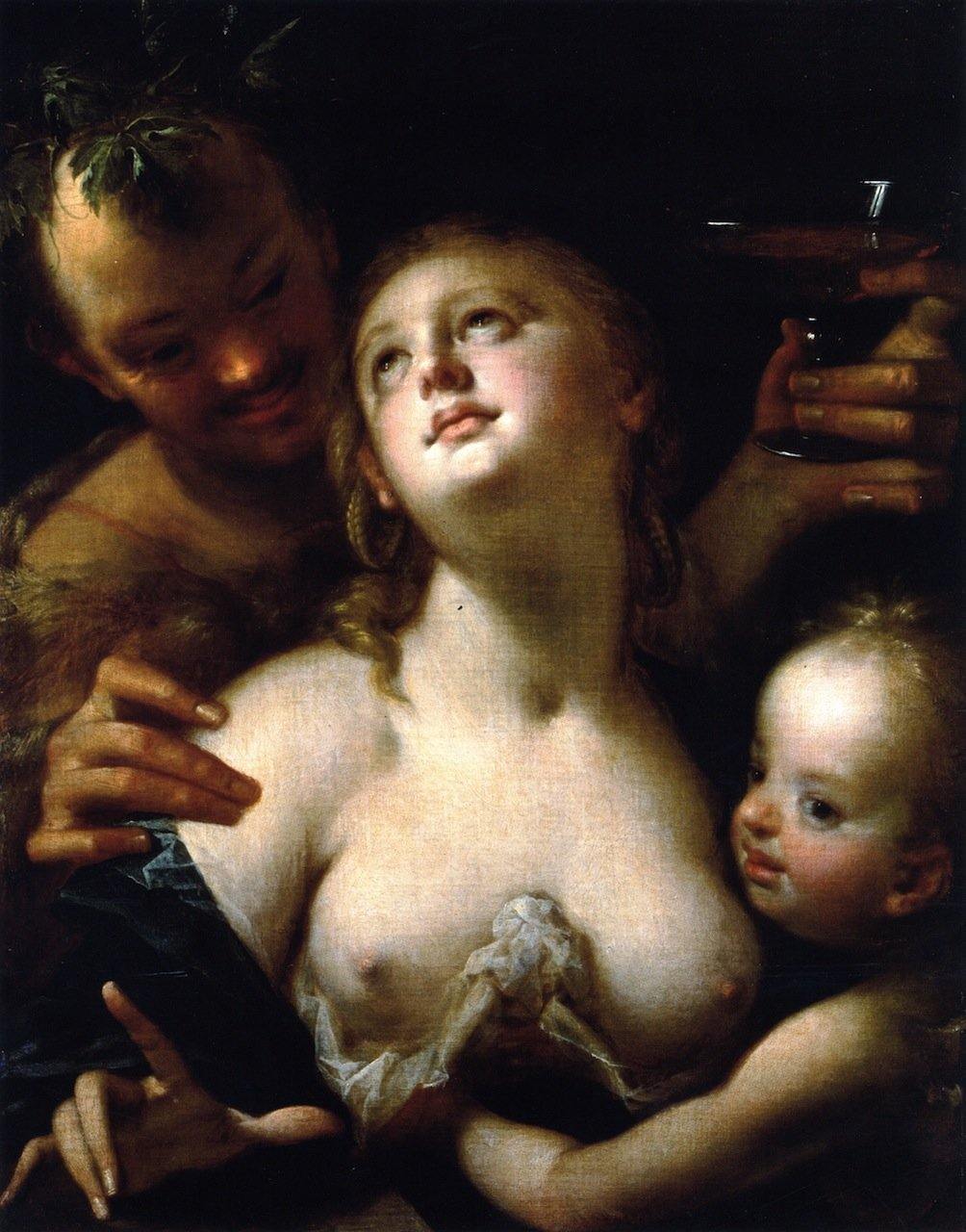
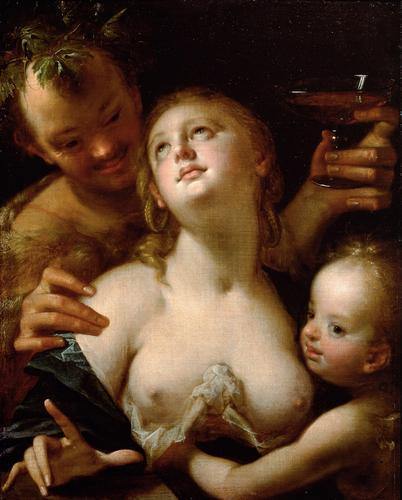
The painting depicts Bacchus, Venus and Cupid in a mythological scene of intense physical closeness. Venus occupies the center, her torso bare and her face turned toward the upper part of the composition. The two child figures gather around her: one leans in from the left and rests a hand on her shoulder, while the other approaches from the right and extends its arms beside her body. In the upper-right corner, a hand holds a dark vessel with a reddish hue; below, black and ivory fabrics partially envelop the central figure. The space is almost entirely absorbed by a black background, giving the bodies and gestures an immediate presence.
The scene brings together Venus, Roman goddess of love, beauty and desire; Cupid, her son and the personification of love’s impulse; and Bacchus, god of wine, intoxication, celebration and ecstasy. Rather than unfolding an extended narrative action, the work condenses these realms into an intimate encounter: love is embodied in the central female figure and in Cupid’s closeness, while Bacchus’s presence introduces the dimension of pleasure and sensory exaltation. The title guides the interpretation of the figures and turns their gathering into an allegory of sensuality, where affection, desire and pleasure intertwine.
The iconography is arranged around Venus’s nude body, which serves as the focus of physical beauty and the emotional center of the scene. Her upturned face opens her expression to an experience of surrender or contemplation, while the hands and arms of the surrounding figures create a continuous network of contact. The reddish vessel alludes to wine and the world of Bacchus, reinforcing the association between amorous pleasure and celebration. The fabrics, arranged in light and dark folds, do more than partially cover the body: they also add a tactile dimension that heightens the contrast between skin, cloth and shadow.
The vertical composition is carefully contained around 3 heads that form an arc around Venus’s face. This structure draws the eye to the centre, then guides it along the diagonals formed by the arms, hands and folds of the fabrics. Warm light is concentrated on the faces and torso, modelling the figures against an almost black background and creating chiaroscuro with a strongly theatrical effect. Flesh, ochre and ivory tones emerge against deep browns, blacks and muted reds; colour thus functions as a form of illumination. The shallow sense of space focuses attention on the figures’ physical closeness, transforming the scene into an intimate, immersive experience.
The work is associated with the international Mannerist style linked to Hans von Aachen, characterised by mythological compositions of pronounced sensuality, elegant, elongated figures, rich colours and dramatic contrasts of light. In Bacchus, Venus and Cupid, these qualities come together in a highly concentrated image: the central anatomy, the childlike bodies and the vessel form a visual weave in which every gesture leads back to Venus. Observe how the darkness eliminates the surroundings, making the illuminated skin the true setting; there, among fabrics, hands and gazes, the mythological allegory becomes intimate, tactile and psychologically intense.
Have questions about our oil painting reproductions? See our frequently asked questions.