




Description
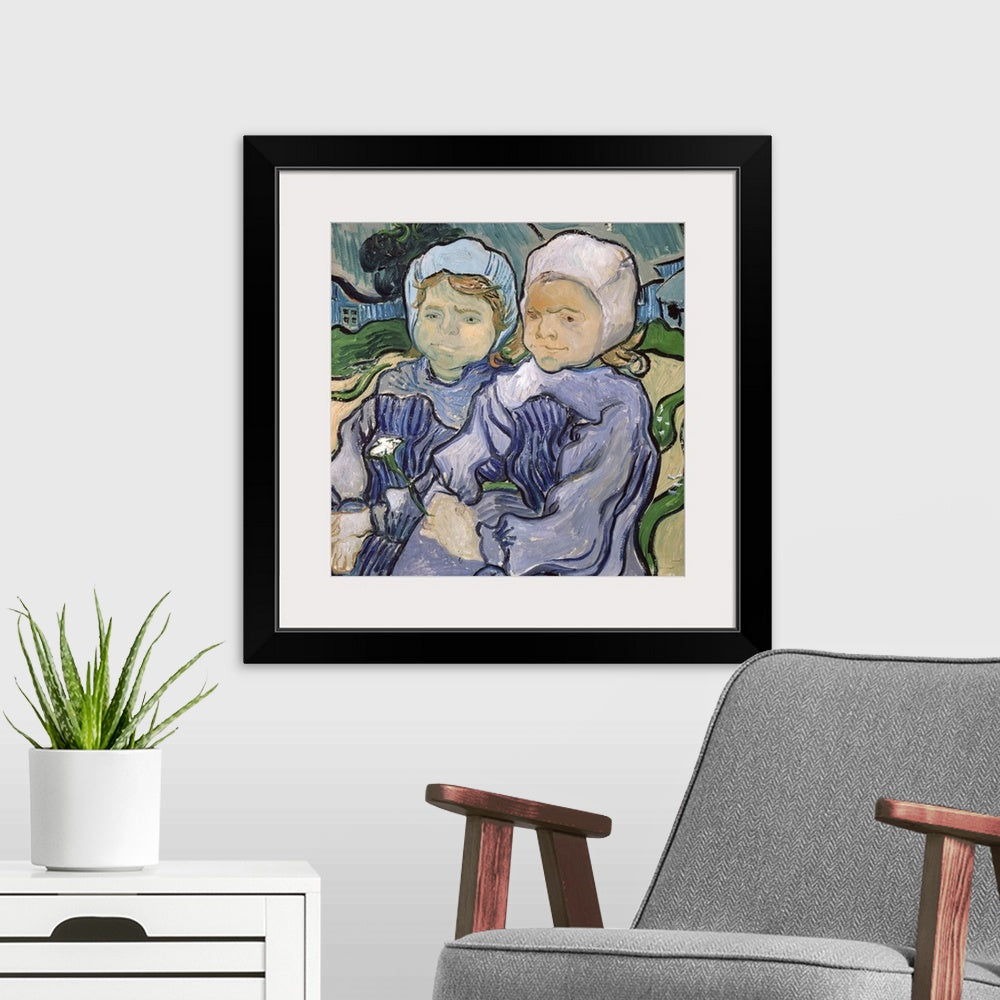
The painting shows two children seated together in the foreground, closely united by the proximity of their bodies and the focused expressions on their faces. The child on the left, with reddish-brown hair, wears blue and violet garments; beside him, the second child is turned slightly toward him, dressed in lilac and wearing a light-colored cap. A small white flower appears near their hands, a delicate counterpoint within the group. Behind the figures stretches a rural landscape of green slopes, strips of land, dark trees, and scattered small buildings. The scene combines the simplicity of an everyday encounter with an intense, compact visual presence.
Two Children belongs to the genres of genre painting and child portraiture in a landscape. It does not depict a specific historical, religious, or literary episode: its interest lies in observing the two figures together in a rural setting, where human life and nature share the same pictorial space. Their closeness focuses the narrative on companionship and familiarity, while the landscape extends the scope of the scene beyond individual description. The distant houses and open land suggest an inhabited world, but do not detract from the intimacy of the foreground.
Their physical closeness can be read as an expression of everyday affection, trust, or companionship. The small white flower introduces a delicate, attentive detail—a subtle gesture that connects the children’s hands with the surrounding vegetation. It does not function as a fixed emblem, but as a sensitive accent within the composition. The large tree in the upper left provides shelter and depth, while the buildings at the sides establish a relationship between the children’s presence and the rural setting. In this way, the work brings together two scales: the intimacy of faces and hands, and the quiet expansiveness of the landscape.
Formally, the composition is vertical and centered. The faces occupy the upper focal point, while the loose-fitting garments form a compact mass of blues, violets, and lilacs below. Dark outlines sharply define the figures against the greens and ochres of the background, making the children seem to advance visually toward the viewer. The landscape is arranged in curved, undulating bands that lead the eye toward the sides before drawing it back around the group. The visible, dense, dynamic brushstrokes keep the field from seeming static: the ground, trees, and sky all take part in a continuous rhythm. The contrast between the figures’ frontal concentration and the landscape’s horizontal expanse sustains the visual tension throughout.
In this work by Vincent van Gogh, the visible brushwork, intense color, pronounced outlines, and landscape built from curving rhythms are associated with traits widely linked to his artistic style. The expressiveness does not depend on dramatic action, but on the way color and line transform a simple scene into an image with great presence. Notice how the violets in the clothing visually connect the two children, while the greens and yellows of the field place them in an open space. The strength of Two Children stems precisely from this contrast: a compact sense of intimacy at the center and a vibrant landscape around it, brought together by brushwork that turns everyday companionship into an absorbing visual experience.
Have questions about our oil painting reproductions? See our frequently asked questions.