

Description
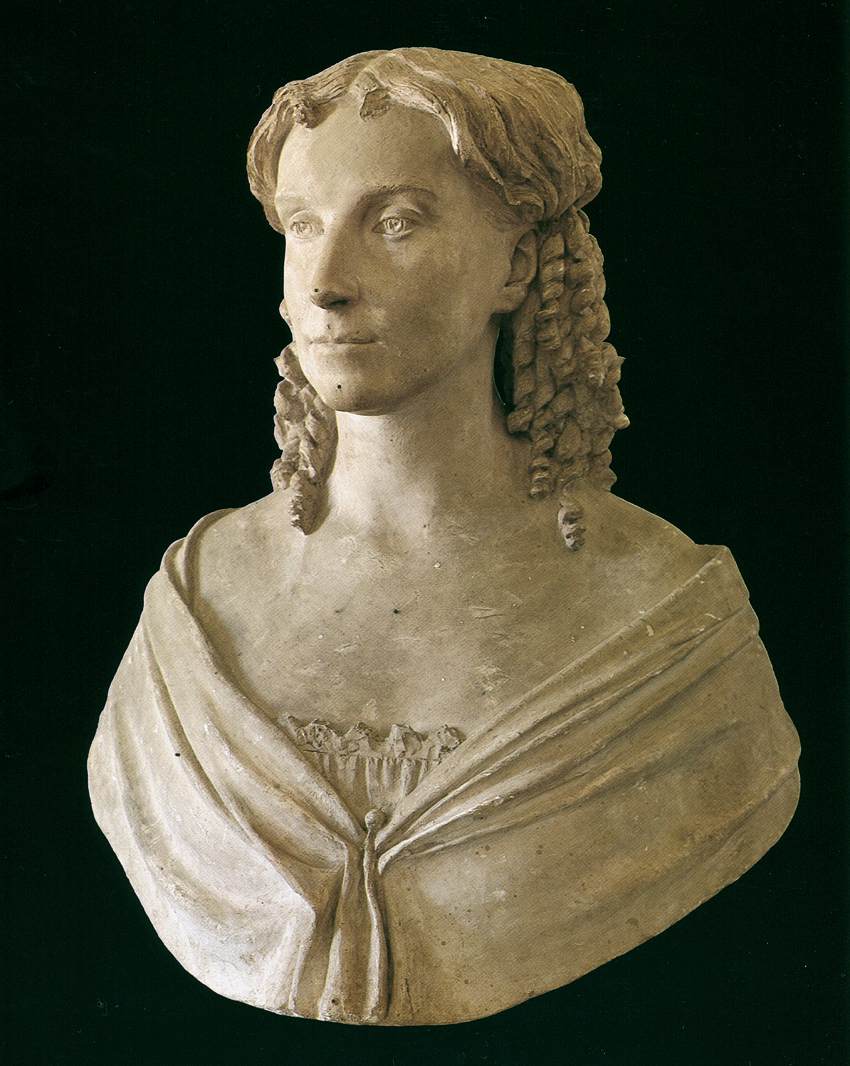
The work depicts a serene female bust, centered against a uniform dark background. Her face turns slightly to the left, as if she were attending to an inner presence rather than an external scene. Her hair, arranged in waves and braided locks, frames her head and falls to her shoulders. A flowing mantle covers her upper torso in deep diagonal folds, while a small vegetal or floral ornament draws attention to the center of her chest. The composition is deliberately pared back to the figure alone, with no landscape, architecture or secondary narrative elements.
The title identifies the figure as a female personification of trust in God. Within the context of Christian devotion, this idea is associated with faith, hope and surrender to divine providence. The work does not need to depict a specific biblical episode: its meaning arises from a spiritual attitude embodied as a human presence. The serene face, dignified bearing and restrained gestures create an image of contemplation that can be read as a visible expression of inner trust. The bust thus gives an abstract idea form in a figure that feels intimate, quiet and tangible.
The face turned to one side establishes a meditative direction, as if the figure’s attention were drawn away from the viewer and toward a reflective dimension. The mantle, with its ordered folds, lends solemnity and a ceremonial quality that elevates the portrait beyond mere physical description. The ornament on her chest serves as a decorative accent and, in a symbolic reading, may be associated with life, purity or virtue. Rather than imposing a narrative, these elements shape an iconography of trust through restrained gestures, careful adornment and dignified presentation.
The vertical structure guides the eye from the head to the center of the chest. The face is the main focal point because of its elevated position and three-quarter turn, while the hair forms an organic frame around the features. By contrast, the folds of the mantle introduce diagonal lines that lead the eye toward the small central ornament and give rhythm to the sculptural mass. The stone beige, light ochre, and grayish-brown tones stand out sharply against the greenish-black background. This chromatic contrast isolates the figure and reinforces its contemplative character; the absence of any sense of depth turns every curve, edge, and fold into an essential part of the composition.
In Lorenzo Bartolini’s work, this sculpture is associated with a naturalistic approach, attentive to physical presence and restrained expressiveness, yet underpinned by sober idealization. The head retains recognizable human features and a tranquil demeanor, but the orderly treatment of the hair and the structure of the mantle transform this individuality into an allegory. The power of Trust in God lies precisely in this union of body and idea: a light-colored surface, an averted gaze, and a system of folds make serenity visible. It is worth observing how the face and the center of the chest establish a focal axis that brings together emotion, symbol, and structure.
Have questions about our oil painting reproductions? See our frequently asked questions.