

Description
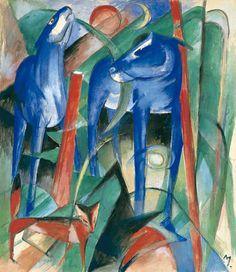
The painting shows Three Fabulous Beasts as a vibrant vision of animal creatures immersed in a vegetal setting transformed by color. Two blue four-legged figures dominate the upper half: the one on the left stretches its neck and raises its head toward the upper edge, while the one on the right gathers its body into a compact form and turns its face to the left. Around them unfolds a network of stems, bands and vertical forms in red, green and blue. In the lower area, angular planes of red, green, blue and beige extend the scene’s space, making the animal world seem to continue within a geometric construction.
Rather than depicting a specific mythological episode, the work presents an imaginary cast of fantastic beasts in a vegetal landscape subjected to intense pictorial transformation. The description “fabulous” suits these creatures, whose blue coloring and simplified anatomy set them apart from naturalistic observation. In this context, the title does not serve as a self-contained narrative, but as an invitation to enter a universe of extraordinary animals, where nature is filtered through imagination, rhythm and structure.
The beasts act as centers of energy within the composition. Their intense blue distinguishes them from the foliage and makes them the protagonists, even as their bodies remain integrated into the surrounding network of vegetation. Vertical, stem-like forms connect the animals and the landscape, while the red and green bands introduce a tension that makes the space vibrate. The overlapping planes in the lower third can be read as an extension of the same fantastic world: they are not merely a ground, but an area where figure, vegetation and geometry begin to merge.
The vertical structure guides the eye from the animals’ heads to the chromatic density of the background and, finally, to the angular base. The left animal’s rising lines convey momentum and openness; the more compact body of the figure on the right provides a counterpoint of stability. Color creates both volume and depth: blues advance visually, greens shape the setting, and reds interrupt the continuity with intensely vivid accents. Rather than using naturalistic perspective, the painting suggests a fragmented depth formed by layers, bands, and overlapping forms. The result is a dynamic space in which each plane seems to push the next forward.
This vision is connected to a widely recognized feature of Franz Marc’s work: the Expressionist depiction of animals, the symbolic and non-naturalistic use of color, and the geometric simplification of forms to express an intense relationship between animal life and nature. In Three Fabulous Beasts, this relationship can be seen in the way the blue bodies emerge from fragmented vegetation without being completely separated from it. Notice how the contrast between the creatures’ blue and the surrounding reds and greens turns the scene into a concentration of chromatic energy: the fantastical subject and the formal construction unfold together, dissolving the boundaries between beast, landscape, and abstraction.
Have questions about our oil painting reproductions? See our frequently asked questions.