

Description
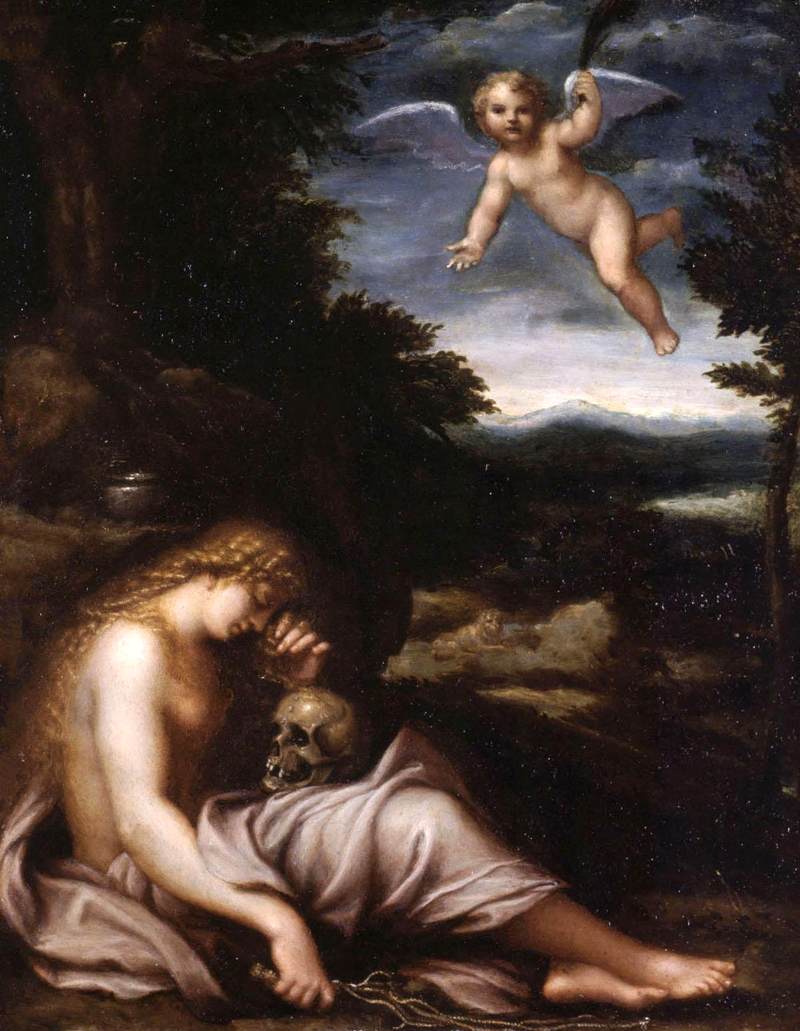
The painting shows a penitent Mary Magdalene reclining in a wooded, rocky landscape, apart from the world and absorbed in contemplation. Her nude figure, partially covered by a pale pinkish cloth, occupies the foreground; her hair falls around her face as one hand reaches toward it in a gesture of silent abandon. Beside her torso is a brownish skull, placed as a tangible presence within the scene. Above it, among dark branches and beneath a violet-blue sky, a winged childlike figure stretches out its arms and seems to hover over the landscape. The trees, uneven terrain and distant hills create a natural refuge with a nocturnal or twilight atmosphere.
The scene belongs to the Christian tradition of Mary Magdalene as a penitent woman withdrawn into solitude. Far from worldly life, the saint devotes herself to repentance, contemplation and detachment from earthly possessions. The skull visually encapsulates this meditation on mortality and the transience of existence. The isolation of the landscape reinforces the idea of spiritual retreat: nature is not merely a backdrop, but the place where the figure withdraws from the inhabited world to focus on an inner experience. The winged presence hovering above the composition introduces a spiritual and visionary dimension, raising the scene from bodily penance to an experience of transcendence.
The symbols are arranged around a tension between fragility and elevation. The skull, close to the body, establishes a direct dialogue between physical beauty and awareness of death; the light-colored fabric accentuates the figure’s vulnerability and provides a delicate counterpoint to the dark earth. The partial nudity can be read as a sign of renouncing appearances and standing exposed before one’s own conscience. Against this earthly solemnity, the winged child brings lightness and movement, while the branches surrounding it seem to open a threshold between the forest and the sky. The rugged landscape, with its rocks, trees, and distant horizon, heightens the sense of trial, solitude, and spiritual discipline.
The vertical composition is structured around 2 related focal points: the reclining body and the skull in the lower area, and the winged figure above. This triangular structure guides the eye from matter and death toward the illuminated sky on the horizon. The dark vegetation acts as an enveloping frame, focusing attention on the lighter surfaces: the skin, the fabric, and the luminous strip in the background. Deep black, green, and brown tones form a dense visual mass, interrupted by purplish blues and pinkish hues. The contrast between stillness and suspension sets the rhythm of the work: Magdalene remains withdrawn and weighted down, while the upper figure introduces an ascending line that opens up the space and prevents the scene from being confined to melancholy.
In this work by Agostino Carracci, the well-defined drawing, the careful modeling of the body, and the compositional balance are linked to a Bolognese sensibility marked by intense devotional expressiveness. The dramatic lighting does not depend on a single visible source; instead, it arises from the contrast between the illuminated figures, the shadowy forest, and the sky brightening in the distance. In this way, the painting turns Magdalene’s penance into a theatrical meditation on bodily frailty: the skull fixes the mind on death, the landscape establishes a place of retreat, and the winged figure suggests spiritual openness. Notice how the gaze rises from the funerary object to the sky, following the inward journey proposed by the composition.
Have questions about our oil painting reproductions? See our frequently asked questions.