

Description
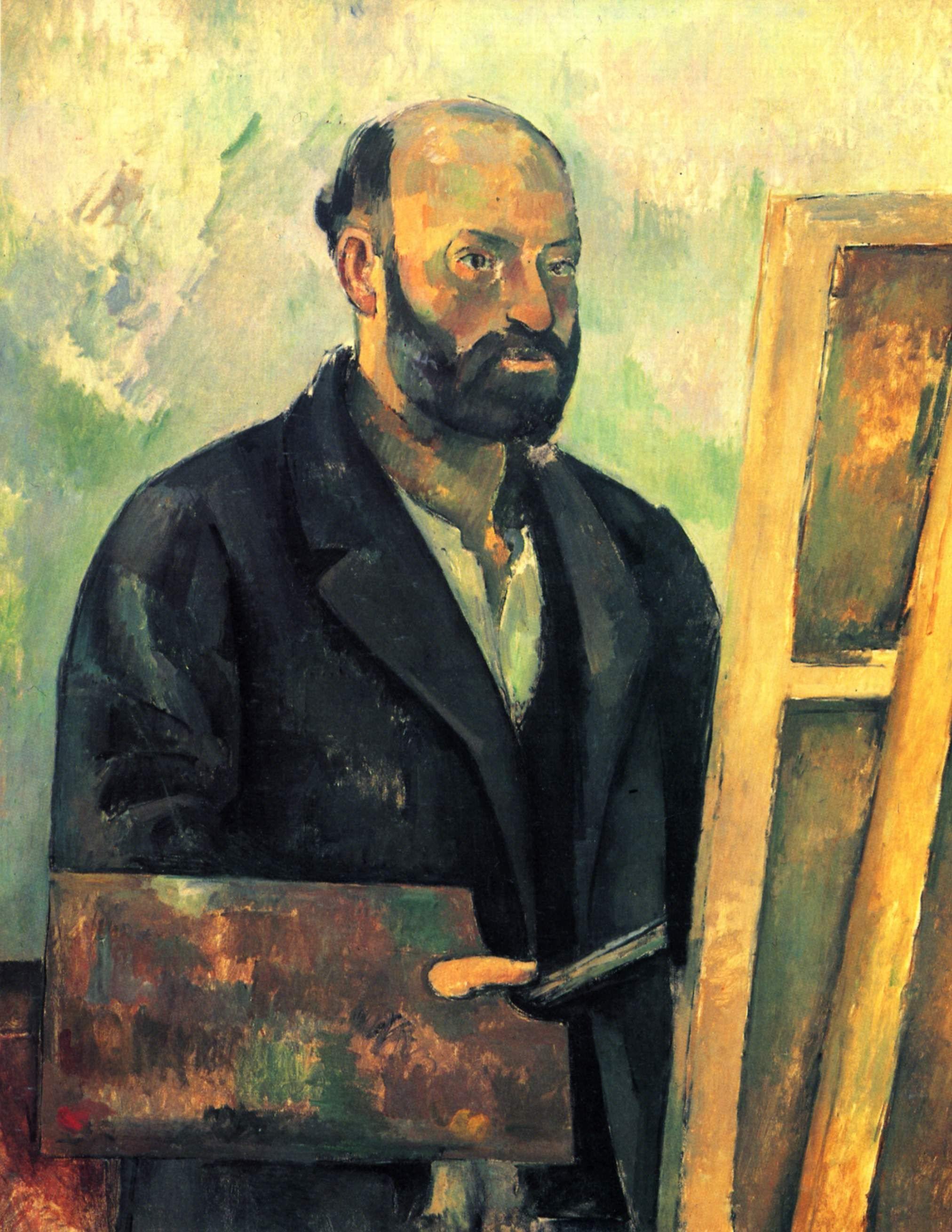
The painting presents Paul Cézanne as the central figure in his own workspace. The artist is shown from the waist up, with a partially bald head, dark hair at the sides and a full beard that accentuates the intensity of his face. He wears a dark jacket over a light shirt and holds a rectangular palette in front of his torso, covered with brown, green, ochre and reddish marks. A brush extends diagonally to the right, where a wooden easel introduces a firm vertical structure. Behind them, the background unfolds in yellow, green, bluish and gray marks, like a studio built up in layers of paint.
The self-portrait makes the painter’s identity the main subject of the work. It is not merely a representation of a face, but a depiction of the artist in relation to the tools that define his craft. The palette, brush and easel place the figure within a tradition in which the creator presents himself as both an observer and a maker of images. In this genre, the artist’s very presence serves as a declaration of identity: the subject portrayed and the artistic activity are brought together in the same scene. The work thus belongs to the modern context of a painting increasingly attentive to its material processes.
The objects in the studio take on clear iconographic significance. The palette and brush serve as attributes of the artist’s craft, while the easel makes visible the space in which representation takes shape. The figure’s focused pose, turned slightly to the right, reinforces an introspective and painstaking reading. The background, far from functioning as a descriptive setting, dissolves into fields of color; in this way, the surroundings, too, are subject to the logic of painting. The scene presents the sitter not only as an individual, but as someone whose identity is inseparably bound up with the act of painting.
The vertical composition guides the viewer’s attention through a balance of masses and directional lines. The body dominates the center and left side, while the easel responds with an upward line on the right. In the foreground, the palette forms a horizontal band across the torso, bringing the artist’s tools closer to the viewer. The contrast between the blue-black jacket and the light shirt draws the eye to the face and hands; around them, ochre yellows, pale greens, and muted blues expand the space without depicting it literally. The visible brushstrokes and partially integrated contours make the figure, tools, and background share the same active surface.
This construction relates to a widely recognized feature of Paul Cézanne’s work: the organization of figures and spaces through planes of color, visible brushwork, and a solid structure, sustained by an earthy, restrained palette. The result does not entirely separate the artist from his surroundings, but presents him as part of a pictorial architecture in formation. The palette guides the eye from the face to the easel, and this trajectory brings together the subject, tools, and surface. This progression conveys the work’s central idea: the self-portrait not only depicts a painter, but makes the very act of constructing the image its true subject.
Have questions about our oil painting reproductions? See our frequently asked questions.