

Description
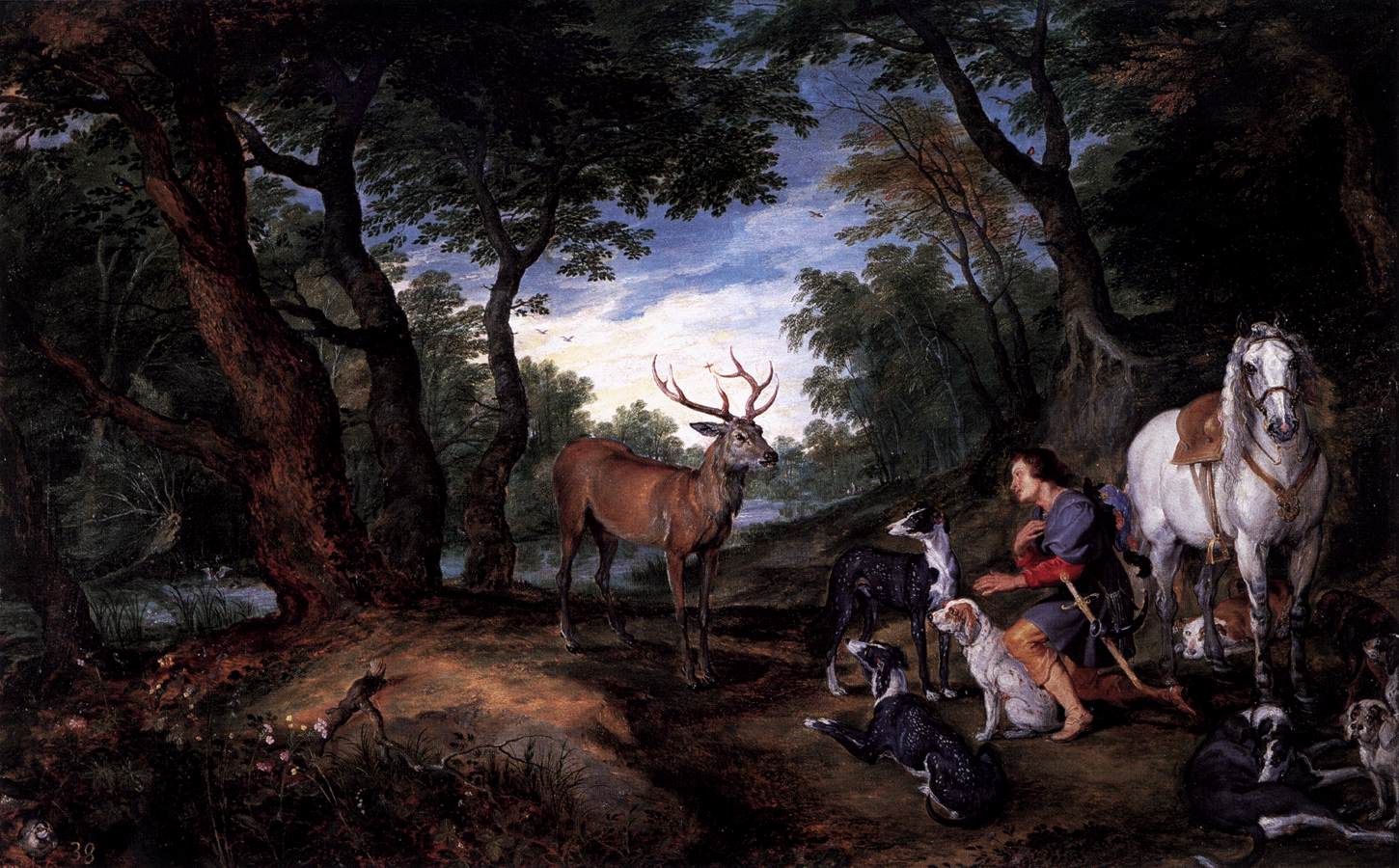
The painting shows Saint Hubert during his vision of the stag, within a dense, shadowy forest. A large-antlered stag stands at the center of the composition in profile, as if commanding the attention of everyone in the scene. On the right, the hunter appears seated or kneeling beside several dogs, while a white or light gray horse, saddled and bridled, completes the group. The dirt path, roots, grasses and small flowers bring the scene into the foreground; behind the stag, a stream recedes toward a sunlit clearing among the trees.
The title refers to the tradition of Saint Hubert, a saint associated with a pivotal experience during a day’s hunting. According to legend, the hunter encountered a stag bearing a crucifix between its antlers and received a call to conversion through this apparition. From then on, Saint Hubert became associated with spiritual life and the protection of hunters. The work sets this story in a recognizable hunting environment: the horse, dogs, hunting gear and path turn the forest thicket into the setting for an encounter that transcends everyday activity.
The monumental stag serves as the scene’s narrative and spiritual axis. Its antlers stand out against the more open part of the landscape, creating a visual connection between the forest floor and the brightness of the sky. The hunter and animals remain gathered in an attentive pose, as if the hunt had come to a halt before a revelation. The dense tree trunks and dark foliage evoke a place of retreat and trial, while the stream and clearing lend the scene a contemplative direction. The contrast between the group gathered on the right and the solitary animal at the center underscores the extraordinary nature of the encounter.
The horizontal composition is organized around a powerful spatial diagonal: from the roots and path in the foreground, the eye moves toward the stag, the watercourse, and the bright opening in the distance. A large, dark tree dominates the left side and acts as a natural frame, balancing the visual weight of the horse and the hunting party. The forest’s deep greens, earthy browns, and blacks make the horse’s white coat and that of some dogs stand out, along with the muted blues and reds of the hunter’s clothing. The alternation between dense areas and open spaces creates depth, while the scale of the stag and trees gives the episode an almost monumental intensity.
The work is associated with the style of Jan Brueghel the Elder, widely recognized for his meticulous Flemish landscapes, populated with vegetation, animals, and multiple planes of observation. Here, the richness of the detail does not distract from the scene: every tree trunk, dog, branch, and path helps create an enveloping natural setting in which the religious story gradually emerges. The vision is conveyed both by the subject and by the structure of the painting: first, we recognize a day’s hunting, and then, as we follow the light into the distance and return to the central stag, the landscape takes on a revelatory dimension. It is worth paying particular attention to this path of the gaze, in which the forest’s half-light transforms a hunting episode into a contemplative experience.
Have questions about our oil painting reproductions? See our frequently asked questions.