

Description
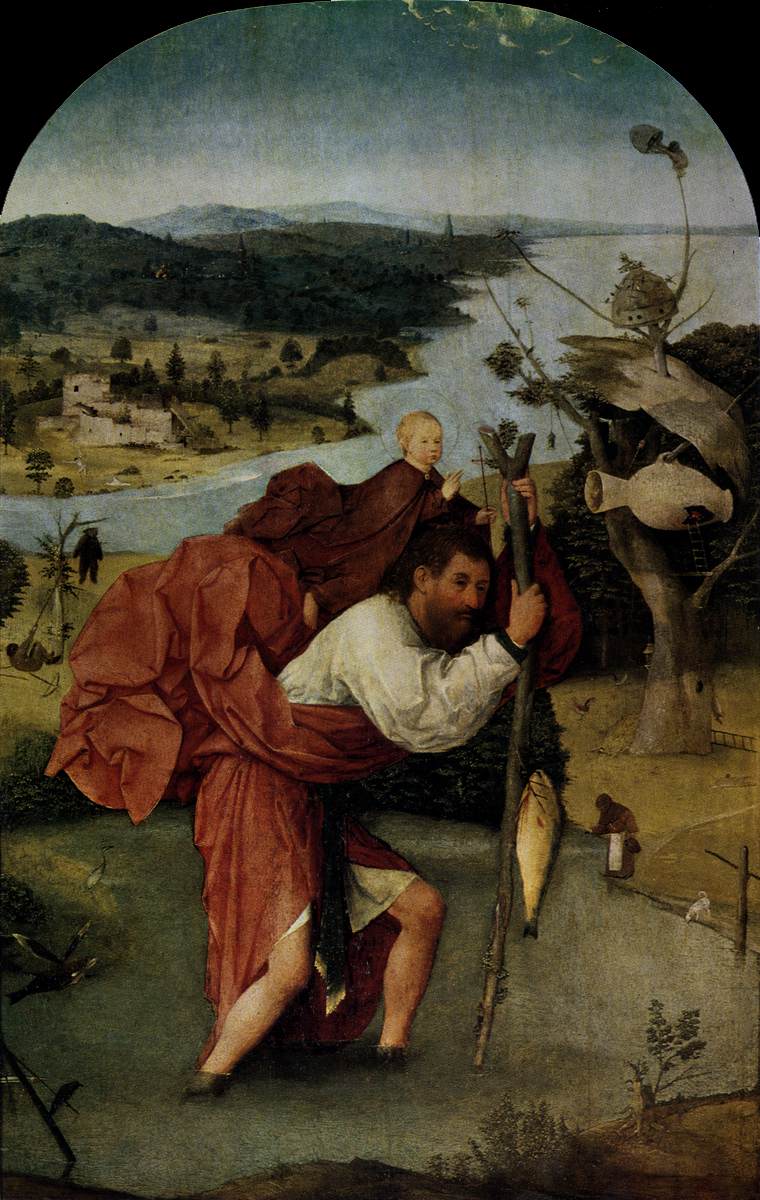
The painting shows Saint Christopher crossing a river landscape with the Christ Child raised behind him. The bearded figure occupies the foreground: he leans forward, wears a light-colored shirt beneath a voluminous red cloak, and holds a long staff from which a fish hangs near the bottom. Behind him, a second figure in a red tunic raises one hand. A large tree with dark foliage dominates the right side, while the river recedes into the distance between banks, hills, buildings, and tiny human and animal figures. The scene thus brings together the monumental scale of the protagonists and the minute activity of a rural world stretching to the horizon.
Christian tradition presents Saint Christopher as a man of extraordinary strength who helped people cross a river. In the decisive episode, he carries a child who is revealed to be Christ; the unexpected weight of this burden expresses the story’s spiritual dimension and transforms an act of service into an experience of revelation. Here, the water is not merely a landscape feature: it is the setting for passage, trial, and transition to another state. The saint’s association with the protection of travelers naturally extends this interpretation, turning the crossing into an image of shelter, effort, and transformation.
The staff visually identifies the act of carrying and moving forward, while the suspended fish adds a concrete detail that connects the figure with life on the river and with the physical realities of the journey. The elevated position of the secondary figure concentrates the narrative tension on the saint’s back and shoulders. Opposite them, the dark tree serves as a threshold: its dense mass contrasts with the open brightness of the water and sky. The landscape, dotted with tiny walkers, animals, and buildings, extends the story beyond the central legend; the individual crossing is set within an inhabited world where the everyday and the sacred coexist.
The vertical composition guides the eye through a series of receding planes. In the foreground, the red cloaks and staff create energetic diagonals; beyond them, the river leads the eye toward the blue-gray hills and pale sky. The contrast between the earthy tones, the tree’s dark green, the cream-white clothing, and the muted hues of the background ties the different planes together. The scale of the principal figures in relation to the small figures along the riverbank underscores their narrative importance without separating them from their surroundings. The water introduces a gentle, winding line that balances the tree’s vertical weight and the saint’s forward-leaning movement.
In Saint Christopher, one can recognize a style associated with Hieronymus Bosch: a religious narrative set within a wide landscape, where secondary details open up multiple possibilities for interpretation. The eye moves from the bearer’s intent expression to the fish, from the tree to the distant figures, and from them to the horizon, following a visual rhythm that combines stillness and movement. Notice how the red of the cloaks links the two figures, while the river carries them toward the distance. The result is a monumental scene of passage: the saint’s legend becomes a visual structure in which effort, protection, and revelation unfold together across the landscape.
Have questions about our oil painting reproductions? See our frequently asked questions.