

Description
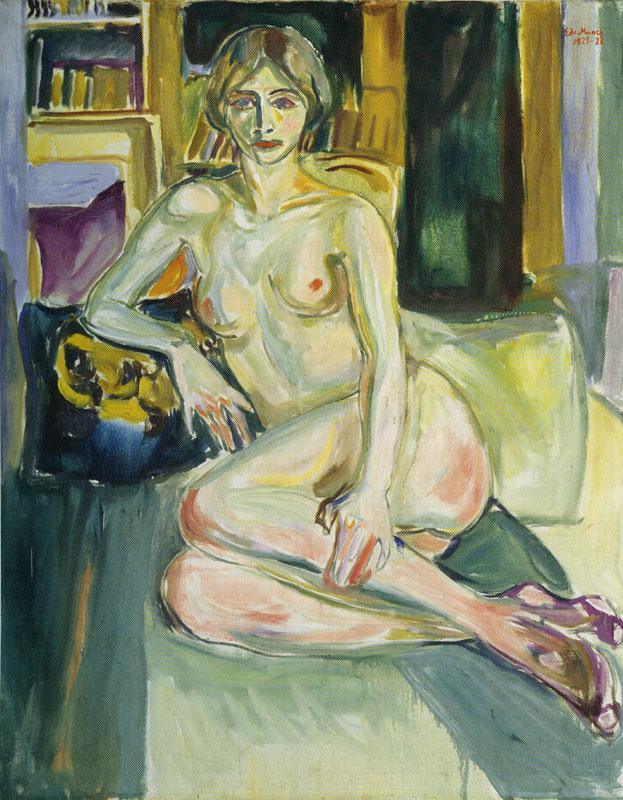
The painting shows a nude woman sitting on a sofa, at the center of a private, densely articulated interior. The figure faces forward, with her torso upright, her head slightly tilted, and her legs crossed diagonally toward the lower right. One hand rests on her thigh while the other arm extends toward the left, creating a posture that is both relaxed and tense. Behind her, a wooden bookcase holding books of various sizes, upholstered surfaces, and a dark vertical opening structure the background. The body dominates the scene, but the domestic space around it retains an active presence.
The subject belongs to the genre of the female nude in an interior, understood here as a situation of bodily presence and intimacy rather than a narrative scene. The room places the figure in a lived-in setting: the books introduce an everyday and intellectual dimension, while the sofa and the vertical structures in the background heighten the sense of an interior refuge. The woman is not shown engaged in any specific action; her stillness makes the contemplation of her body, face, and posture the true focus of the work. In Edvard Munch’s expressive visual language, the domestic setting takes on an intensity that goes beyond a simple depiction of the furnishings.
The nude serves as a subject for observing the body and its emotional presence. The frontal view of the face and the direct exposure of the torso create an immediate connection with the viewer, while the crossed legs introduce a note of reserve and withdrawal. The books reinforce the sense of the setting as a private space without imposing a fixed symbolism: they suggest an inner life that contrasts with the central nudity. On the right, the dark opening creates an area of depth and shadow against the brightness of the body, establishing a tension between intimacy and exposure. The dark object beside the left arm and the small reddish marks in the background enrich the visual surface without becoming dominant emblems.
The compositional structure focuses attention on the figure through a vertical organization of space and a marked difference in scale between the body and the surrounding elements. The crossed legs guide the eye from the torso toward the lower-right corner, while the arms form diagonal lines that balance the frontal stability of the chest and head. The bookcase introduces a rhythm of compartments and rectangles in the upper-left area; by contrast, the dark background on the right acts as a compact visual pause. The palette of sage greens, ochre yellows, deep blues, violets and pale pinks departs from naturalistic representation and turns the interior into a chromatic experience. The contours and surfaces contribute to this expressive effect: the space is shaped as much by bands of color as by recognizable objects.
In general, Edvard Munch is known for an expressive visual language that uses color, simplified forms, and psychological intensity to transform figurative scenes and interiors into images with a strong emotional resonance. In Nude, Sitting on the Sofa, this approach can be seen in the way an apparently simple domestic situation becomes a scene of intense presence. The figure is not isolated from her surroundings: the sofa, the books, the dark opening, and the bands of color all contribute to the construction of her visual state. The crossing of her legs and the tilt of her head temper the body's frontal pose, while the color makes palpable the tension between introspection and exposure. The result is a nude that invites contemplation both for its anatomy and for the psychological atmosphere arranged around it.
Have questions about our oil painting reproductions? See our frequently asked questions.