

Description
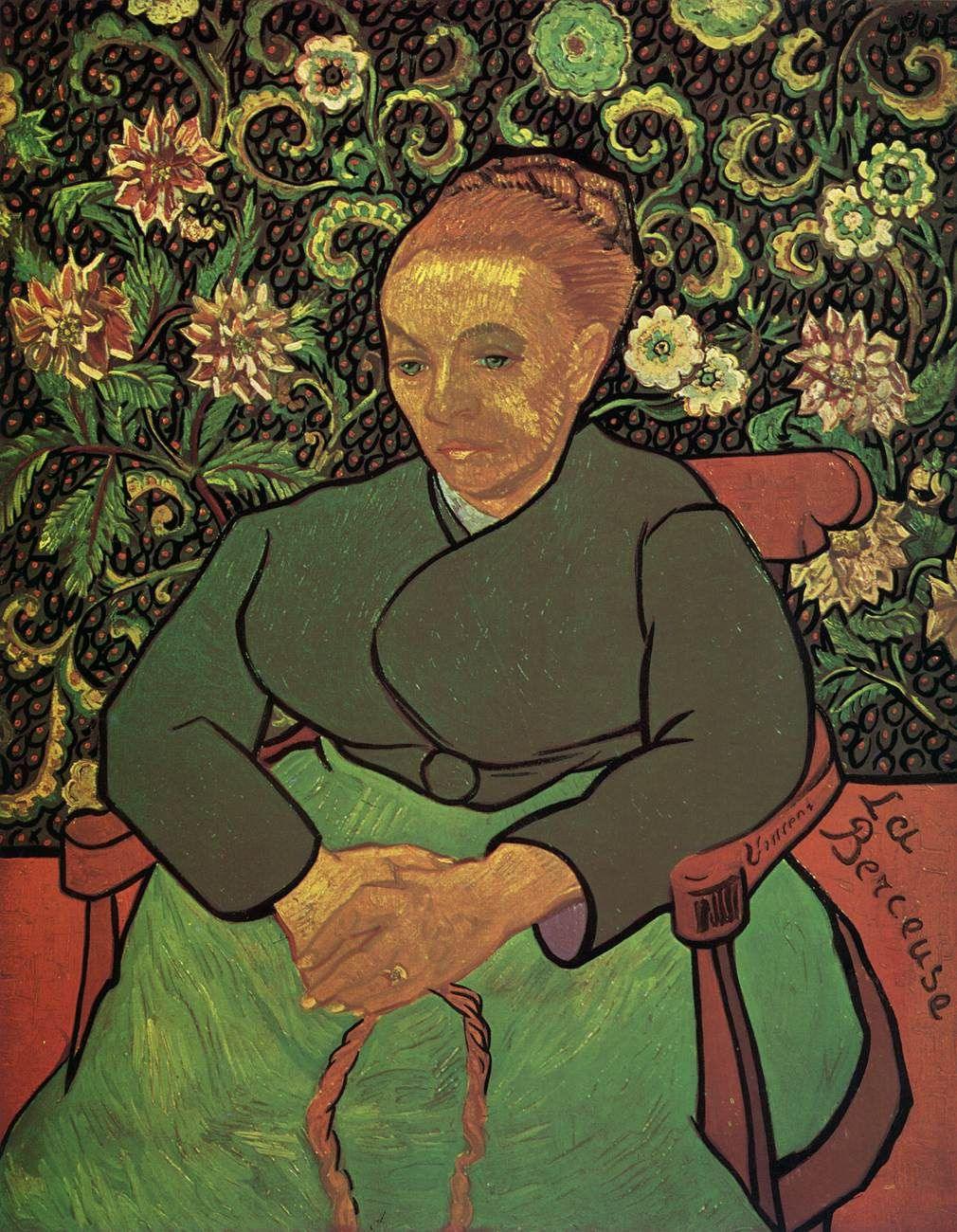
The painting shows Madame Augustine Roulin seated at the center of a vertical composition, her face slightly inclined and her hands joined in her lap. Her figure extends from the middle area to the lower edge, dressed in dark and light green tones that stand out against the background. Behind her, flowers, leaves, stems, and vegetal scrollwork form an almost continuous ornamental tapestry. On the right, the reddish back and arms of a chair or armchair introduce a domestic reference and visually balance the floral mass. Her composed pose focuses attention on her face and hands, while the setting turns the portrait into a serene, immersive scene.
Augustine Roulin was the wife of Joseph Roulin, the postman from Arles whom Vincent van Gogh portrayed on several occasions. During his time in Arles, van Gogh painted several portraits of members of the Roulin family, expressing through them his interest in particular individuals and in the expressive intensity of portraiture. Here, the model’s identity is conveyed through an intimate presentation: she does not appear as an abstract figure, but as a woman seated in a recognizable space, supported by the chair and surrounded by dense ornamentation.
The floral background serves as an ornamental setting that intensifies the work’s color. Cream, yellow, and reddish flowers, intertwined with elongated leaves and green stems, surround the figure like a living frame. This profusion of vegetation contrasts with the restraint of her joined hands and focused expression. The reddish chair provides a warm counterpoint to the predominant greens and anchors the figure in a domestic setting. The result combines intimacy and exuberance: the model remains still, while the field of flowers sustains a constant visual vibration around her.
The composition is organized around a frontal, centered structure. The head occupies the upper axis, the hands form a focal point in the lower center, and the skirt extends the body vertically toward the edge of the painting. With no large empty areas, the floral background reduces conventional depth and makes the figure and ornamentation seem to share the same surface. The greens of the dress create continuity with the leaves, while the yellows, creams, and reds distribute accents that guide the eye along the sides. The chair, positioned behind her right shoulder, introduces a diagonal and a variation in texture within this leafy rhythm.
In Madame Augustine Roulin, Vincent van Gogh’s expressive use of color, intense contrasts, and combination of psychological presence with an energetic, ornamental surface are clearly recognizable. The understated figure is not overwhelmed by the background; its stillness, in fact, makes it easier to appreciate the richness of the flowers, leaves, and scrolls surrounding her. Notice how the joined hands serve as the composition’s quiet center, while the decorative garden expands the sitter’s presence until it fills almost the entire field of vision. The portrait thus derives its strength from the balance between human introspection and chromatic exuberance.
Have questions about our oil painting reproductions? See our frequently asked questions.