

Description
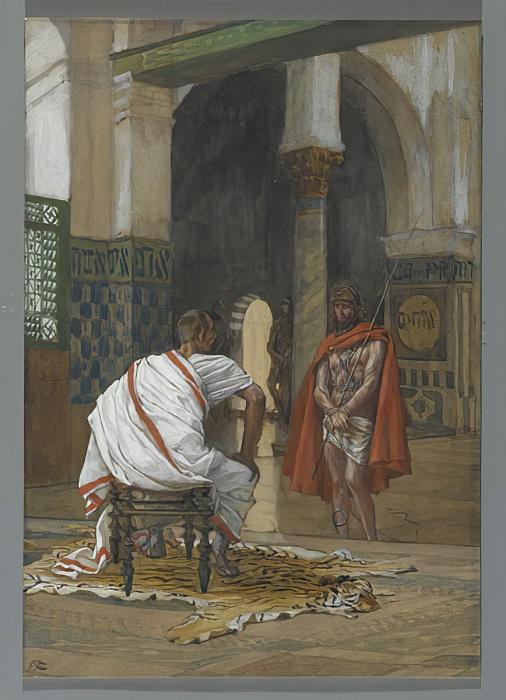
The painting depicts Jesus’s second appearance before Pilate inside the monumental interior of a palace or courtroom. In the foreground, a seated figure seen from behind occupies an ornate stool and faces Jesus, who stands at the center of the room in a light-colored tunic and a red cloak. Cloths and garments lie spread across the floor between them, while the columns, arches, and decorated walls create a grand setting. In the background, a bright opening cuts through the architectural gloom, visually extending the space beyond the encounter.
The episode belongs to the cycle of the Passion of Christ and shows Jesus before Pontius Pilate after he has been sent to Herod. The Roman governor must decide his fate, while Christ stands before him with a restrained demeanor, without emphatic gestures or dramatic movement. The protagonists’ positions encapsulate the narrative tension: Pilate is associated with the seat and judicial authority; Jesus, standing erect before him, embodies the human and spiritual dimension of the story. The scene precedes the condemnation and crucifixion, so the depicted dialogue carries a gravity that can be felt even in the silence between the two figures.
The architecture acts as a visual extension of institutional power. The columns, capitals, arches, and geometric panels turn the encounter into a public and solemn event, although only two characters take part. Jesus’s red cloak introduces a note of intensity against the stone-colored palette and can be read as a sign of dignity, suffering, and sacrificial destiny. The seated figure establishes a clear judicial asymmetry: his low yet stable position, connected to the seat, contrasts with Christ’s verticality. The cloths on the floor add a material and theatrical dimension, as if the episode were unfolding in an inhabited, ceremonial space rather than against an abstract backdrop.
The vertical composition is carefully organized by the perspective of the interior. The lines of the columns and arches draw the eye toward the bright opening in the background, while the contrast between the white and red garments brings attention back to the central dialogue. The seated figure, seen from behind, serves as a compositional threshold: it draws the viewer into the scene and directs their gaze toward Jesus. The subdued lighting shapes the stone surfaces and reserves the brightest accents for the garments and the distant passageway. The result combines depth, theatricality, and stillness; each architectural element frames the suspended judgment without detracting from the two figures.
In this work, James Tissot combines decorative precision with a biblical narrative of pronounced theatricality. His attention to architecture, clothing, and historical setting transforms the second interview into a tangible, almost stage-like scene in which the space tells as much as the characters do. Notice how the red cloak stands out against the stone, how Pilate’s back guides the viewer into the scene, and how the light in the background opens up a symbolic distance from the chamber of judgment. Power, waiting, and the imminence of the Passion converge in the contrast between a seated authority and a standing figure.
Have questions about our oil painting reproductions? See our frequently asked questions.