

Description
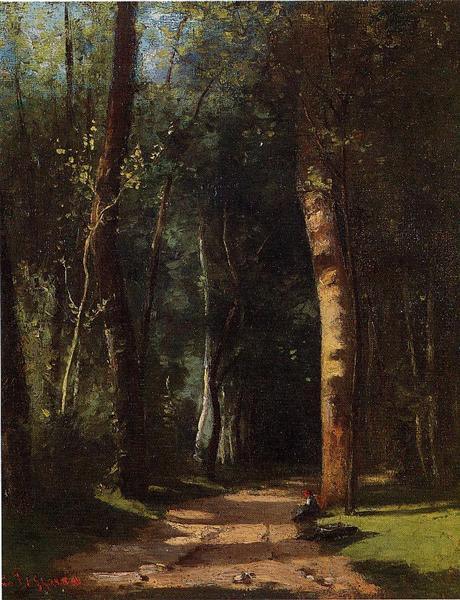
The painting shows a dirt path leading into a dense forest, surrounded by tall trunks, undergrowth, and masses of foliage. The path begins in the foreground, curves gently toward the center, and draws the eye between the trees until it disappears into the green, shadowy depths. A small figure beside the base of a tree trunk introduces a discreet human scale, almost absorbed by the spacious surroundings. Patches of light falling across the ground and vegetation interrupt the shadows and allow the landscape to breathe with subtle variations.
As a landscape, In the Woods focuses on a quiet experience of immersion in nature. It does not depict a developed narrative scene, but rather a fragment of the natural world in which the visual journey takes the place of action. The path serves as an invitation to enter the wooded space, while the tiny figure calls to mind the difference in scale between human beings and a landscape that dwarfs them. The work thus belongs to a tradition of close observation of the surroundings, in which an everyday place can gain intensity through light, atmosphere, and spatial arrangement.
The path winding between the trees can be read as a route for movement and contemplation: it guides the eye, while leaving the destination open. The vertical trunks act as natural boundaries and frames, forming a rhythmic sequence that separates illuminated areas from darker corners. The tiny human presence provides a quiet point of reference without imposing itself on the landscape; its scale emphasizes the forest’s vastness and sense of seclusion. In this balance, nature is not merely a backdrop but the true setting that shapes the entire visual experience.
The composition is structured around a profound interplay of verticals and diagonals. The tree trunks draw the eye upward and fragment the field of vision, while the path introduces a curved line that softens the rigidity of the trees’ forms and leads toward the center. Dark greens, browns, ochres, and bluish tones create an earthy, restrained palette, punctuated by muted yellows where the light reaches the ground or filters through the canopy. The contrast between the dense areas and the luminous openings creates depth without relying on a rigid vanishing point. The brushwork and color relationships make the forest feel like a living, shifting, densely vegetated surface.
The association with Camille Pissarro places the work within a landscape tradition especially attentive to the changing effects of light, atmosphere, and natural color. Here, this sensitivity is expressed in the way the tree trunks, foliage, and path form a network of relationships rather than an isolated depiction of each element. The painting’s appeal lies in transforming an apparently ordinary woodland path into an experience of depth and stillness. Notice how the small figure is integrated into the landscape and how the patches of light guide the eye from the foreground into the depths: there, the tension between human presence, silence, and nature comes into focus.
Have questions about our oil painting reproductions? See our frequently asked questions.