

Description
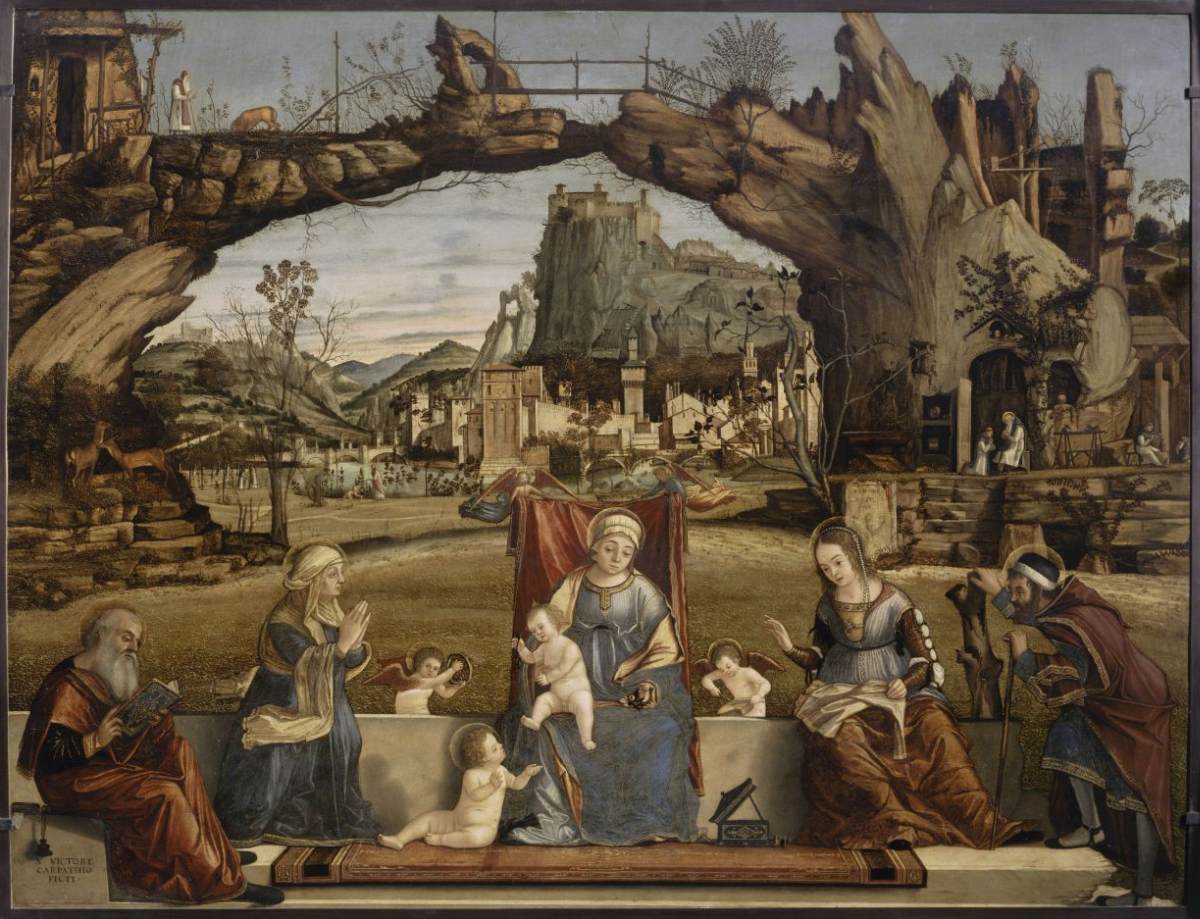
The painting shows the Virgin and Child surrounded by sacred figures in a mountainous landscape of almost visionary expansiveness. Mary occupies the center of the foreground, seated and crowned by a circular halo, with the Child on her lap. Several adults and children gather around her, including a woman with her hands clasped in prayer, another woman seated beside a child, and a bearded man holding an open book. At the opposite end, a leaning man wears a hat and carries a walking stick. In the background stretch a valley, roads, trees, blue-tinged mountains, and a city of towers and rooftops, crowned by a fortified structure. An open shelter and several smaller figures complete the scene.
The title refers to the sacra conversazione, a convention in Christian painting that brings the Virgin and Child together with saints in a single space, not necessarily during a specific narrative episode. The gathering is presented as a spiritual community united in contemplation. Mary's central position emphasizes her role as the mother of Christ, while the figures who pray, bow, or read express different forms of devotion. The open book introduces a dimension of study and doctrine, turning the group into a scene of shared reflection rather than a mere gathering of figures.
The iconography relies on recognizable gestures: clasped hands signify prayer, the halo focuses attention on the sacred dignity of the central figure, and the Child establishes the emotional and theological axis of the composition. The arch formed by trunks, branches, and rocks serves as a natural enclosure that visually shelters the group. Beyond this frame, the city, castle, and mountains extend the religious experience across an entire landscape, integrating the human, the architectural, and the rugged natural world. The children lend the group a sense of intimacy and vitality without disrupting its contemplative tone.
The panoramic composition guides the eye from the densely populated lower strip into the open depth of the valley. The central group acts as an anchor, while the lines of the landscape lead the viewer’s attention toward the city and the mountains. The large tree trunks at the sides and the arch above create an enveloping structure that contrasts with the luminous horizon. The palette of browns, ochres, muted greens, bluish grays, and dark reds unifies the figures and landscape, creating a feeling of serene antiquity. The small buildings and figures in the background introduce a meticulous rhythm that rewards unhurried observation.
In this work by Vittore Carpaccio one can recognize the Venetian interest in narrative detail, architectural and landscape settings, and the integration of devotional figures in expansive spaces of nuanced color. The scene transforms a quiet gathering into a panoramic vision: the Virgin and Child concentrate the meaning, while the valley, the city, and the natural arch create a large-scale spiritual frame. It is worth observing how the book, the prayerful poses, and the architecture guide the eye toward the center, and how the landscape transforms an image of intimate devotion into an open, immersive visual experience.
Have questions about our oil painting reproductions? See our frequently asked questions.