

Description
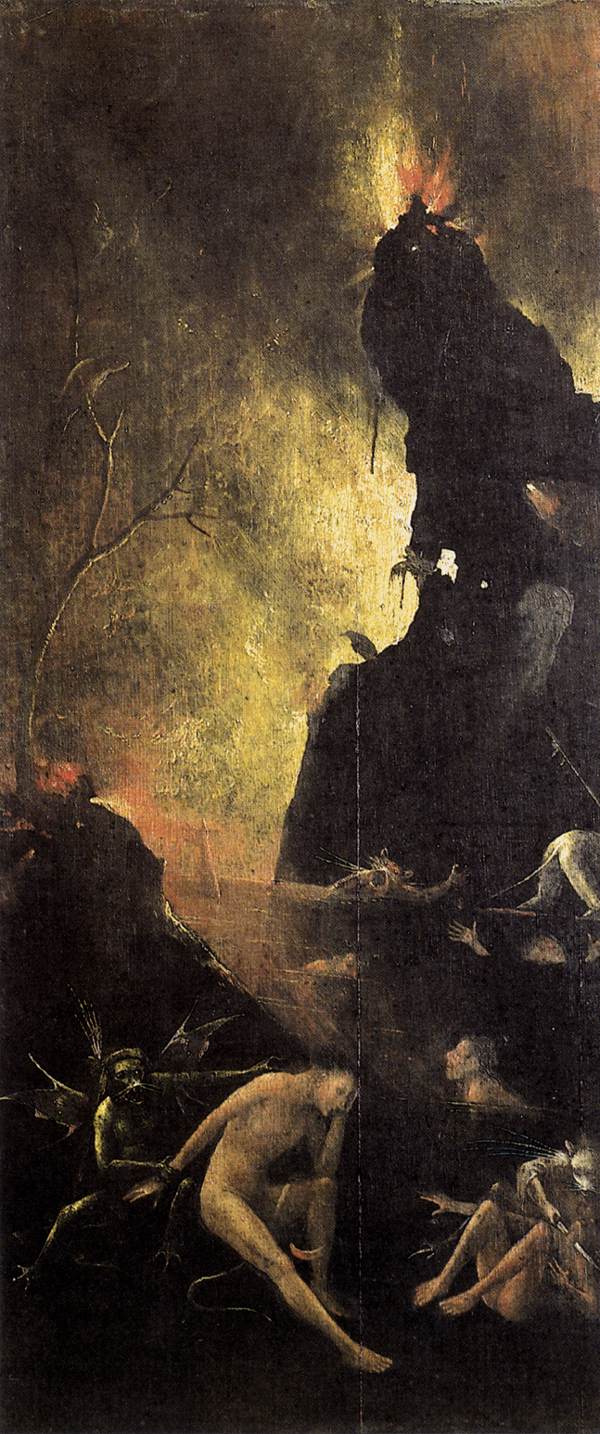
The painting depicts Hell as a vertical, shadowy and turbulent space, dominated by a large black figure on the right. Its bulky silhouette stands out against a yellow and ochre glow rising through the center, while small touches of orange intensify the upper area. At the bottom, several naked or partially naked human figures cluster among rocks, shadows and fractured surfaces. One figure leans forward in the center; others, smaller in size, appear seated or reclining to the right. On the left, a bare branch introduces a stark, branching line, beside a fantastical creature with angular appendages emerging among the dark forms.
In the Christian imagination, Hell represents the realm of punishment for the damned and their separation from divine salvation. The scene turns this religious concept into a physical landscape: the souls appear exposed and vulnerable, surrounded by an environment with no secure refuge. Darkness, intense glows, tormented bodies and monstrous creatures are part of a widely recognizable infernal iconography. In the artistic world associated with Hieronymus Bosch, this kind of religious vision takes shape through grotesque figures, hybrid beings and settings that translate sin and punishment into images of great imaginative power.
The nakedness of the bodies accentuates the helplessness of the human figures, deprived of protection from the dominant presence occupying the right side. The angular creature in the lower-left corner reinforces the impression of a world governed by monstrous forces, while the rocks and bare branch create a barren, inhospitable setting far removed from the natural order. The central glow can be read as an ardent or supernatural light: it does not illuminate the scene peacefully, but instead cuts out the silhouettes and makes the shadows’ proximity more unsettling. The black mass thus acts as an oppressive center of gravity, around which bodies and forms are scattered.
The composition guides the eye through a strong contrast between the dark verticality of the main figure and the luminous field opening up behind it. The eye travels up that yellow band and then returns to the lower group, where the diagonal bodies and fragmented rocks create an irregular rhythm. The branch lines introduce a lateral direction that partially balances the visual weight on the right. The palette, built from blacks, browns, ochres, muted yellows, and reddish oranges, avoids a clear separation between landscape, creature, and human figure; everything seems to emerge from the same shadowy matter. This chromatic continuity turns the space into a compact, suffocating vision.
The scene is consistent with Hieronymus Bosch’s widely recognized style: a moralizing religious imagination populated by hybrid creatures, grotesque figures, and unsettling landscapes, where contrasts of light convey instability and menace. The interest of Hell lies in transforming a theological idea into a mental and physical landscape at once. When viewing it, it is worth following the path from the central glow to the black figure and then to the vulnerable bodies in the foreground: this trajectory reveals how light, scale, and the dispersal of forms turn religious punishment into a vision of cosmic disorder.
Have questions about our oil painting reproductions? See our frequently asked questions.