

Description
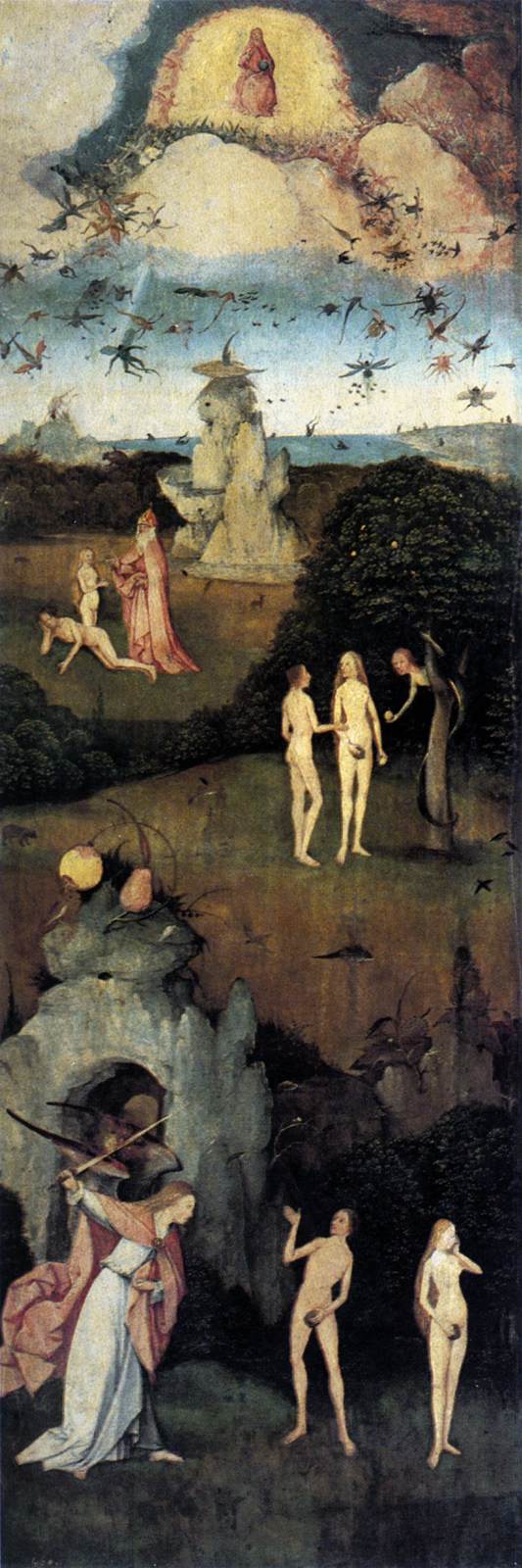
The painting shows the left wing of the The Haywain Triptych as a visionary landscape populated by human figures, winged creatures and fantastical natural forms. At the top, a clear sky opens between clouds in cream, pink, yellow and gray hues, while numerous small creatures cross the space. A luminous circular form draws the eye high above. Below, a vertical stone structure rises in front of a band of blue on the horizon. Around it are nude figures, intertwined couples and characters dressed in red, dark or light robes. The vegetation grows denser toward the sides, giving way to rocks, a shadowy opening and more bodies partly concealed in the lower area.
Traditionally, this wing is associated with the Earthly Paradise and with episodes connected to creation, humanity and the Fall. It is not a linear narrative, but a space where different moments and presences coexist in a single setting. The figures’ nudity places humanity in a primordial state, still integrated with an exuberant, supernatural natural world. Viewed as a complete triptych, this paradisiacal beginning is set against the allure of worldly goods and their infernal consequences, establishing a moral interpretation of desire, sin and the human condition.
Nude couples and scattered groups turn the landscape into a stage for relationships, encounters, and temptations. The water, vegetation, and winged creatures create a fertile yet strange setting, where the natural and the imaginary intermingle without a clear boundary. The central structure symbolically organizes this Edenic world and shapes the space between the luminous sky and the dark thicket. The coexistence of human bodies, fantastic creatures, and improbable architecture suggests a moment of transition: the wonder of creation remains visible, yet the contrast of light and shadow introduces a moral unease that foreshadows the Fall.
The vertical composition is arranged in successive tiers. The sky opens up the upper section, offering a light, expansive field; the blue horizon creates a pause; then the stone structure and human groups concentrate the action; finally, the masses of foliage, rocks, and darkness below enclose the space. Pale blue and cream tones contrast with deep greens, browns, and blacks, making the light-colored figures emerge from the vegetation. The repetition of bodies, wings, branches, and rounded forms creates an abundant, almost musical rhythm. At the same time, the central architecture provides a stable vertical axis that guides the eye from the creatures in the sky down to the figures in the foreground.
In this work, Hieronymus Bosch displays traits widely associated with his artistic language: fantastical imagination, a profusion of episodes, hybrid creatures, and a landscape conceived as a setting for religious and moral allegories. The painting does not separate beauty from danger; both appear united in a fertile, seductive, and enigmatic natural world. It is worth observing how the intertwined human figures and the creatures crossing the sky form part of a network of movement, while the central structure and the shadows at the sides hold the scene together. In this way, the left wing transforms Paradise into a visionary theater where creation and moral unease are perceived simultaneously.
Have questions about our oil painting reproductions? See our frequently asked questions.