

Description
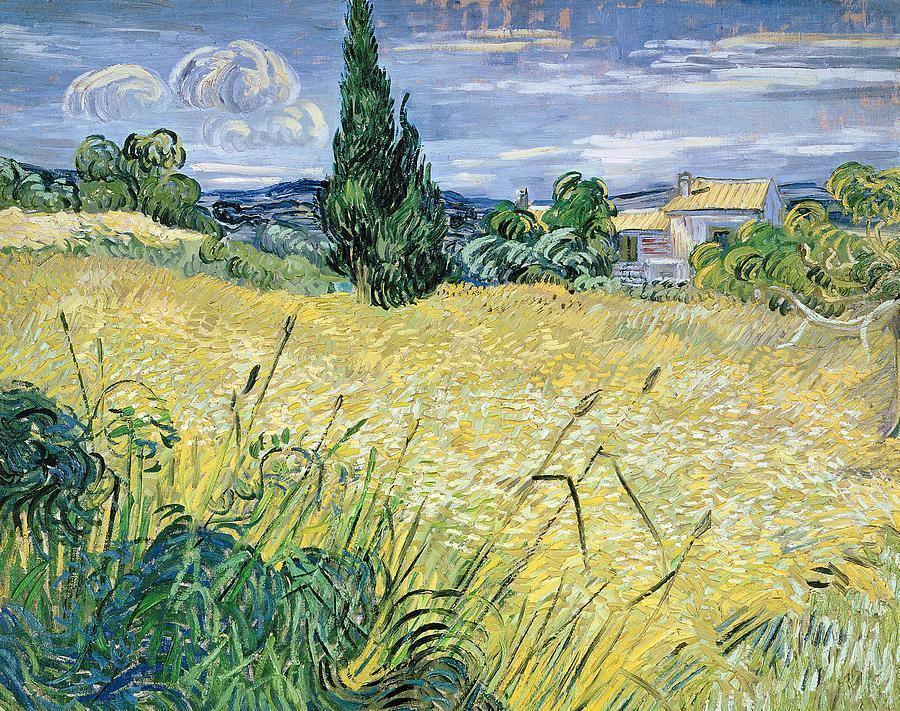
The painting depicts an open rural landscape where an extensive wheat field, rendered in golden and ochre tones, meets a lush band of trees and vegetation. At the center, a tall, slender cypress rises from the ground toward the sky, imposing a vertical axis against the field’s horizontal expanse. To the right, a light-colored building with a yellowish roof is partially nestled among the trees; in the distance, low hills complete the horizon. The blue sky, crossed by white and gray clouds, heightens the sense of space and daylight.
More than a narrative scene, Green Wheat Field with Cypress belongs to the realm of landscape as a visual and emotional experience. Vincent van Gogh transforms an agricultural view into a composition of forces: the land stretches laterally, while the cypress draws the eye and lifts it upward. The tree is also a recurring motif in many of the artist’s landscapes, where it introduces a powerful vertical counterpoint to fields, roads and open horizons. The house, clusters of trees and hills place the scene in an inhabited landscape, though the vastness of the field preserves a sense of freedom and quiet contemplation.
The contrast between the golden hues of the land and the dark greens of the vegetation shapes an interpretation of vitality, maturity and seasonal abundance. Formally, the cypress acts as an axis that orders the landscape and, at the same time, as a concentrated presence of energy set against the field’s serene expanse. The foreground vegetation creates a close, tactile scale, while the house and hills guide the eye toward a more open distance. Thus, each element contributes to a tension between the immediate and the distant, between nature’s density and the clarity of rural space.
The composition is arranged in horizontal bands: sky, tree-lined horizon, expansive field, and foreground vegetation. This stable structure is decisively interrupted by the central cypress, whose irregular silhouette adds rhythm and upward movement. The visible brushstrokes in the sky and field keep the surfaces from appearing static; the clouds gather into rounded forms, and the terrain takes on a chromatic vibrancy that draws the eye. The light blue of the sky intensifies the yellows and ochres, while deep greens create areas of contrast and depth around the main axis.
The work can be situated within Vincent van Gogh’s characteristic treatment of landscape through intense color, visible brushwork, and a dynamic composition that transforms a rural view into an expressive experience. The painting’s interest lies in this transformation: the field is not merely a setting, but an active expanse that finds its counterpoint in the tree’s verticality. When viewing it, it is worth following the path from the nearby vegetation toward the golden field, then pausing at the cypress, because there one can understand how color, scale, and the direction of the forms turn a tranquil scene into an image of powerful visual tension.
Have questions about our oil painting reproductions? See our frequently asked questions.