

Description
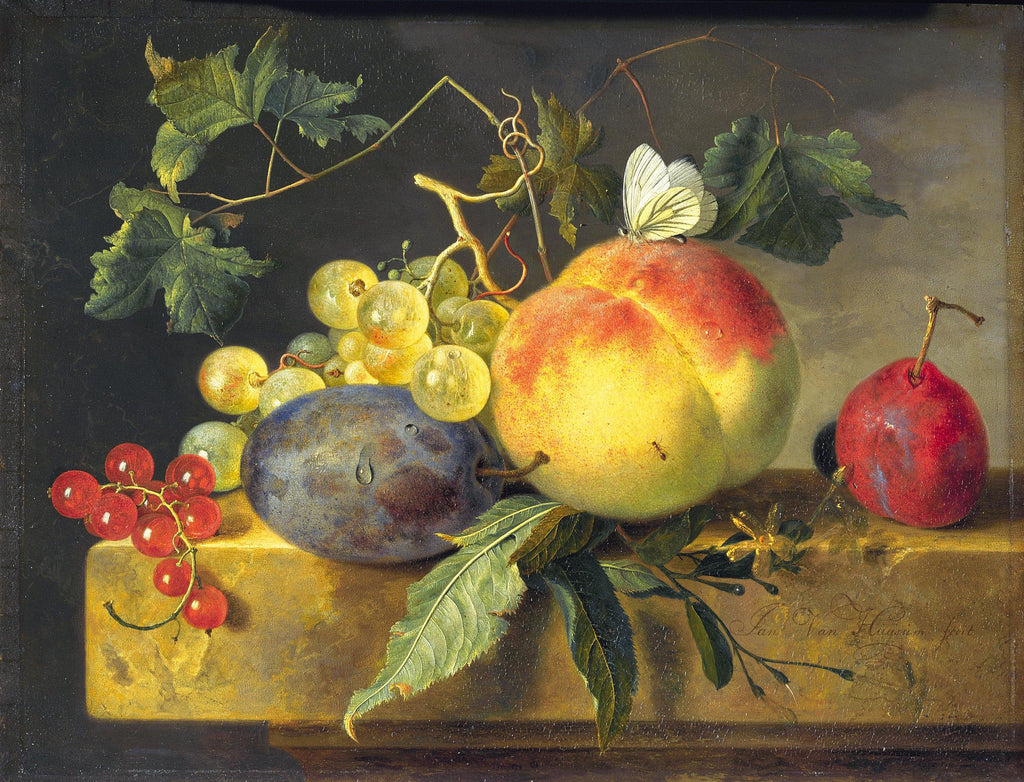
The painting presents a still life of fruit arranged on a golden-toned ledge, with an abundance of natural forms set against a dark background. Green and yellowish grapes, red berries and several large fruits in yellow, reddish and purplish-blue tones cluster at the center. A red fruit sits slightly apart from the group on the right, with a white butterfly resting on its surface. Vine leaves, slender stems and curling tendrils stretch across the upper part, while small insects subtly enliven the stillness of the scene. The handwritten inscription in the lower-right area is part of the painting’s material presence without disrupting its visual balance.
As a genre, still life focuses attention on inanimate objects arranged within a carefully constructed space. Here, fruit, leaves, insects and a ledge make up a scene without figurative narrative, yet rich in sensory presence. The European still-life tradition turned the close observation of natural elements into a way of studying color, volume, texture and the state of preservation of things. The abundance gathered in this painting transforms everyday produce into a subject for contemplation, in which every surface takes on importance and the composition as a whole approaches a small celebration of nature.
The grouped fruits suggest abundance and fullness, while the butterfly and insects introduce a delicate tension between the stillness of the arrangement and the fleeting vitality of living things. Their presence makes the scene seem liable to change at any moment: a flutter of wings, the slightest movement or the passage of time could alter the balance achieved on the ledge. The vine leaves and tendrils connect the different fruits through an organic rhythm, as though plant growth continued around the composition. Rather than imposing a single symbol, these details enrich the still life with associations of fragility, fullness and transience.
The horizontal structure is arranged around a compact central mass, reinforced by the red berries in the left foreground and balanced by the fruit set apart on the right. The curved lines of the stems and leaves lead the eye toward the fruit, while the diagonal plant forms keep the arrangement from seeming static. Warm lighting concentrates its glow on the skins, markings and forms, bringing the fruit into relief against the almost-black background. The contrast heightens the theatricality of the presentation and brings out tactile differences: the powdery surface of the purplish-blue fruit, the speckled skin of the larger fruits and the butterfly’s translucent delicacy.
The work reflects Jan van Huysum’s fondness for sumptuous, meticulously detailed still lifes, characterized by a rich variety of colors, carefully rendered surfaces, and a composition abundant in natural elements. Here, visual luxury depends not only on the quantity of fruit, but also on the way each piece is illuminated in its own distinctive way and forms part of a network of leaves, stems, and insects. Note how the gilded ledge supports and defines this world: below, it establishes a solid plane; above, the foliage brings it to life. Thus, Still Life with Fruit turns abundance into an experience of color, texture, and suspended time.
Have questions about our oil painting reproductions? See our frequently asked questions.