

Description
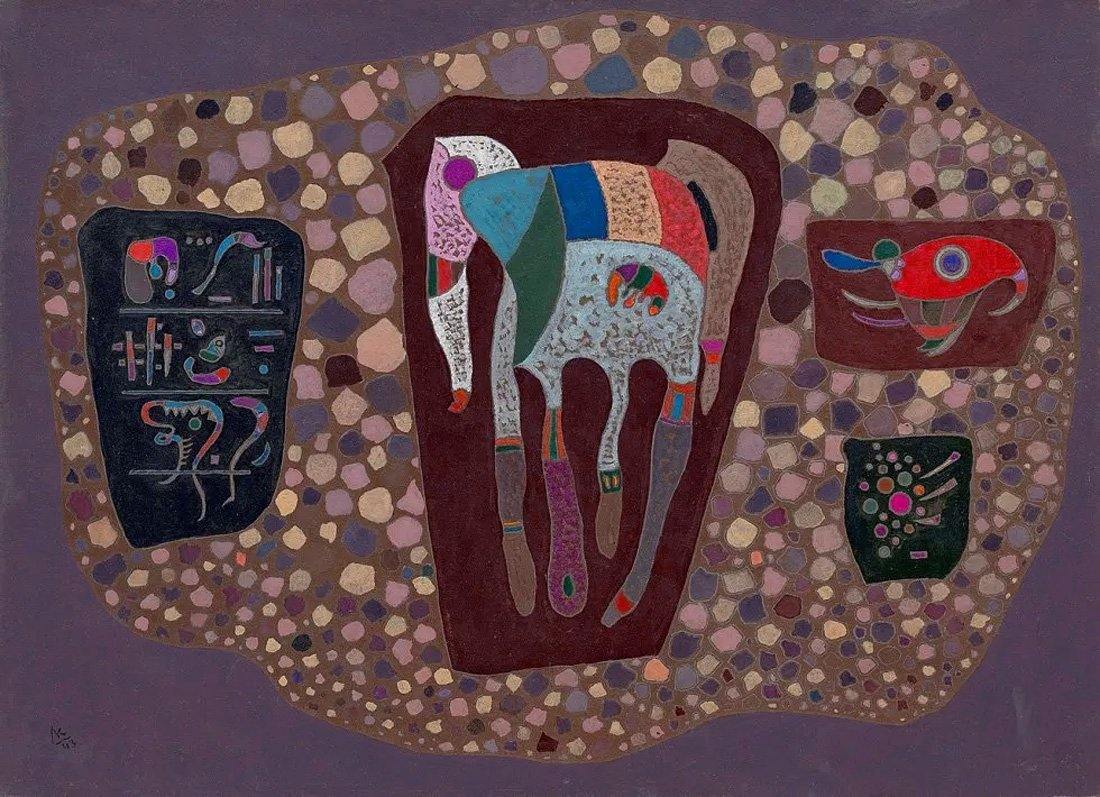
The work presents an abstract, fantastical composition organized around a central zoomorphic figure. Its broad, segmented body extends into four elongated limbs, while different color fields form a stylized, almost emblematic animal. Around it, an irregular burgundy outline defines an interior space that widens toward the lower area. The background is covered with numerous polygonal and rounded shapes, resembling mosaic pieces, in shades of beige, pink, lilac, blue, green, brown, and cream. Three dark panels interrupt this multicolored field: one on the left and two on the right, filled with lines, bars, circles, and biomorphic shapes.
Fragments does not develop a specific historical, religious, or mythological narrative. Its subject belongs to the realm of abstraction, although the four-legged presence introduces a recognizable reference to the animal world and gives the work a figurative center of gravity. The image is constructed as a repertoire of signs assembled on a single surface: the central figure, the side panels, and the surrounding mosaic form distinct units within a shared structure. In this sense, the painting approaches a modern conception of abstract art in which a form need not depict a naturalistic object to acquire presence, rhythm, and evocative power.
Fragmentation functions here both as a visual principle and as a key to interpretation. Each piece in the outer field retains its color, outline, and scale, yet contributes to a whole that gains cohesion through accumulation. The zoomorphic figure can be read as a fantastic emblem integrated into this universe of signs, rather than as a precise depiction of a particular species. The dark panels expand the work’s visual vocabulary: their dots, curved lines, and isolated shapes resemble small abstract constellations in dialogue with the animal’s segments. The contrast between the central creature and the scattered units around it creates a fertile tension between identity and multiplicity, between a compact presence and a world made up of parts.
The frontal composition focuses attention on the center and maintains an almost symmetrical balance, although its internal forms are deliberately irregular. The maroon outline acts as a frame within a frame, separating the figure from the field of pieces and guiding the eye toward its multicolored body. The black or very dark panels serve as visual pauses against the mosaic’s chromatic density; at the same time, their curved strokes and dots set movement in motion again in the lateral areas. Bright colors circulate among the background, the figure, and the compartments, so that no element is completely isolated. The depth is limited and decorative: interest arises from the overlapping outlines, the alternation of scales, and the rhythm of shapes that guides the eye from one fragment to another.
In this work by Wassily Kandinsky, color, line, and autonomous forms shape the meaning without relying on naturalistic representation. The combination of free geometry, biomorphic signs, and vivid contrasts reflects a modern vision of abstraction that is dynamic and open to visual associations. The strength of Fragments lies precisely in its transformation of dispersion into order: the outer mosaic, the panels of signs, and the central zoomorphic figure do not compete but come together in a rhythmic system. Notice how each element retains its individuality while reinforcing the presence of the whole; this is where the painting’s essential tension lies, between multiplicity and unity.
Have questions about our oil painting reproductions? See our frequently asked questions.