

Description
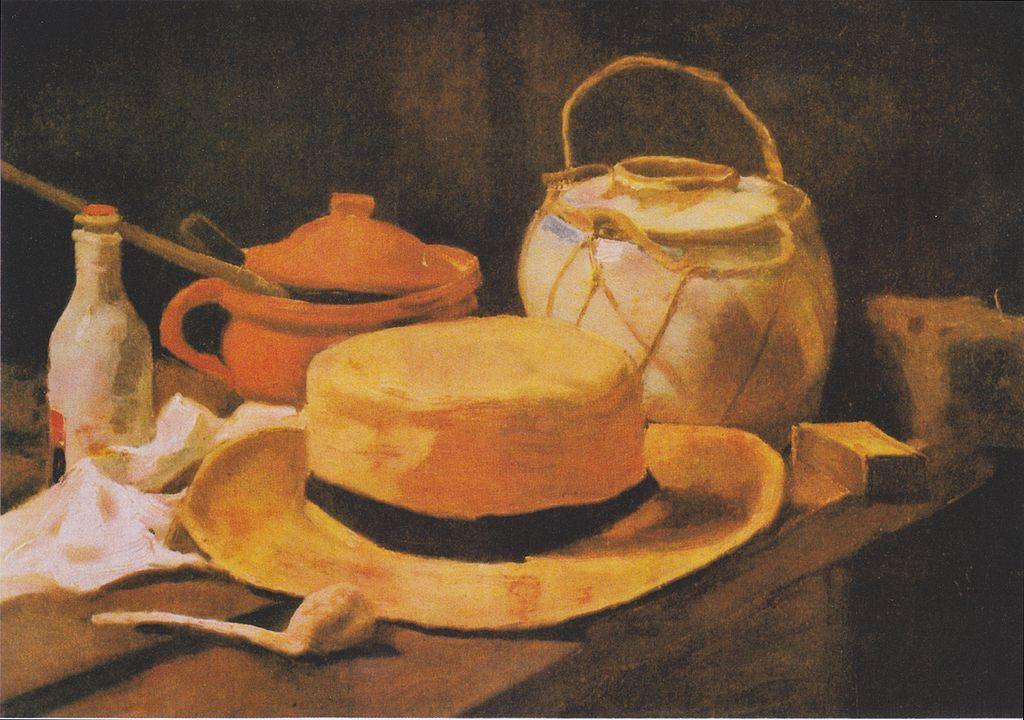
The painting shows a warm-toned still life built around a wide-brimmed yellow hat placed in the foreground on a dark wooden surface. The low crown and outstretched brim occupy much of the lower area and immediately become the visual center of the scene. Behind it are a large pale teapot with an arched handle and golden reflections; a reddish lidded vessel on the left; a narrow bottle; and an elongated implement that cuts diagonally across the background. A light cloth, folded and partly concealed, introduces a textile note in the lower corner, while other containers and blocks of color complete the domestic grouping.
As a still life, the work does not rely on a historical, religious or literary narrative, but on the concentrated presence of everyday objects. The interest shifts to their shapes, their materials and the relationships they establish among themselves within a confined space. The teapot, the bottle, the reddish vessel and the hat evoke a familiar setting, although the compact arrangement and theatrical lighting remove them from a simple scene of daily use. In the context of Vincent van Gogh, this type of composition allows one to appreciate how ordinary objects can acquire a pictorial intensity of their own through color and contrast.
The hat functions as the dominant motif not only because of its size but also because of its frontal position and its golden-yellow color. Its presence concentrates attention on the identity and materiality of an object associated with the body, even though here it appears separated from any human figure. Around it, the utensils reinforce the domestic character of the group and establish a dialogue between metallic, ceramic, textile and wooden surfaces. The absence of people focuses the gaze on the indirect traces of everyday life: objects gathered, used and left on a table. The contrast between the luminous hat and the deep background transforms that familiarity into an image of remarkable intensity.
The horizontal composition is organized through a succession of volumes that progresses from the background toward the viewer. The hat’s brim creates a broad, almost architectural form, while the kettle introduces a vertical curve and the reddish vessel provides a compact, dark counterpoint. The diagonals of the utensil and the folds of the cloth break the stability of the grouping and lead the eye between the different areas. Warm light concentrates on edges, handles and reflective surfaces, causing the objects to emerge from the background without losing chromatic unity. Ochre, cream, terracotta, brown and golden-yellow form an earthy palette, intensified by the darkness of the table and the surrounding space.
The association with Vincent van Gogh provides a helpful framework for reading the work’s expressive use of color, the intensity of its contrasts and the tangible presence of objects. Without reducing the painting to a stylistic formula, these traits help explain why the still life has an energy that is more than merely descriptive: each object participates in a structure of light, weight and color. Notice how the hat, apparently simple, takes on an almost monumental scale by occupying the foreground, while the teapot and other vessels build its visual environment. The result transforms a gathering of everyday utensils into a concentrated, warm and silent scene in which the material itself sustains the expressiveness of the whole.
Do you have questions about our oil-painting reproductions? See our frequently asked questions.