

Description
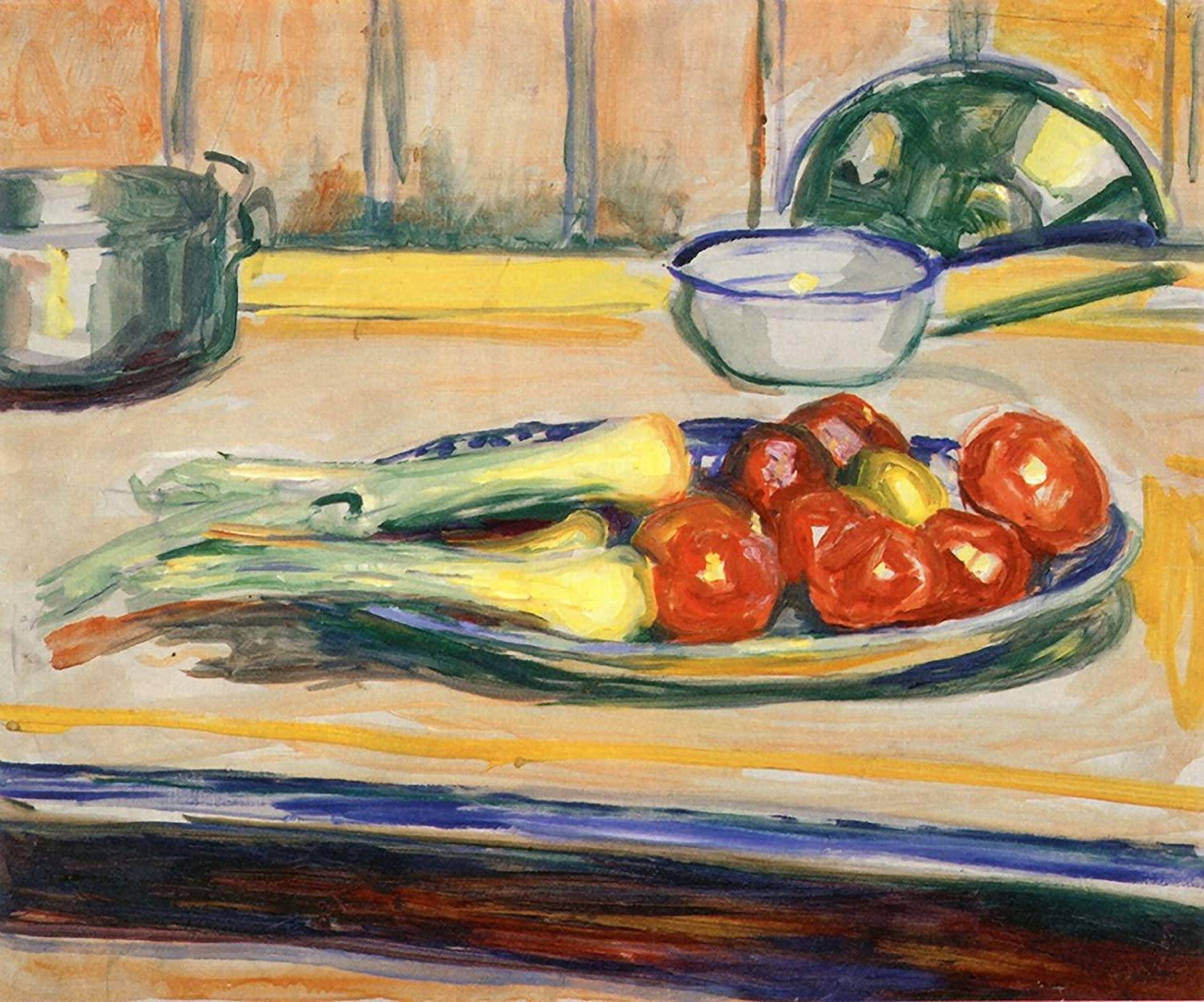
The painting depicts a still life of food and vessels arranged on a table, with an oval platter as the visual center. Several leeks with long leaves and pale stems are grouped on it alongside red tomatoes and a yellow-green fruit, forming a compact, colorful arrangement. Behind them, a white bowl outlined in blue complements the composition, while other vessels and a mass of greenery occupy the back. The background is organized into vertical bands that suggest windows, panels or curtains. The domestic scene thus takes on an intense presence: the everyday objects are not shown in isolation, but arranged into a vibrant pictorial construction.
As a still life, the work does not develop a historical or religious narrative; its subject arises from observing food, utensils and everyday surfaces. The title brings together tomatoes, leeks and stew pots around a table, emphasizing the relationship between the fresh produce on the platter and the bowl, which extends the culinary dimension of the scene. The painting’s interest lies in transforming a simple gathering of objects into a subject in its own right, capable of holding the viewer’s gaze through its relationships of color, form and material. The kitchen or domestic space serves here as a field of visual experience, where the ordinary takes on expressive intensity.
The tomatoes and leeks evoke an abundance of produce and a connection to everyday life. Their organic, irregular, overlapping forms contrast with the orderly structure of the platter, which holds them and presents them as a group. The bowl and other vessels reinforce the still life’s utilitarian character, while also introducing curves and ovals that balance the verticality of the background. The red fruit concentrates energy in the foreground, while the greens suggest freshness and continuity between the food and the mass of foliage behind it. Rather than serving as fixed symbols, these elements create a sense of domestic vitality through their tangible presence.
The composition extends horizontally, but the eye moves through it in stages. It first comes to rest on the leeks and tomatoes, whose diagonals and overlapping forms create rhythm across the platter; it then rises toward the bowl and secondary objects. The vertical bands in the background create geometric tension against the rounded forms of the food and vessels. Color organizes the space as much as drawing does: dark greens, orange-reds, yellows, creamy whites, and purplish blues confront and balance one another. The visible brushwork and simplified contours prevent the scene from feeling coldly descriptive, allowing the surface to retain the painting’s direct, energetic impulse.
In this work by Edvard Munch, the still life can be associated with an expressive use of color, simplified forms, and visible brushwork that transforms an ordinary scene into an emotionally charged structure. Its intensity does not depend on an event, but on the way the food, ceramics, and background are set in tension with one another. It is worth noting how the bowl brings the elements together in the foreground, while the vertical bands create a second spatial rhythm: between these two zones, the tomatoes and leeks become the focal point of a composition in which the domestic takes on an almost monumental energy.
Have questions about our oil painting reproductions? See our frequently asked questions.