

Description
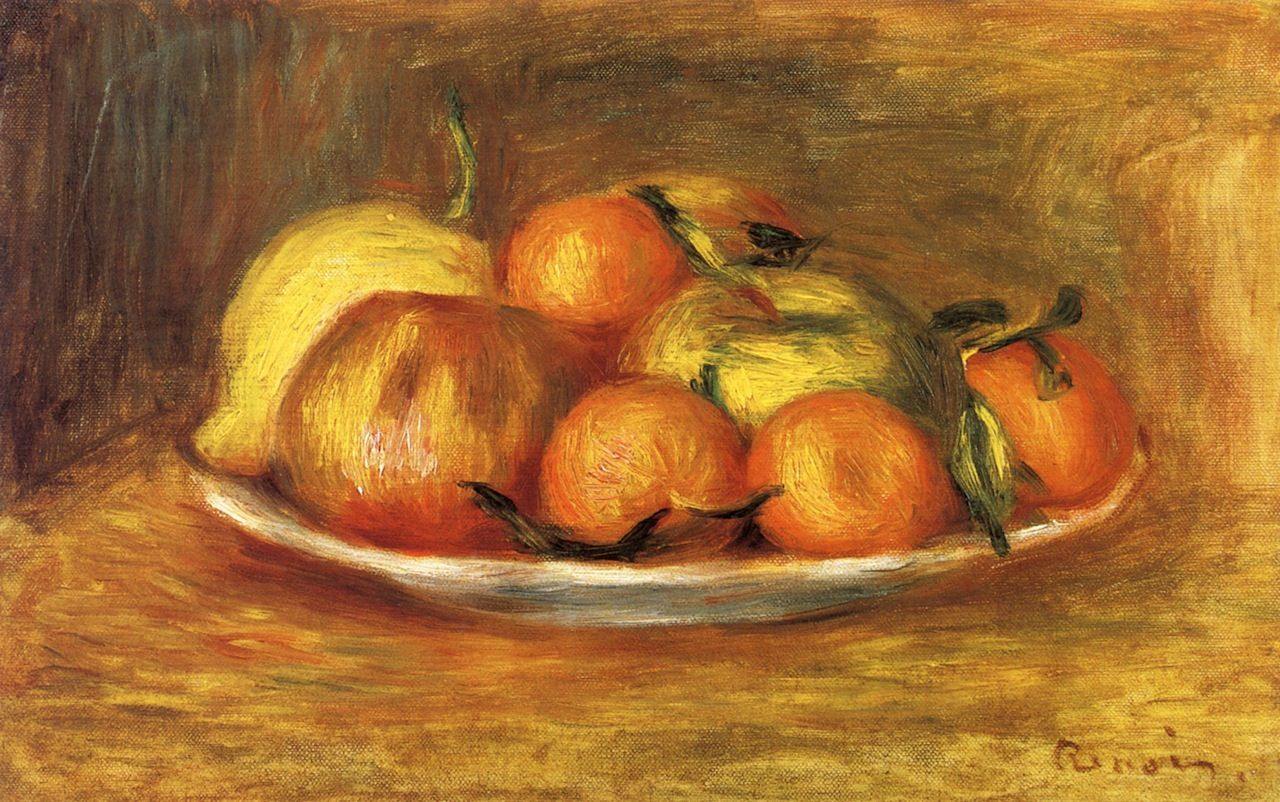
The painting depicts a still life of tangerines, apples and a lemon gathered on a light-colored oval plate. The fruit forms a compact group at the center of the composition: the red and orange pieces occupy the foreground and upper area, while the yellow lemon rises behind them on the left, introducing a luminous note among the warm colors. Narrow leaves and dark stems are interspersed among the fruit, emphasizing its connection to the plant world. Everything rests on a golden-brown surface, visually extended by a background of ochres, earth tones and yellowish reflections.
As a genre, the work belongs to the still-life tradition, a form of painting that turns everyday objects into an opportunity to study color, material and balance. There is no specific historical or religious narrative here: interest arises from contemplating a domestic arrangement, simple in its elements yet rich in visual relationships. The plate organizes the abundance and gathers the fruit in a close, almost intimate space, where the everyday takes on a pictorial presence. The scene evokes a family table, although its formal composition elevates it beyond the mere depiction of food.
The concentration of fruit creates a celebration of domestic abundance and the chromatic variety of the still life. The leaves and stems provide a linear counterpoint to the rounded forms, while also reinforcing the impression of freshness and connection to their plant origins. The lemon serves as a bright accent within the group, while the tangerines and apples link their reds, oranges and yellows in a warm sequence. Rather than isolated symbols, these elements create a unified reading: nature is brought together and transformed into rhythm, color and texture.
The horizontal composition is anchored by the oval shape of the plate, which acts as a visual base and guides the eye toward the central group. The fruits overlap slightly, creating depth without recourse to a spacious setting; volume emerges from their proximity, shifts in tone, and visible brushstrokes. The background and the surface below share an earthy palette that envelops the objects and avoids a rigid division between table and wall. Against this continuity, the reds and yellows stand out more intensely. The dark stems introduce diagonals and small breaks in the mass of color, while the leaves enliven the center and right side. The golden light is not concentrated in a single spot: it spreads across the fruits and transforms the group into a vibrant surface.
Broadly speaking, the work can be situated within Pierre-Auguste Renoir’s sensibility through its warm treatment of color, visible brushwork, and attention to luminous effects, even in a domestic subject. The still life thus transforms an ordinary group of fruits into a study of color temperature, texture, and balance. It is worth observing how the yellow of the lemon enlivens the neighboring tones, and how the plate, seemingly secondary, contains and organizes the entire composition. The key to the work lies in this relationship between the support, fruits, leaves, and background: abundance is expressed not only through the number of objects, but through the richness of their visual connections.
Have questions about our oil painting reproductions? See our frequently asked questions.