

Description
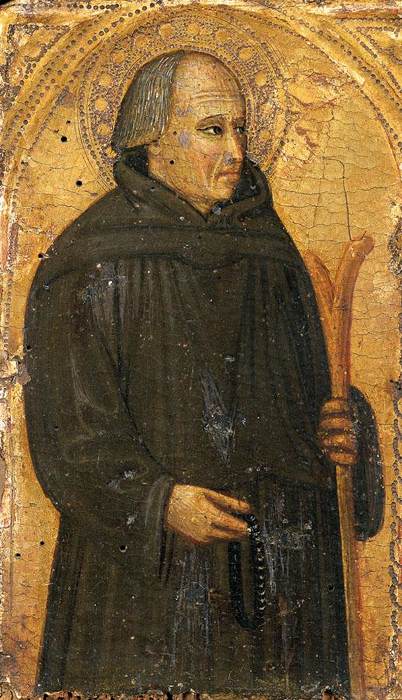
The painting depicts Blessed Gerard of Villamagna full-length and in profile, facing right. The figure occupies almost the entire center of the composition and wears a voluminous, heavy habit, rendered in blacks and dark browns that fall in vertical folds. His elongated face, short hair, and composed demeanor emphasize the subject’s concentration. One hand rests on the habit, while the other holds a vertical staff at his right side. Around his head is a circular halo composed of several golden rings, set against a background of aged ochre, dots, circles, and ornamental lines.
Gerard of Villamagna belongs to the Christian tradition of the blessed associated with religious and devotional life. The work does not present a complex narrative scene, but rather an individual figure conceived for contemplation: the subject appears before the viewer as a sacred, silent presence, set apart from everyday life. The golden background contributes to this reading, replacing the depth of a landscape or architecture with a timeless space. Thus, the figure does not take part in a fleeting action but remains an example of contemplation, discipline, and spiritual devotion.
The halo conventionally identifies the subject as a saintly or blessed figure and draws attention to his head, the spiritual center of the composition. The dark habit reinforces a sense of austerity, while the staff introduces a vertical axis that complements the blessed figure’s upright, restrained posture. It also evokes a life marked by journeying, retreat, and perseverance. The hands gathered in front of the body create a gesture of reserve and prayer, although one of them is directly connected with the staff. The gold surrounding the figure separates him from the everyday world and transforms the space into a realm of contemplation.
The vertical structure guides the eye from the staff and the folds of the habit to the face and halo. The dark silhouette stands out clearly against the golden field, creating a direct chromatic contrast that makes every contour legible. The concentric rings of the halo establish a circular rhythm in the upper part, balanced by the linear fall of the tunic and staff. The shallow depth and restrained profile encourage a stable, almost iconic perception. The craquelure, wear, and small visible losses on the surface add an aged materiality that resonates with the solemnity of the subject and reinforce the impression of a devotional image preserved through time.
In relation to Bicci Di Lorenzo, the work is associated with Florentine religious painting at the transition between the late Gothic and the early Renaissance, particularly in its use of a gold background, clarity of drawing, and solemn construction of the figure. The composition does not rely on a dramatic gesture, but on the precision with which it brings together the profile, habit, staff, and halo in an image of concentrated presence. It is worth noting how the dark volume of the body stands out against the ornamental radiance of the background: in this contrast, Blessed Gerard becomes more than merely a figure being depicted; he becomes a focus of spiritual stillness, sustained by the geometry of the halo and the ascetic verticality of his posture.
Have questions about our oil painting reproductions? See our frequently asked questions.