

Description
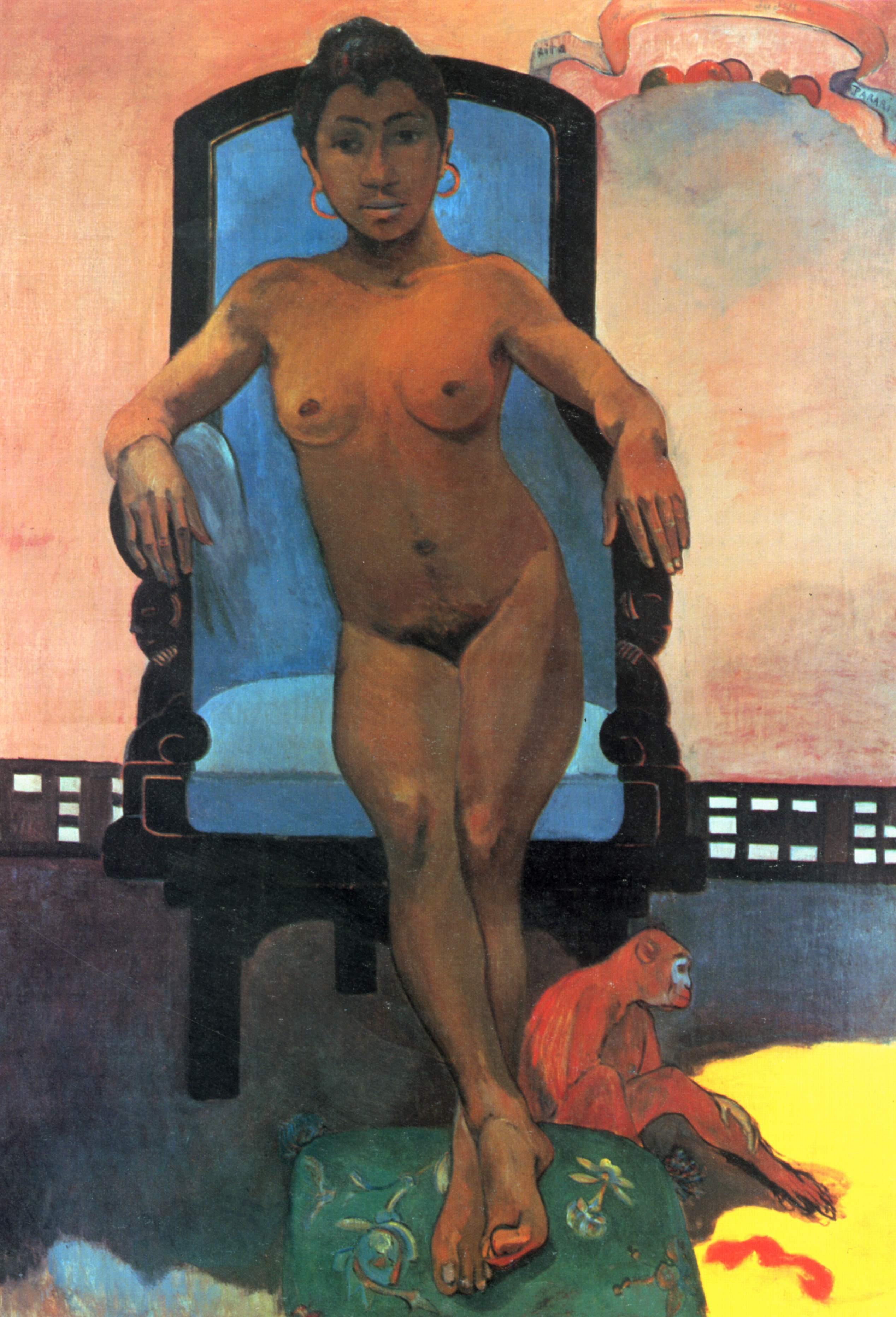
The painting depicts Annah the Javanese seated facing forward at the center of an intricately decorated interior. The female figure is nude, with short dark hair and large circular earrings, and rests her arms on the sides of a high-backed chair. The piece of furniture, blue on its central panel and dark in its frame, serves as a visual frame for the body. Beside her legs, in the lower-right area, a reddish monkey sits in profile. Beneath her feet is a green cushion or surface with plant motifs, integrated into an environment of fabrics, ornamental bands, and vibrant colors and shapes.
The title identifies the protagonist as Annah and describes her as Javanese, making the work a distinctive figurative portrait, far removed from conventional depictions by the presence of the animal and the richness of the setting. The figure is not isolated against a neutral background: she shares the space with objects, colors, and patterns that make the interior an essential part of her characterization. The scene thus brings together individual presence and theatrical composition. The monkey and ornamental textiles expand the portrait into a vision of decorative exoticism, in which the setting is not merely a backdrop but an active structure that guides the viewer’s gaze.
Annah’s frontal pose focuses attention on her physical presence and gives her a hieratic, almost ceremonial quality. Her steady posture contrasts with the variety of forms around her, while the reddish monkey introduces an animal and narrative counterpoint beside her legs. The relationship between these elements makes the scene both still and full of character. The green cushion, plant motifs, and fabrics above add associations of nature, ornament, and theatricality. Rather than imposing a single symbol, these details create a visual network in which the body, animal, and objects share the spotlight.
The composition is vertical and frontal, organized around a human axis descending from the head to the feet. The blue backrest and black frame of the chair define this axis with firm geometry, while the ornamented armrests and the horizontal band in the background introduce lateral rhythms. The flat, intense colors—salmon pink, blue, orange-red, green, and yellow—replace a uniform naturalistic illusion with a chromatic architecture of strong contrasts. The monkey concentrates visual weight in the lower right and balances the central figure; the cushion, in turn, extends the movement toward the lower edge. Depth is created through overlapping forms and patterns, rather than through dominant perspective.
In this work by Paul Gauguin, the portrait is linked to a visual language of simplified forms, expressive colors, and decorative surfaces—features widely associated with his departure from strictly descriptive naturalism. The chair, cushion, fabrics, and background do not compete with Annah; they establish the visual system that makes her presence visible. Note how the blue backrest outlines the body, how the monkey’s red extends the scene’s chromatic energy, and how the greens and yellows draw the eye toward the floor. The result is a highly theatrical portrait in which identity, animality, and ornamentation come together in a memorable, frontal composition.
Have questions about our oil painting reproductions? See our frequently asked questions.