

Description
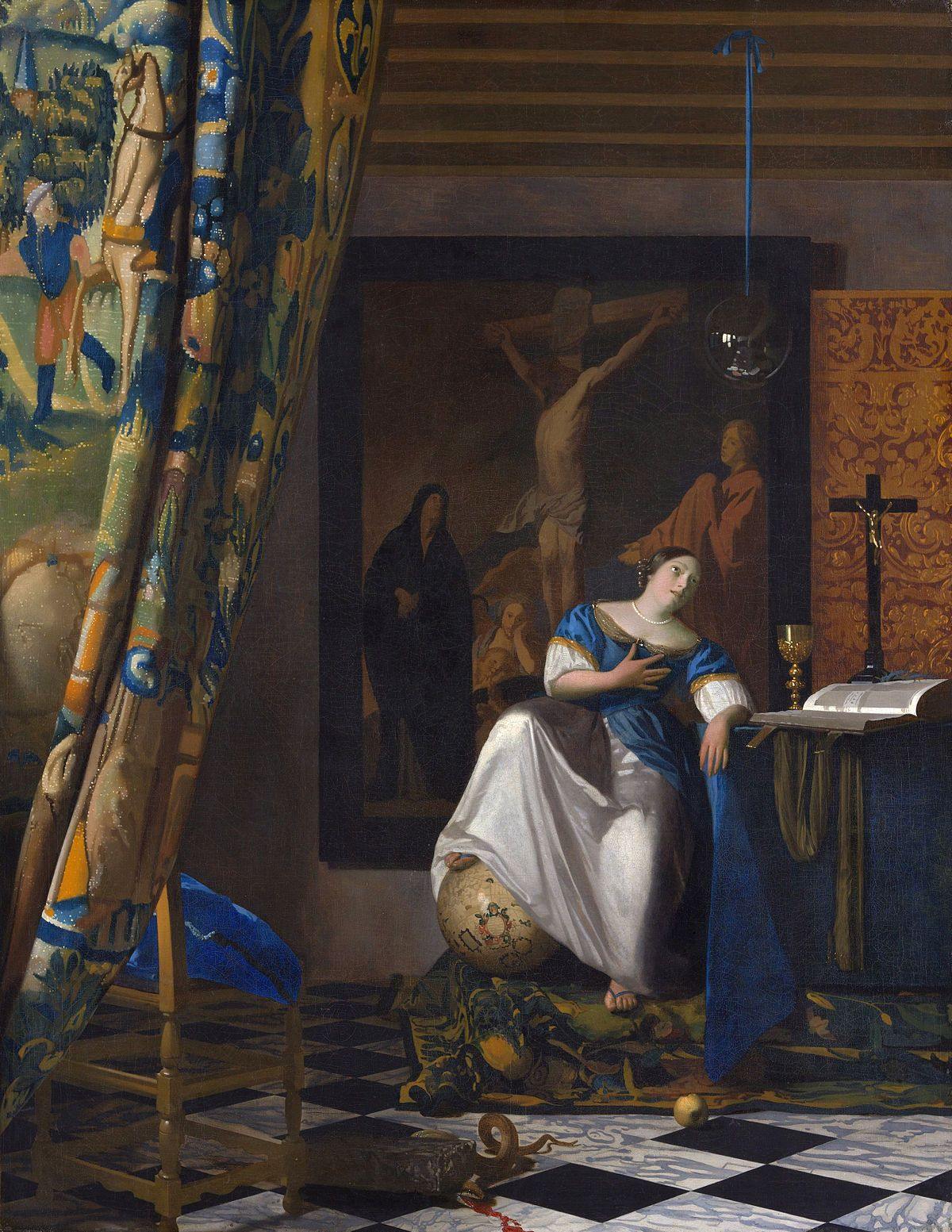
The painting shows a female personification of faith seated in a dark, carefully arranged interior. The woman, dressed in blue and white, occupies the center of the scene and places one hand on her chest in a gesture of contemplation. Beside her, a narrow table holds an open book, a golden chalice and a crucifix. In the background, a scene of the Crucifixion introduces a second narrative focus: Christ appears at the center of the cross, surrounded by several figures. On the left stands a vertical structure draped in ornamental fabrics, while the checkerboard floor, decorated sphere and rounded objects in the lower area add to the visual richness of the interior.
In Allegory of the Catholic Faith, Johannes Vermeer turns a domestic space into a setting for Christian contemplation. The Crucifixion depicts the passion and death of Jesus Christ, the core of Christian narrative, and places Christ’s sacrifice at the spiritual center of the composition. The objects gathered on the table bring this event into the realm of prayer and liturgy: the chalice is particularly associated with the Eucharist, the crucifix presents a devotional image of Christ crucified, and the open book evokes Scripture, doctrine or religious meditation.
The seated figure serves as the human and symbolic axis of the work. Her hand on her chest conveys an attitude of inner commitment, contemplation and devout profession. She is not isolated, but surrounded by attributes that bring together different dimensions of faith: the narrative image of the Crucifixion, the sacramental object, the sign of devotion and the book for spiritual reading. The decorated sphere introduces a note of worldly expansiveness into the religious setting, while the textiles and gilded panel enrich the surroundings with a sense of ceremony. In this way, the everyday is transformed into a scene of allegorical meaning.
The vertical, asymmetrical composition guides the eye through contrasts of scale, direction, and texture. The textile structure dominates the left third like an ornamental column, balanced by the grouping of the woman and the table on the right. The floor of large black-and-white squares creates a firm perspective toward the foreground and adds a geometric rhythm that contrasts with the softness of the fabrics and the organic forms of the fruit and objects in the lower area. Warm light falls on the dress, the book, the chalice, and the gilded surfaces, while the wooden walls remain in shadow. This distribution of light makes the devotional objects gradually emerge from the dark space.
The work can be associated with widely recognized features of Johannes Vermeer’s art: carefully constructed interiors, concentrated lighting, the quiet monumentality of the figures, and meticulous attention to fabrics, surfaces, and color effects. Here, these qualities are applied to an allegorical and religious composition in which stillness concentrates spiritual intensity. The woman, the Crucifixion, and the table form a visual chain: the figure embodies faith, the scene in the background recalls its narrative foundation, and the nearby objects turn it into a practice of prayer. The entire interior thus functions as an intimate theater of belief, in which the light guides the eye from the shadows to the devotional heart of the image.
Have questions about our oil painting reproductions? See our frequently asked questions.