

Description
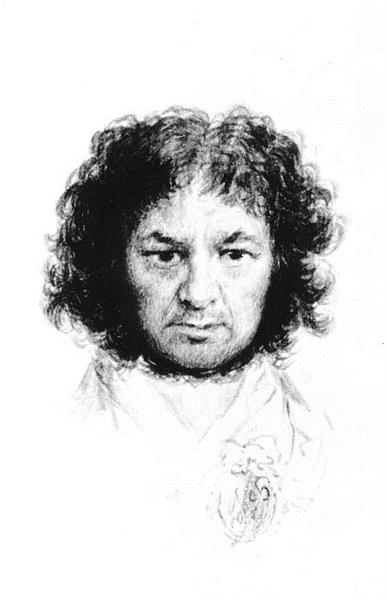
Francisco Goya's "self -portrait", created in 1795, is a deep testimony not only of the magnitude of the Spanish painter's talent, but also of an era of transformation and self -consciousness in the artistic field. Goya, an innovative whose production covers from neoclassicism to the dawn of romanticism, is positioned in this work as a critical observer of his own world, catching the viewer's gaze in an intimate and challenging representation.
The self -portrait shows Goya in an environment that fuses simply with majesty. The composition is well balanced, with the artist portrayed in the foreground, which highlights his presence. The way it appears, with a slightly inclined head and look directly directed towards the viewer, causes an immediate connection. The expression of his face, serene but with a subtle burden of introspection, offers us a glimpse of his psyche. Through this representation, Goya establishes a dialogue in which he invites observers to consider not only his figure, but also the context in which he is and the role of the artist in the society of his time.
The use of color in this work is particularly remarkable. Goya applies a palette that predominates in dark tones with warm nuances, which manifests itself in the almost monotonous background that surrounds the portrayed. This approach to tone reinforces the figure of the artist, who dresses with a black jacket that intensifies the contrast with his pale face and the brilliance of his hair. An atmosphere of solemnity is created, where Goya's poise is counteracted with the shadows that surround it, reflecting the social and political tensions of Spain in the late eighteenth century.
It is interesting to note that Goya used this self -portrait to show a significant change in the perception of art and art as a means of personal expression. Unlike other portraits of his time, where idealization and distance were common, Goya is presented here more humanly and vulnerablely. The choice to portray himself without ornaments or noble attributes highlights his desire to be perceived as an authentic reflection of himself and, in a broader sense, of the human condition.
In terms of style, this work is part of a transition to what will later be recognized as romanticism. Attention to subjective experience and individuality that emanates from self -portrait is a precursor of movements that will increasingly assess personal expression. Goya, throughout his career, would continue to explore complex emotions and his own conscience, as he would later in emblematic works such as "the disasters of war" or "the naked maja".
The relationship that Goya establishes between his figure and the spectator in this self -portrait is a milestone in the course of Western art, anticipating reflections that would develop in the coming centuries about the identity of the artist. This work is not a portrait, but a visual manifesto, a dialogue on the creation and loneliness inherent in the act of being an artist. Goya's story, in this self -portrait, becomes an invitation to explore the tension between a world that changes vertiginously and the incessant search for meaning in the existence itself.
KUADROS ©, a famous paint on your wall.
Hand-made oil painting reproductions, with the quality of professional artists and the distinctive seal of KUADROS ©.
Reproduction service paintings With a guarantee of satisfaction. If you are not completely satisfied with the replica of your painting, we refund your money 100%.