

Description
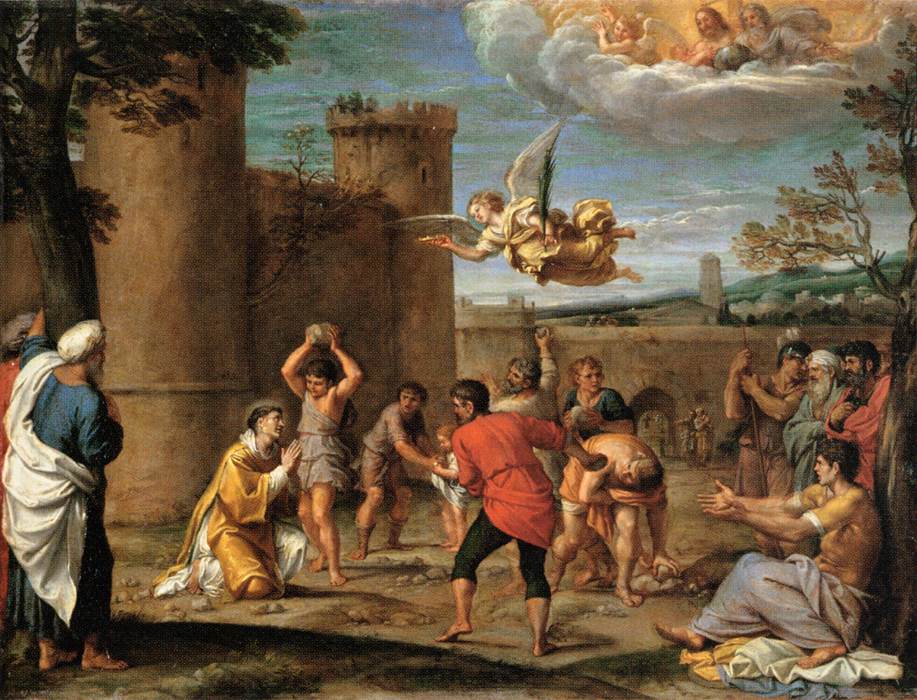
The painting depicts the martyrdom of Saint Stephen before a massive stone fortification. In the left foreground, a kneeling figure in a golden tunic clasps his hands and raises his gaze, while a crowd of figures swirls around him. Some figures raise their arms, others lean forward, and several kneel or recline, forming a chain of gestures across the lower part of the scene. Behind them rise a wall, a cylindrical tower in ochre tones, and a square, battlemented tower. Above the group on the ground, a winged figure dressed in gold crosses the sky in front of the central tower, while several figures gather among the clouds in the upper-right corner.
The scene depicts the biblical episode of the stoning of Saint Stephen, traditionally venerated as the first martyr of Christianity. According to the Acts of the Apostles, he was accused before the authorities in Jerusalem and stoned to death by his persecutors. The account also tells how, during his martyrdom, he saw the heavens opened and the Son of Man in the glory of God, and prayed for those who persecuted him. The painting thus brings together two inseparable dimensions: the collective violence unfolding on earth and the heavenly vision opening above it. The saint’s attitude of prayer concentrates the spiritual meaning of a scene dominated by turmoil.
The iconography is shaped by the contrast between Saint Stephen’s vulnerability and the physical pressure of the crowd. Raised hands, leaning torsos, and outstretched arms turn the stoning into a collective action, while the saint maintains a withdrawn posture and keeps his gaze fixed upward. The clouds and celestial figures extend his gaze, and the winged presence creates a visual bridge between the earthly realm and the divine manifestation. The fortification provides a material reference to the biblical setting: its walls weigh upon the scene, but the open sky introduces a dimension of revelation and hope.
The horizontal composition is densely populated and organized through rising diagonals. The foreground group forms a dynamic band of reds, whites, dark greens, ochres, and golds; their angular poses create an almost choreographic rhythm. In contrast, the celestial blue and pale masses of clouds lighten the upper section and draw the eye toward the vision. The central tower serves as an architectural axis, while the dark trees at either end frame the setting and enhance its depth. The alternation of overlapping figures, wall, distant landscape, and sky creates several planes of interpretation: first the physical drama, then the architecture, and finally the celestial expanse.
In Annibale Carracci’s work, this monumental, theatrical composition is associated with a Baroque vocabulary of expressive gestures, diagonal relationships, and a powerful integration of landscape and light. The scale of the crowd, the architecture, and the sky transforms an episode of martyrdom into a vision of spiritual ascension. Rather than being caught up in the violence surrounding him, Saint Stephen’s gaze extends along the diagonal formed by the winged figure and the clouds. This is where the key to the work lies: the earthly weight of the crowd and the fortification contrasts with a luminous upper zone that transforms suffering into a scene of revelation.
Have questions about our oil painting reproductions? See our frequently asked questions.