

Description
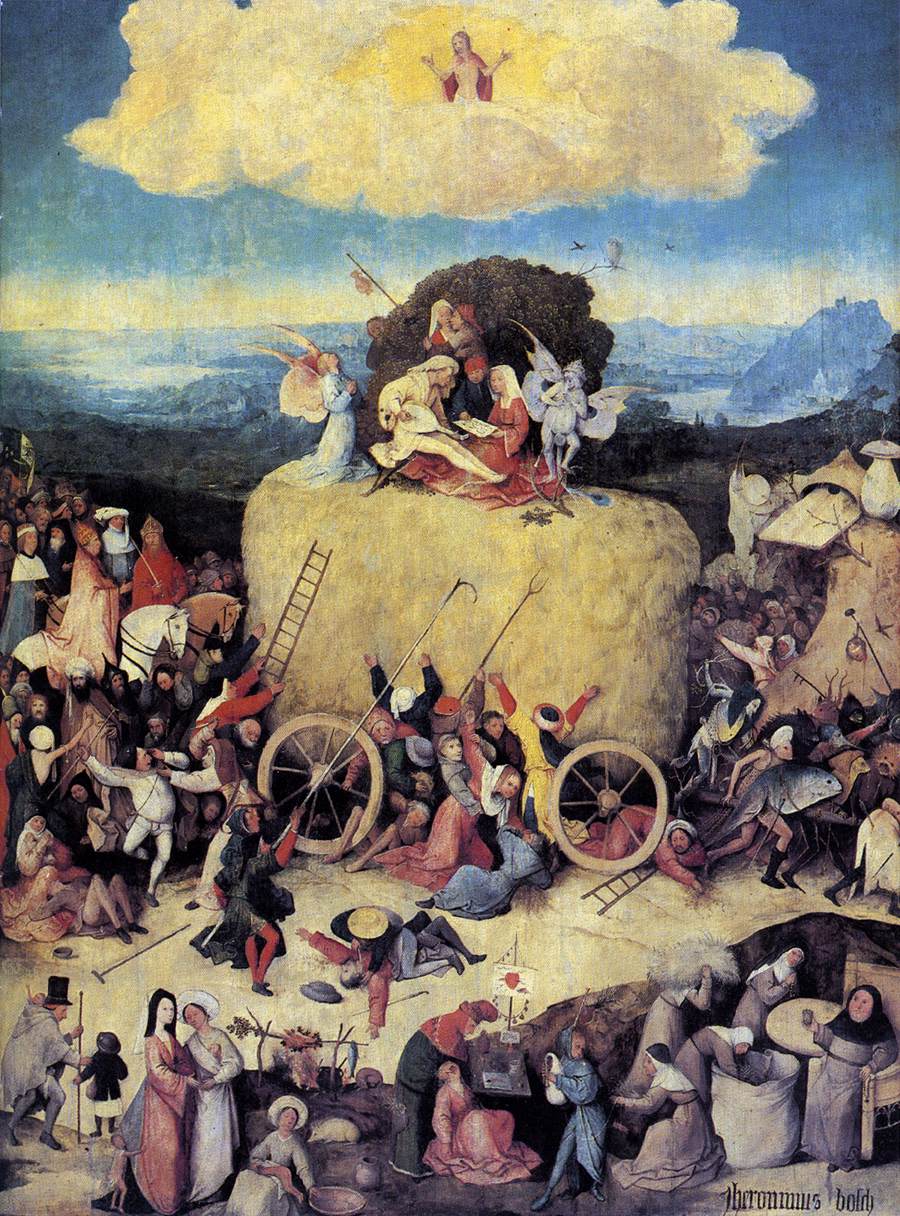
The painting shows the central panel of the Haywain Triptych as a crowded, turbulent vision of human life. At the center of the composition rises a large rocky formation, surrounded by the haywain, its large wheels, ladders, and numerous figures climbing, jostling, or trying to reach what draws everyone’s attention. On either side, people on foot and horseback advance among raised spears, clubs, swords, and tools. Some figures lie on the ground, while others sit or kneel beside scattered containers and objects. Above the tumult, Christ appears amid an expansive golden cloud, visually separated from earthly activity. The mountainous landscape, birds, and open sky expand the scene into a panoramic spectacle.
Hieronymus Bosch’s work develops a Christian moral allegory about the allure of worldly possessions. The hay represents what everyone longs to obtain, even though it is fleeting and has no lasting value: an image of vanity, ambition, and unrestrained desire. People of different social standings take part in the same dispute, so the crowd does not depict an individual episode but rather a shared human behavior. The figure of Christ, suspended in the upper area, offers a divine perspective on the turmoil that dominates the world below. The narrative meaning emerges from this contrast between spiritual guidance and the collective scramble around the haywain.
The secondary elements turn the allegory into a visual reading of human competition. The wheels organize the movement and make the cart the focal point; the ladders heighten the sense of effort and ascent, while the weapons and opposing bodies transform desire into conflict. The horses and riders add speed and hierarchy to the scene, but are absorbed into the same throng surrounding the figures on foot. The golden cloud and winged figures introduce a luminous, transcendent dimension, in contrast to the dark, earthy, dense tones of the foreground. The open landscape expands the moral scene and presents human disorder against a horizon encompassing all of society.
Formally, the composition is structured in 3 clearly articulated levels. The sky occupies the upper band, with a yellow light that first directs the eye toward Christ; it then descends to the group elevated on the rock and finally scatters among the crowd below. The large central mass acts as a vertical axis and divides the groups at the sides, while the diagonals of the ladders, spears, and bodies create an ascending, broken rhythm. The wheels provide solid circles within a surface filled with lines, gestures, and movement. Bosch combines the breadth of the landscape with meticulous attention to small actions, making each area contain new episodes of agitation, struggle, or abandonment.
This narrative density displays traits widely associated with Hieronymus Bosch: allegorical imagination, a profusion of figures and objects, meticulous observation of human behavior, and a contrast between luminous landscapes and scenes of moral turmoil. The panel functions as a panoramic theater of human greed, where celestial clarity does not dispel the tumult but makes it more visible. The eye descends from the figure of Christ to the wheels and bodies in the foreground, joining the transcendent with the everyday and turning the painting’s structure into a meditation on desire. Every gesture is part of a crowd caught up around a possession that everyone pursues and no one can keep.
Have questions about our oil painting reproductions? See our frequently asked questions.