

Description
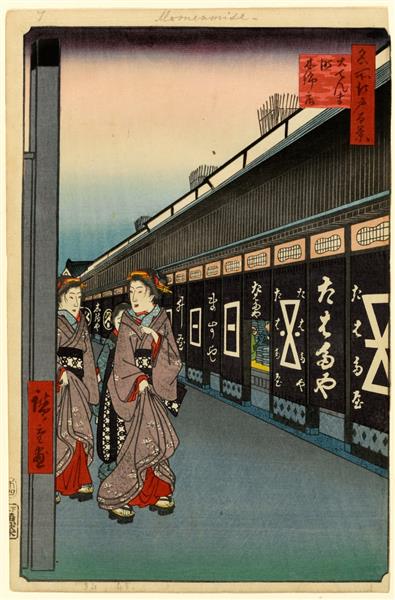
The work "Cotton Goods Shops in Ōdenma Chō" by Utagawa Hiroshige, created in 1857, is a remarkable example of ukiyo-e, a genre of woodblock prints that flourished in Japan during the Edo period. Hiroshige, one of the masters greatest of this art form, is known for his skillful use of color and attention to detail, constructing scenes that not only document the daily life of his time but also evoke the ephemeral beauty of nature and Japanese urban culture.
In this composition, Hiroshige depicts a vibrant urban landscape where cotton merchants are showcased in their natural environment. The first impression is the harmony of colors that dominate the painting, from the soft shades of cotton textiles to the darker tones of the architectural structure. The colors, carefully chosen and applied, reflect the lively atmosphere of trade and daily life in Ōdenma Chō.
The distinctive style of ukiyo-e manifests in the fluid lines and stylized forms that characterize both the buildings and the figures. Although the scene is centered on the shops, the human figures are an essential element that brings dynamism to the composition. While the figures are represented schematically, their inclusion in the context allows the viewer to imagine the human interactions and the bustling trade environment that once characterized this area.
A notable aspect is the representation of the products for sale. The rolls of cotton seem to come to life, with textures that invite touch. Hiroshige captures not only the shape of the rolls but also the light that plays over them, providing a visual depth that invites the viewer to explore every corner of the image. This detail is representative of Hiroshige's focus on daily life, showing an appreciation that goes beyond the merely functional; where art intersects with life.
The architecture surrounding the shops exhibits typical features of the era, with elevated roofs and wooden structures that evoke a sense of tradition. This architectural representation supports the cultural and temporal context of the scene, providing the viewer with a window into 19th-century Japanese aesthetics. Hiroshige not only captures a moment but situates it within a broader cultural framework, showcasing his expertise as a sharp observer of urban life.
The use of space in this work also deserves attention. Hiroshige skillfully employs depth of field, with foreground elements contrasting against a more muted background, suggesting a continuity that could extend beyond the frame of the painting. This technique generates a sense of immersion, as if the viewer could walk through the scene.
It is important to highlight that "Cotton Goods Shops in Ōdenma Chō" is not only representative of Hiroshige's work but also emphasizes the social and economic change in Japan during the Edo period. The commercialization of products, especially regarding fabrics and textiles, provided a new perspective on daily life and urban interaction that may have been little known outside this context.
In summary, Hiroshige's work is a celebration of everyday life, precisely framed in a rich cultural context. Every element of the painting, from the choice of color to the representation of characters and their surroundings, invites reflection both on the history of Japan and on the artistic skill of one of its greatest masters. "Cotton Goods Stores in Ōdenma Chō" captures a fragment of a world in transformation and, through its beauty and detail, connects us with a past that still resonates in the present.
KUADROS ©, a famous painting on your wall.
Hand-made oil painting reproductions, with the quality of professional artists and the distinctive seal of KUADROS ©.
Reproduction service of paintings with a satisfaction guarantee. If you are not completely satisfied with the replica of your painting, we will refund 100% of your money.