

Description
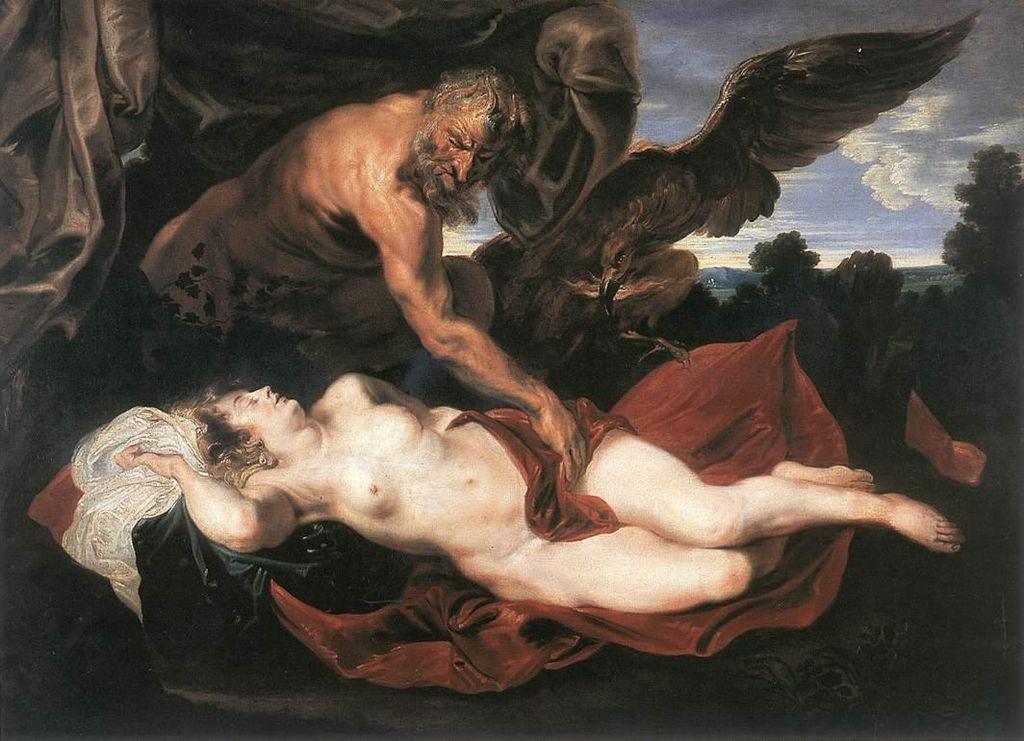
The painting depicts Jupiter and Antiope in an encounter of intense physical charge, set in an open, dramatic landscape. In the foreground, Antiope lies nude on a jumble of red, dark and light fabrics, her body stretched out horizontally with her head tilted to the left. Leaning over her is a muscular, bearded male figure, also nude, whose torso creates a diagonal from the upper left toward the center of the composition. Behind them, a large dark-feathered bird spreads its wings and occupies much of the sky. Trees, rocks and a green horizon place the scene in a natural setting, while bluish-gray clouds intensify its theatrical tone.
The episode belongs to the mythological cycle of Zeus and Antiope. Jupiter is the Roman name of Zeus, the principal male deity of the Greco‑Roman world; Antiope, in turn, is associated with Zeus and the genealogy of the twins Amphion and Zethus. According to tradition, Zeus approached Antiope while taking the form of a satyr, a narrative that frames the encounter in a seductive and transgressive register. The painting concentrates that story in the proximity of the bodies and in an outdoor scene where the divine presence is announced both by the male figure and by the spread bird.
The eagle functions as the most immediate iconographic sign of Jupiter: its outstretched wings amplify the authority of the male figure and carry the episode’s tension toward the sky. The closeness of the two bodies turns the bending gesture into an image of amorous approach, although the disparity in scale and the man’s dominant posture also introduce a relation of power. The deep red of the cloths brings sensuality and chromatic violence; together with the black and brown folds, it wraps Antiope in an intense visual field. The landscape is not a mere backdrop: its rocks, shadows and clouds extend the conflict between desire, nature and divine force.
The composition combines a horizontal band formed by Antiope’s reclining body with two rising diagonals: the male torso and the bird’s wings. This crossing of directions keeps the eye moving and links the foreground to the sky. Light concentrates on the skin, causing the bodies to stand out against the dark draperies and shadowed landscape. The modeling of the anatomies creates sculptural volumes, while the fabrics introduce broken rhythms of folds, edges and color patches. Depth is achieved through the succession of figures, vegetation, rocks and horizon, but the contrast of light keeps the drama focused on the central encounter.
In relation to Sir Anthony van Dyck, the work can be placed within a Flemish Baroque sensibility marked by elegant, sculptural figures, dynamic compositions, rich color and theatrical lighting. Here that tradition stages the mythological episode through a blend of sensuality and gravity: luminous flesh draws the gaze, the red draperies intensify it, and the eagle adds a dimension of celestial authority. The man’s diagonal and the bird’s expanded wings respond to Antiope’s extended stillness; in that contrast the painting turns a lover’s scene into an image of desire, power and Baroque drama.
Do you have questions about our handmade oil-painting reproductions? See our frequently asked questions.