



Description
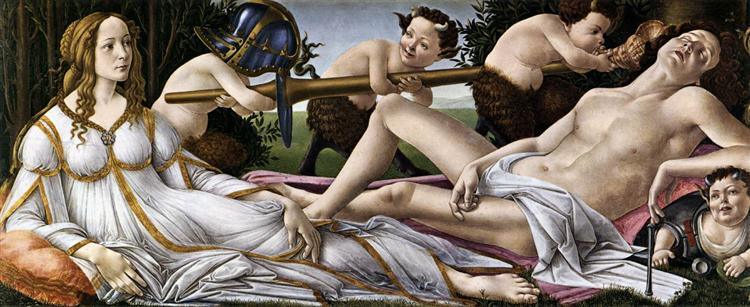
In Sandro Botticelli’s Venus and Mars, the artist depicts a scene from Greco-Roman mythology showing the god of war, Mars, beside the goddess of love, Venus, in a rather compromising position.
After making passionate love, Mars lies before Venus, asleep, snoring, almost naked and exhausted from sex. Venus, on the other hand, remains calm and serene, fully dressed, the very image of perfection. The goddess’s hair seems to be woven into the fabric of her dress.
By portraying the gods as such, Botticelli empowers the female body, since she has “conquered” Mars. In this way, the painting becomes an allegory of the idea that love conquers war.
Commissioned by the Vespucci family in Florence in the late 15th century, this painting originally served as a wedding gift for a bride. This type of painting was usually hung in a multipurpose room called a chamber. People would take their guests to the chamber to show off their prized possessions, including works of art like this one, family portraits and similar treasures. In addition, when a man and his wife were trying to conceive a child, they would do so in front of the painting. They believed that when a woman looked at a handsome man before having sex, her chances of conceiving a boy increased, hence the immaculate masculine form of Mars surrounded by little baby cupids.
In this painting, Botticelli depicts the putti as satyrs, who in Greco-Roman mythology are drunken, perpetually aroused creatures that are half man and half goat and spend all their time carousing. The word “satyr,” meaning a lascivious, lustful person, derives from this mythological creature. In classical art, satyrs are typically depicted with human bodies, goat legs, a tail, ears and a massive, raging erection. The technical term for these half-man, half-goat erections is “ithyphallic.” This vocabulary word is not relevant to understanding this painting, but it is interesting that a technical term exists for satyrs’ erections. Botticelli’s clever depiction of putti as satyrs combines the representation of love (cupids) with sex and fertility (satyrs). Although the artist depicts the satyrs in Venus and Mars as babies rather than adult men with exaggerated erect penises, the historical and mythological context of these creatures relates directly to the purpose of this commission as a wedding gift for a newly married couple.
Some art historians believe that the wasps near Mars’s ear are a reference to the sting of love, while others insist that they refer to the Vespucci family, since the Italian word for wasp is vespe. Another amusing detail is the satyr peering at the viewer through Mars’s armor, ready to wake him from his deep sleep. With its wealth of rich imagery, Botticelli’s painting captures a joy and humor that viewers would have appreciated in the work’s original context and that are still enjoyed and celebrated today.
In Venus and Mars, Venus gazes into the distance at Mars. His muscular body is as limp as his drooping finger, his head tilted back as he sleeps. Venus emerges victorious from this sexual encounter, while Mars is completely lost in sleep.
Venus was married to the god Vulcan, an unattractive blacksmith. When he discovered that Venus had been unfaithful to him, he made a fine net of chains to catch her in the act. The net was so delicate that the two beautiful gods did not realize they had been caught until it was too late. Vulcan invited all the gods of Mount Olympus to come and laugh at the trapped lovers.
Botticelli has treated the story with a sense of humor, including many playful details intended to amuse his patron. Mars is so deeply asleep that he does not notice a satyr has stolen his spear and helmet. Another has crawled into the cuirass (body armor) beneath his elbow. The sound of the conch shell does not wake him, even as one of the mischievous creatures blows it into his ear. The noise and commotion have disturbed a wasps’ nest, and a swarm of fat insects buzzes around his head while Mars continues to sleep despite all the activity around him. The shell was a symbol of Venus, who was born from the sea, almost visible in the distance.
Botticelli’s association with Lorenzo de’ Medici, known as Lorenzo the Magnificent, meant that the painter was in contact with all the contemporary scholars and poets who came and went at court. Lorenzo de’ Medici was a devotee of classical culture and surrounded himself with people who were deeply knowledgeable about these subjects.
It may not be surprising, then, that an ancient account corresponds to the images of the playful satyrs in this painting. It is the Roman writer Lucian’s description of a painting depicting the marriage of Alexander the Great and Roxana. In that image, little cupids play with the armor of the warrior Alexander: two lift his spear, while another crawls into his breastplate. Botticelli has turned the cupids into satyrs, which may indicate his knowledge of a poem by the scholar and poet Angelo Poliziano, who tutored the Medici children. Poliziano’s poem, written around the same time as this painting was made, mentions “little goat-legged satyrs.” They were companions to a sleeping shepherd who inhabited a dreamlike realm of love and pleasure. Perhaps Botticelli was inspired by this poem, which he may well have known. This possible combination of sources of inspiration reflects the artist’s extensive knowledge of both ancient and contemporary culture.
Botticelli also demonstrates his knowledge of ancient sculpture, which was so fashionable in Florence at the time. Mars’s left foot is caught in the pink fabric. This unusual detail may be a deliberate reference to a well-known and admired ancient sculpture, the Sleeping Hermaphroditus.
The painting also shows the braids in Venus’s hair joined to her dress, forming a border fastened with a jewel, which makes her dress impossible to remove. Perhaps Botticelli intended to emphasize the goddess’s chastity, despite her infidelity. Her blond hair, pale skin, and red lips allude to the contemporary ideal of feminine beauty depicted in poetry. Here, Venus looks more like a contemporary Florentine beauty, or perhaps even an image of the Virgin Mary, than a classical sculpture, and quite unlike the nude goddess Botticelli painted in his painting The Birth of Venus.