

Description
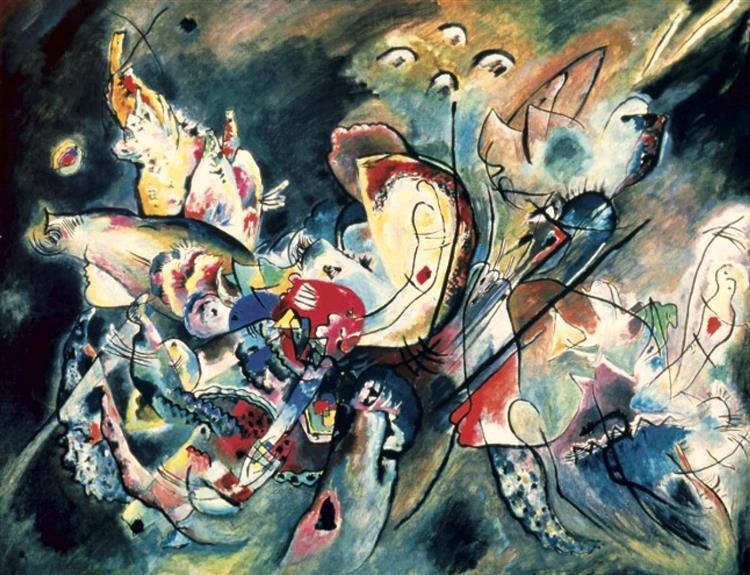
The painting presents a highly intense biomorphic abstract composition, with organic and angular forms overlapping across almost the entire surface. A large vertical element in cream and yellow tones dominates the center, defined by a dark outline, red patches, and an interior curved line. Around it unfold elongated, pointed, and undulating forms, some suggestive of aquatic organisms, alongside a compact red and blue form in the center-left. In the upper right, a light-colored angular structure incorporates black lines and a bluish core; above it, small circular clusters introduce pauses within the dense network. There is no conventional narrative scene, but rather a visual field of ambiguous presences that intersect, hide, and reappear.
The Troubled functions as an abstract expression of tension and inner conflict. The title does not refer to an identifiable character, but to an emotional condition that extends across the entire pictorial surface. Wassily Kandinsky’s abstract approach is relevant to understanding this construction: color, line, and form take on expressive autonomy and organize the experience without relying on literal representation. The whole evokes an organic world in transformation, where each form participates in an overall dynamic of pressure, resistance, and movement.
The network of curved black lines, spirals, and diagonals creates a structure of tension that connects the different elements. These lines do more than outline the forms: they pass through them, divide them, and bring them into relation, as if the entire field were subject to an internal current. The elongated biomorphic silhouettes sustain a mutable universe, open to animal or organic associations without settling on any particular species. The contrast between the large, light focal point at the center and the surrounding dark areas establishes an opposition between clarity and pressure, expansion and confinement. The reds and yellows heighten the sense of alarm and vitality, while the deep blues and greens lend density and gravity.
Formally, the work is organized as a dense, dynamic horizontal composition. The eye enters through the light central element, but is soon diverted by diagonals, curves, and overlaps toward the sides and the lower band. The jagged forms in the lower area, the figures extended diagonally, and the scattered circular marks keep the visual journey in motion. The palette combines petrol blue, dark green, white, cream, ochre yellow, red, pink, and black in strong contrasts, so that each area vibrates against the one beside it. The linear drawing brings precision to a restless surface, while the patches of color retain a tactile, corporeal presence.
The work thus belongs to the abstract strand of Wassily Kandinsky’s art, recognizable by the expressive interplay of color, line, geometry, and biomorphic motifs. Its energy comes not from a depicted story, but from the way the elements confront and connect with one another across the picture plane. When viewing it, it is helpful to first follow the large, light-colored form at the center, then observe how the black lines connect it to the red, blue, and green figures around it. This journey reveals that the turmoil in the title is not contained in a single figure: it takes shape in the composition as a whole, through the accumulation of forms, the tension of the directions, and the sustained clash between light, color, and darkness.
Have questions about our oil painting reproductions? See our frequently asked questions.