

Description
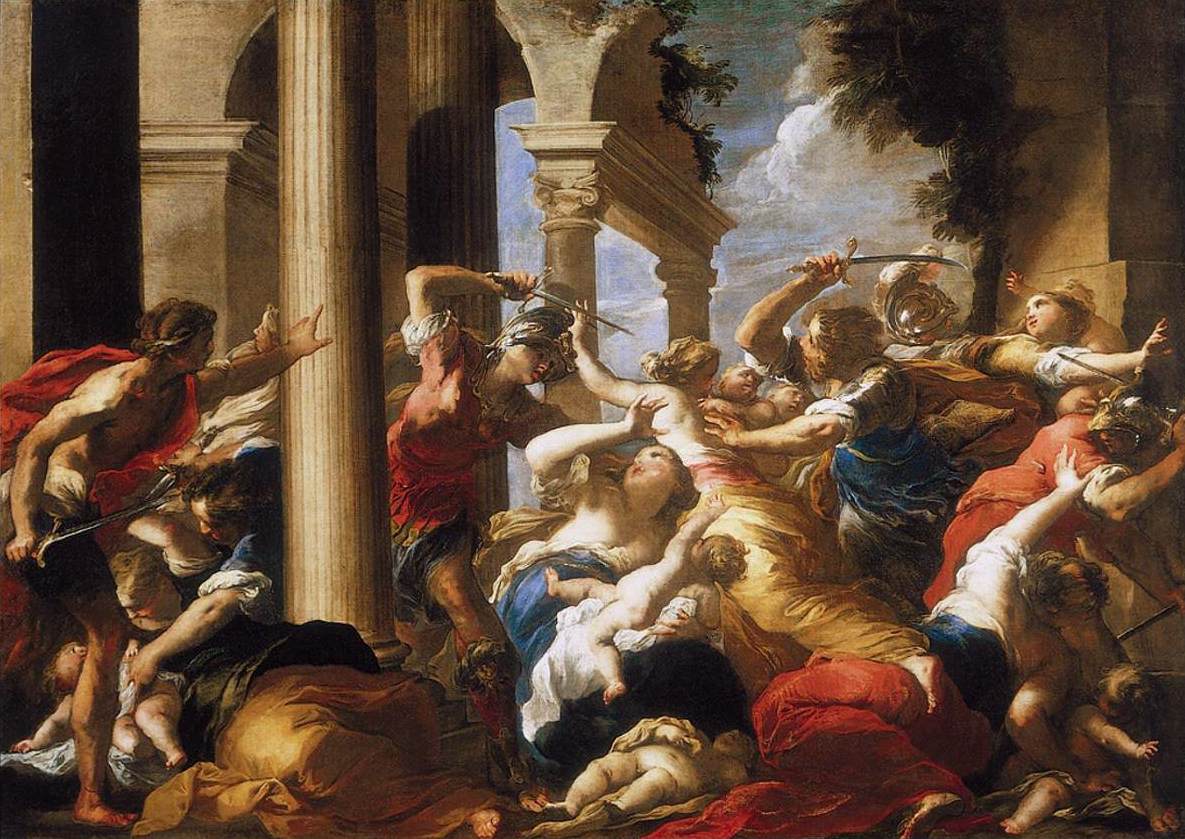
The painting depicts The Massacre of the Innocents as a whirlwind of bodies, weapons and billowing drapery among monumental columns. A crowd of adults and children presses into the space: some bend down to protect or support the little ones, while others raise their arms in gestures of supplication, defense or despair. Several swords cut across the composition in tense diagonals, and a circular shield appears behind the central group. In the foreground, fallen bodies, dark fabrics and robes in red, white, blue and gold gather together. The architectural setting, formed by fluted columns, arches and classical ruins, opens the scene onto a grayish-blue sky heavy with clouds.
The episode belongs to the Christian account of Jesus’ childhood and is narrated primarily in the Gospel of Matthew. According to the biblical account, Herod ordered the killing of the young children in Bethlehem for fear of the birth of a rival who was considered the future King of the Jews. Christian tradition places the Holy Family’s flight to Egypt before the massacre. The painting focuses the story on the violence suffered by the civilian population: armed figures burst in among adults, children and fallen bodies, turning the event into a collective tragedy. This is not a silent or contemplative scene, but a moment of crisis in which each gesture seems to prolong the turmoil of the one before it.
The iconography relies on direct contrasts. The swords and shield signal the presence of an armed force, while the outstretched arms of the adult figures convey a human response of resistance, supplication, and protection. The children, interspersed among the bodies and cloaks, embody the vulnerability associated with the Massacre of the Innocents. The classical architecture extends the tragedy’s public reach: the columns and arches turn the drama into a monumental, almost theatrical event, with the violence unfolding against an open horizon. The sky and vegetation glimpsed among the ruins do not ease the tension; they serve as a vast backdrop against which the suffering takes on greater scale.
The horizontal composition is traversed by an ascending diagonal that leads the eye from the bodies at the lower left edge to the raised weapons in the upper right. The columns establish firm vertical axes that contrast with the instability of the bodies, cloaks, and arms. Light is concentrated on the central group, highlighting the pale fabrics and flesh tones against the shadowy edges. The intense reds serve as visual accents and engage with the architecture’s golden ochres, while the sky’s grayish blues create depth behind the mass of people. The rhythm arises from the repetition of diagonals, folds, and expansive gestures, keeping the scene in motion even where motionless bodies appear.
In Valerio Castello, this sensibility is compatible with a highly dramatic Genoese Baroque vision: dynamic composition, intense contrasts of light, and a palette capable of turning color into a narrative force. The painting does not separate its religious subject from its visual construction; the figures’ despair becomes visible through the interweaving of diagonals, shadows, fabrics, and architecture. It is worth observing how the illuminated central group first draws the eye, and how the arms, weapons, and fallen bodies then lead it toward the edges. In this progression, the work transforms a biblical episode into an experience of collective violence, in which the monumentality of the setting intensifies the fragility of those who inhabit it.
Have questions about our oil painting reproductions? See our frequently asked questions.