

Description
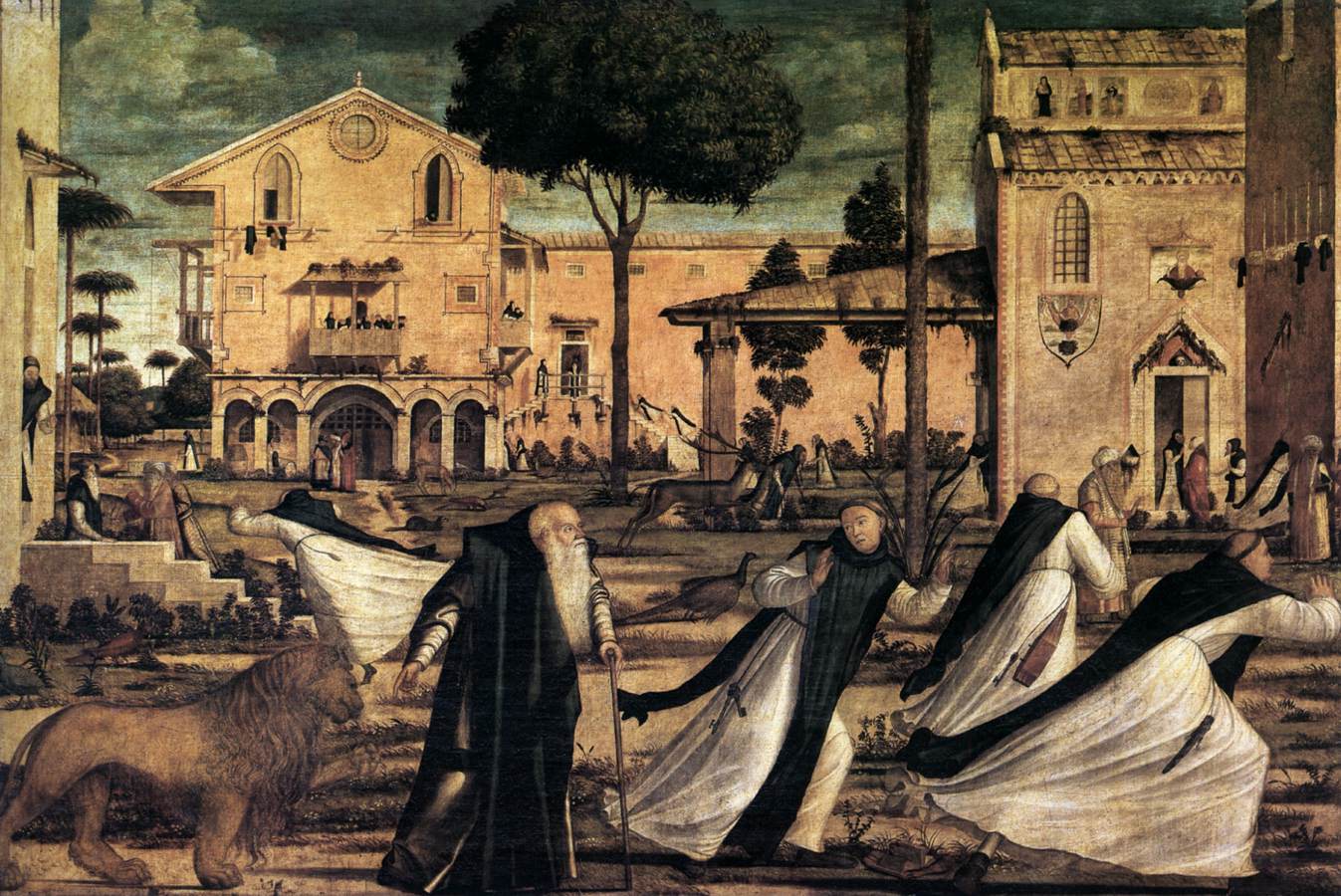
The painting shows Saint Jerome and the lion inside a monastic enclosure conceived as a small urban world. In the foreground, the saint appears as a bearded old man, dressed in a dark robe and leaning on a long staff. Several figures in habits and cloaks gather around him; some are bent over, kneeling, or lying down, while others stand in the courtyard. The lion is part of this religious setting, alongside other animals and secondary figures. Two large stone buildings frame the scene: on the left, a triangular façade with an oculus, pointed windows, and an arcaded gallery; on the right, a taller structure marked by a large vertical window, a coat of arms, and a monumental entrance.
The episode belongs to the hagiographic tradition of Saint Jerome, a saint associated with penance, the life of a hermit, and the study of Scripture. According to the traditional account, a wounded lion approached the saint and, after being healed, remained by his side as a companion. The painting expands this legendary encounter into a scene featuring a group of people: the protagonist does not appear alone in a desert but is integrated into a religious community of courtyards, galleries, walkways, and convent buildings. This choice connects the hermit's figure with a collective dimension, in which spiritual discipline unfolds amid inhabited architecture.
The iconography of Saint Jerome centers on the elderly figure, his beard, dark habit, and staff, attributes that evoke experience, austerity, and retreat. The lion introduces an image of reconciliation between the ascetic life and nature. The inclined and kneeling poses in the foreground reinforce the devotional character of the scene, while the groups distributed across balconies, entrances, and walkways extend the narrative beyond its protagonists. The courtyard thus serves as a space of transition between contemplation and activity, between the saint’s severity and the community’s daily life.
The horizontal composition is organized in successive planes. The buildings on either side act as architectural wings, directing the eye toward the center, where the large tree establishes a vertical axis above the courtyard. The diagonal formed by Saint Jerome, the nearby figures, and the group kneeling on the right introduces movement into a stable structure. Ochres, browns, dark greens, blacks, and creamy whites unify the scene beneath subdued light; the gray-blue sky and earthy ground heighten its sober character. The meticulous rendering of arches, stairways, rooftops, and balconies creates depth and turns every corner into a potential episode of monastic life.
In Vittore Carpaccio’s work, pictorial storytelling often relies on architecture, urban spaces, and the presence of numerous secondary figures. Here, this narrative approach transforms a religious legend into a vast, almost theatrical setting in which the saint, the animal, the buildings, and the community all contribute to the same visual construction. The viewer’s attention shifts from the staff and figure of Saint Jerome to the arcades, walkways, and groups in the background, which expand the scale of the episode. The work derives its strength from combining the intimacy of the encounter between the saint and the lion with the complexity of an entire monastic world.
Have questions about our oil painting reproductions? See our frequently asked questions.