

Description
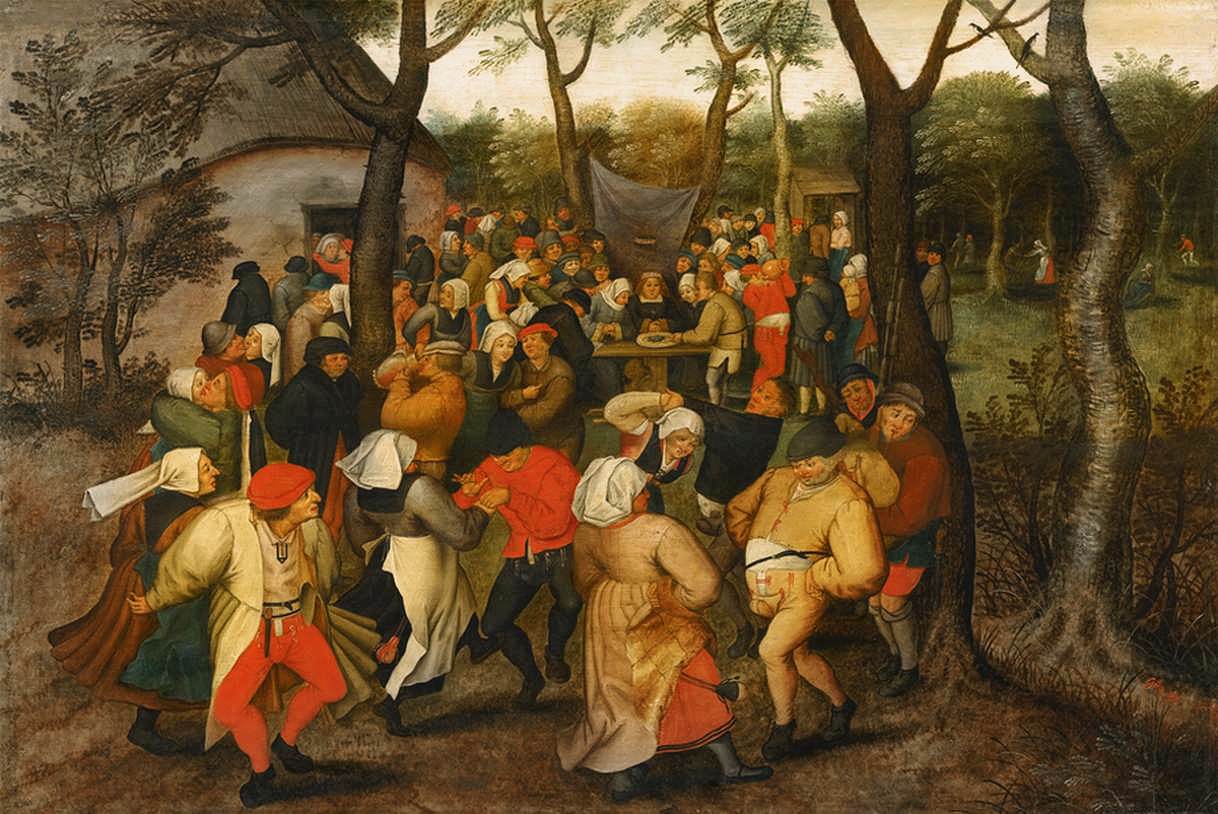
The painting shows a peasant wedding dance taking place in a forest clearing beside a rural dwelling and several open-sided structures. A crowd of villagers fills almost the entire space: in the foreground, figures move forward, bow, talk and dance, wearing brightly colored dresses, aprons, caps, cloaks and hats. The tables in the center hold vessels, food and utensils, while other people carry sacks, cloths or objects for the celebration. The scene extends into the background among tree trunks, vegetation and simple buildings, making the gathering seem to continue beyond the main group.
The title frames this lively gathering as a rural wedding celebration. Rather than depicting a single ceremonial moment, the work presents the communal dimension of the festivities: some participants dance, others prepare food, a few watch, and several move between the tables and the dwelling. The wedding thus provides a narrative framework for a broad view of village life, in which the collective event matters as much as any individual protagonist. The range of apparent ages, poses and tasks turns the forest clearing into a lively social setting full of interaction.
Everyday objects take on significance because they connect the celebration with work and communal life. The tables, vessels and bundles being carried introduce a practical dimension into the festive atmosphere, while the distinct clothing lends rhythm and character to each group. The house and the small stall in the background root the gathering in an inhabited setting, rather than an idealized space. The forest, with its upright tree trunks and dense undergrowth, acts as a protective frame that focuses attention on the community. With the dancing spread among several figures rather than reserved for a single couple, the celebration becomes a shared experience.
Formally, the horizontal composition is built from a dense network of bodies, diagonals, and vertical lines. The large tree trunks divide the field of view into sections, while also guiding the eye toward the center, where the tables and the most animated gestures are grouped. The band of figures in the foreground moves from the lower-left corner toward the right, creating a continuous sense of movement, reinforced by tilted arms, billowing skirts, and bodies in motion. Dark green, brown, and ochre tones integrate the figures into the landscape, while the reds, whites, and beiges of their clothing create visual accents that bring faces, gestures, and points of activity into focus.
The work is consistent with Pieter Brueghel the Younger's widely recognized interest in village festivals, peasant gatherings, and crowded compositions. Rather than concentrating the narrative on a central figure, he arranges numerous minor episodes within a single rural setting, where every pose contributes to the overall movement. The result invites viewers to take in the painting slowly: first the energy of the dance emerges, then the activity around the tables, and finally the expanse of the community among the trees, house, and stalls. This combination of social observation, earthy color, and the rhythm of a crowd makes the celebration feel like a complete human landscape.
Have questions about our oil painting reproductions? See our frequently asked questions.