

Description
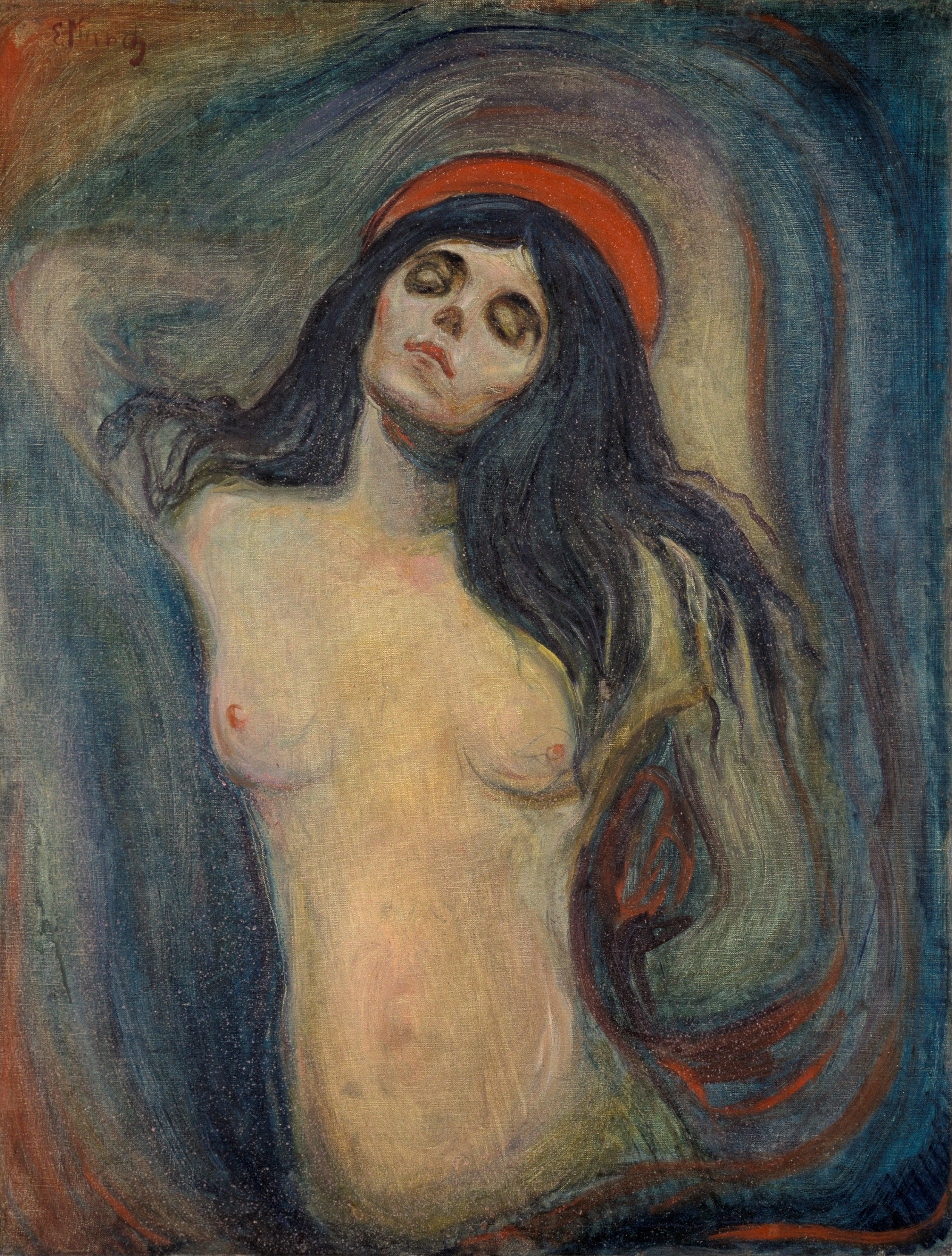
The painting shows a frontal Madonna, depicted from the head to the lower torso, with an intimate and absorbing presence. The female figure tilts her face slightly, while her long, dark, undulating hair spreads around her head and falls over her shoulders, blending into the surrounding space. Her nude torso occupies the center of the composition; the shoulders, chest and abdomen are modeled with a clarity that contrasts with the abstract background. Behind her head, a reddish circular shape opens up, resembling a halo, though it is treated as part of the painting’s color language. There is no narrative setting or secondary objects to distract the viewer: everything leads to the face, the body and the figure’s silent intensity.
Madonna is a traditional name for the Virgin Mary in Christian art and devotion. In Christian iconography, Mary holds a central place as the mother of Jesus Christ and as a figure associated with sacred motherhood, compassion and spiritual intercession. Here, Edvard Munch transforms this familiar framework into a modern, sensual and psychologically intense image. The absence of the Child and other narrative attributes shifts the focus from a specific biblical scene to the physical presence of a woman turned into a symbol. The religious reference remains, but is infused with a more personal, unsettling and earthly sensibility.
The red arch behind the head retains the visual resonance of a halo, but its fiery color and integration with the background brushstrokes make the boundary between the sacred and the emotional ambiguous. The frontal nudity reinforces a bodily and vulnerable reading of the Madonna, far removed from the idealized distance of a conventional devotional image. Her hair, spread out like an enveloping web, seems to protect and imprison her at the same time: it surrounds the figure, separates her from the outside world, and focuses the viewer’s gaze on her face. The dark, undulating bands in the background turn the space into an extension of the scene’s inner state, closer to a psychic realm than to a recognizable place.
The vertical composition is organized around a strong central axis, dominated by the face and torso. Against this stability, the hair and the curved forms in the background introduce continuous movement that prevents the figure from becoming completely still. The skin, in warm flesh and beige tones, stands out against a palette of dark blue, grayish green, brown, and orangey red. This contrast directs attention to the body and makes the arch behind it function as a secondary chromatic focal point. The sinuous brushstrokes create depth without resorting to descriptive perspective; layers of color surround the figure and create a sense of absorption, as if she were emerging from a space in transformation.
The work is consistent with Edvard Munch’s Symbolist and expressive style: figures charged with psychological intensity, undulating contours and brushstrokes, emotional color, and compositions conceived to convey inner states rather than provide a naturalistic description. In this Madonna, the religious element does not disappear; instead, it becomes physical, vulnerable, and disturbingly intimate. It is worth observing how the inclined face, the nude figure, the flowing hair, and the red form support one another: each element alters the meaning of the others. The figure can be read at once as a sacred presence, a sensual woman, and a concentrated emotional state—and it is precisely this tension that allows the painting to retain its power after the first glance.
Have questions about our oil painting reproductions? See our frequently asked questions.