
Description
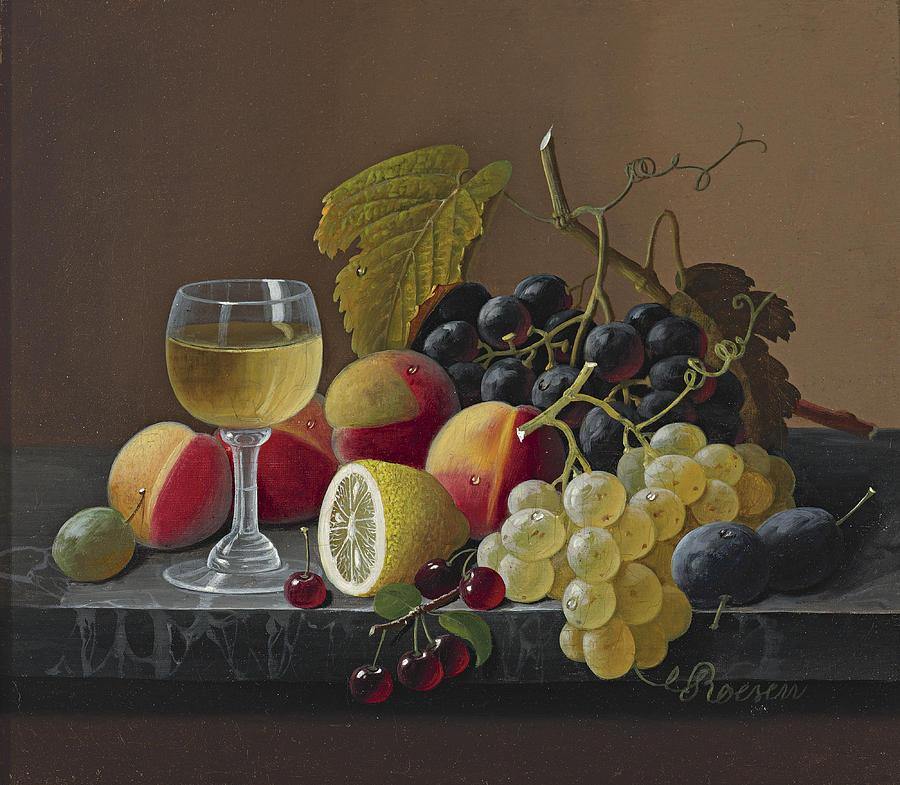
The painting depicts a still life of fruit with a lemon, grapes, and a glass of wine arranged on a dark surface. On the left, the glass contains pale yellow wine and creates a vertical counterpoint to the accumulation of fruit. The center and right side bring together clusters of dark and light grapes, round red and yellow fruits, cherries with slender stems, and two elongated fruits of a deep hue. In the foreground, a cut lemon reveals its radial pulp, while vine leaves and tendrils rise behind the arrangement. The scene is contained by a uniform brown background and a shelf with a shadowed edge.
As a genre, the still life arranges food, vessels, and elements of nature to make them objects of visual contemplation. Here, the abundance of fruit and the presence of the vine place the scene within a tradition associated with the harvest, material wealth, and sensory pleasure. The glass introduces a note of conviviality and enjoyment, although the work tells no specific story: its appeal lies in the concentrated presentation of objects and textures. At the same time, the ripe fruit and cut citrus evoke a quality characteristic of such motifs: their splendor is intense, yet bound to the transience of perishable things.
The grapes, tendrils, and leaves visually connect each fruit to its botanical origin and reinforce the idea of natural fullness. Their proximity to the wineglass evokes associations of harvest, celebration, and abundance within the still-life tradition. The cut lemon serves a particularly powerful purpose: its yellow peel protects a luminous, moist flesh that reveals the fruit’s internal structure. The cherries gathered along the lower edge add an intimate, tactile scale, while the accumulation of fruit creates an impression of sensory abundance. Rather than imposing a single allegory, these elements allow material richness and transience to coexist in the same scene.
The horizontal composition is structured through a gradual concentration of forms. The glass balances the relative emptiness on the left, while the visual weight increases toward the center and right, where the bunches form a mass of overlapping shapes. The cut lemon acts as a luminous focal point in the foreground; its yellows engage with the nearby fruit and contrast with the purples, blues, and blacks of the grapes. The directed lighting makes the glass gleam, defines the fruit skins, and separates the leaves from the brown background. The upward lines of the stem and tendrils introduce movement into an essentially still scene, while the dark edge of the shelf provides stability and depth.
This work by Severin Roesen displays features widely associated with his still lifes: dense arrangements of fruit, rich color, and meticulous attention to the variety of surfaces, highlights, and natural forms. The abundance does more than fill the space; it creates a true visual architecture in which every cluster of grapes, leaf, and fruit contributes to the overall balance. Notice how the goblet, the cut lemon, and the foliage guide the eye through the composition: the sensory pleasure arises precisely from this relationship between order and excess, between the tangible freshness of the fruit and the quiet awareness of its limited lifespan.
Have questions about our oil painting reproductions? See our frequently asked questions.