

Description
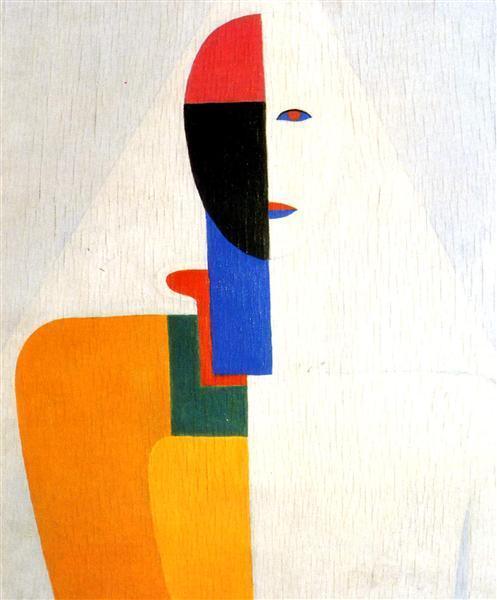
The painting presents a female torso reduced to a vertical construction of geometric planes. The figure occupies the central area, slightly shifted to the right, and is organized by a curved-edged red segment, a large black block, an elongated blue plane and small red and blue accents that evoke facial features. In the lower left are clustered an orange mass, a yellow shape and a dark green block, as if the body continued into a set of independent chromatic pieces. All of this is arranged on a broad, quiet ivory field with a linear texture that allows the silhouette to breathe and reinforces its isolated presence.
The title places the work in the realm of female representation, although the anatomy has been deliberately reduced to essential signs. There is no specific narrative, religious or historical scene here: the interest focuses on transforming bodily presence into an abstract structure. The woman is not depicted through naturalistic volume, detailed posture or individualized features, but through a fragmented silhouette that barely preserves the suggestion of a torso and a face. This tension between recognition and simplification makes the work a visual reflection on how far a figure can be reduced without completely losing its identity.
The small red and blue forms placed at the right act as accents that evoke an eye and a mouth, giving the composition a concentrated facial dimension. Rather than developing a complete anatomy, these signs organize the reading of the whole and direct the gaze toward the central figure. The blocks of color turn the suggested body into an autonomous construction based on contrasts of weight, rhythm and balance. The ivory background, with its vertical grain, functions as a space of isolation: it separates each plane from the surrounding masses and grants the figure an almost emblematic character, between human presence and abstract design.
Formally, the painting rests on a very calculated asymmetry. The central, narrow, vertical shape establishes the principal axis, while the orange, yellow and green masses in the lower-left area introduce a lateral expansion that prevents rigidity. The upper red first draws attention; then the black concentrates visual weight and leads the eye toward the lower blue. The curves soften the geometry of the rectangles and allow the figure to retain an organic quality within a structure based on planes. The broad ivory void heightens the chromatic contrast and makes each color seem to occupy a precise place, as part of a balanced visual assembly.
In this work by Kazimir Malevich, the sensibility associated with geometric abstraction and Suprematism is applied to an anthropomorphic figure that remains recognizably human. The reduction to elementary shapes, colour planes and essential spatial relationships does not entirely erase the body: it turns it into a system of signs that the viewer reassembles while surveying the surface. The interest of Female Torso lies precisely in that oscillation between face, bust and abstract structure. Note how a small lateral accent can trigger a facial reading, while the red, black, blue and lower masses keep the figure suspended between representation and the pure organisation of colour.
Do you have questions about our handmade oil-painting reproductions? See our frequently asked questions.