

Description
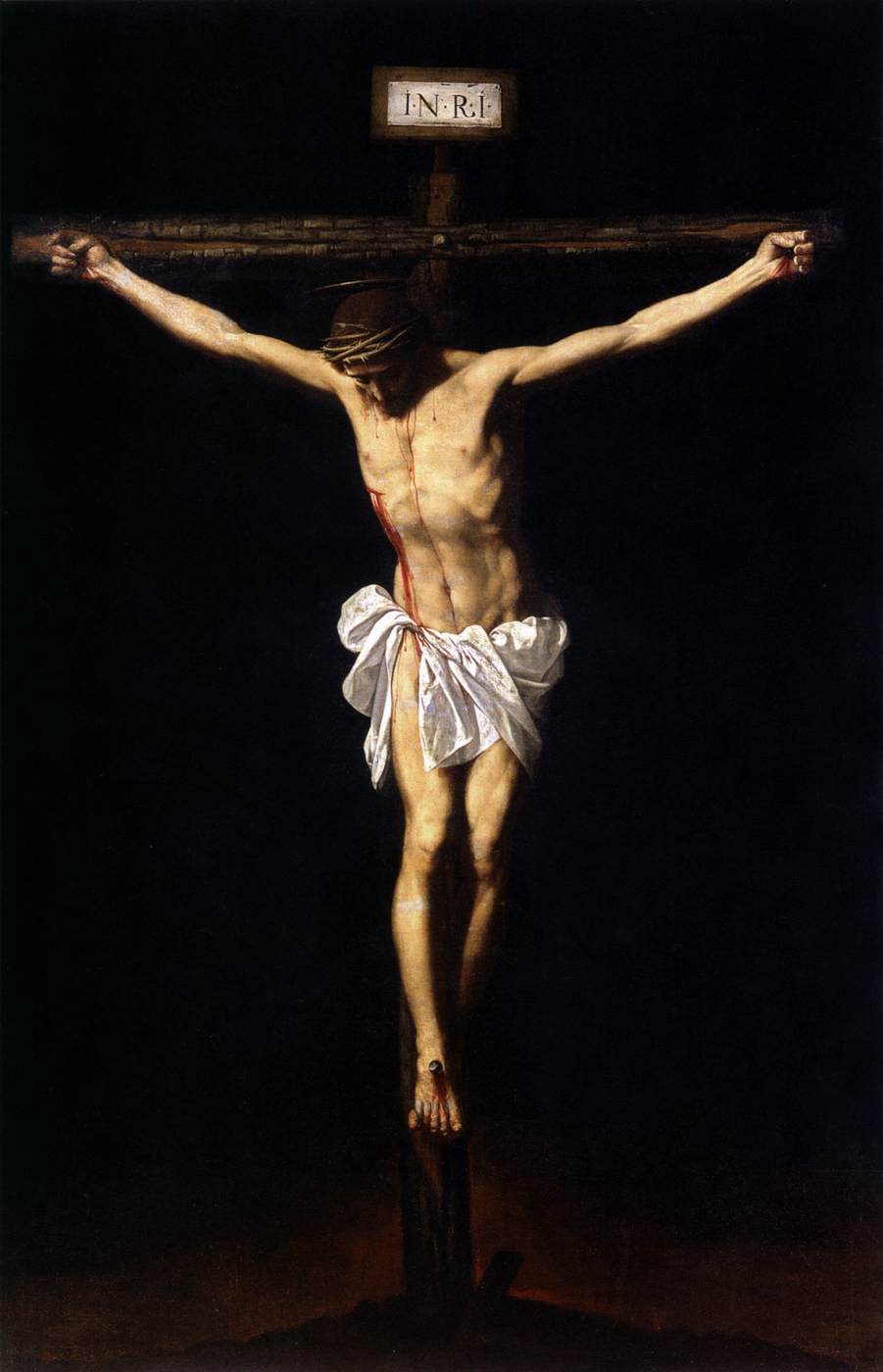
The painting shows Christ crucified at the center of a vertical, frontal composition of great dramatic intensity. His full-length body is fixed to a dark wooden cross whose arms extend horizontally across the upper part of the composition. His head bowed toward his chest, the crown of thorns, and the white cloth gathered in folds around his waist clearly define the figure. Wounds and reddish marks run across his torso, side, and limbs, while a plaque bearing the inscription «INRI» tops the crossbeam. Everything stands out against an almost black background, with no landscape or architecture to distract from the central episode.
The scene depicts the Crucifixion of Jesus Christ, one of the central moments of the Christian Passion. Here, the cross is an instrument of torment and, at the same time, a fundamental symbol of the Christian faith. The crown of thorns recalls the suffering and humiliation Christ endured before his death, while the inscription «INRI» traditionally identifies him as the king of the Jews. The image thus focuses the narrative on the moment of sacrifice, without including secondary scenes or other figures to expand the story. The crucified figure’s solitude turns the religious episode into an experience of direct, silent contemplation.
The visible attributes establish a precise iconography. The wood supports not only the body but also the spiritual axis of the composition: the vertical of the cross connects the figure to the dark space, while the crossbeam extends its arms toward the edges of the picture. The crown, wounds, and nails make the physical nature of the martyrdom visible, while the white cloth introduces a counterpoint of purity and light amid the violence. The plaque above adds a public dimension to the condemnation. The contrast between the bare torso, the whiteness of the fabric, and the shadowy background heightens the scene’s sacrificial significance.
Formally, the work guides the viewer’s gaze through an almost symmetrical structure and focused lighting. The illuminated body emerges from the darkness as the main visual focal point; first the bowed head and torso draw the eye, then the gaze descends to the loincloth and legs. The outstretched arms create a horizontal pause that balances the post’s dominant vertical line. The black, brown, and ochre tones of the cross and background envelop the figure, while the flesh, white, and dark reds create contrasting accents. Depth is reduced to a minimum, giving Christ’s physical presence an almost sculptural force.
Within the context of the Spanish Baroque tradition associated with Alonso Cano, this religious vision stands out for its concentrated drawing, restrained composition, and the devotional intensity of the solitary figure. The scene does not rely on movement or complex action: its effect arises from the frontal view, the spatial stillness, and the tension between the wounded body and the darkness surrounding it. Note how the cross organizes every element and how the white loincloth interrupts the dark field, leading the gaze toward the human center of the composition. In this way, the work transforms a familiar episode into a visual meditation on suffering, sacrifice, and spiritual presence.
Have questions about our oil painting reproductions? See our frequently asked questions.