

Description
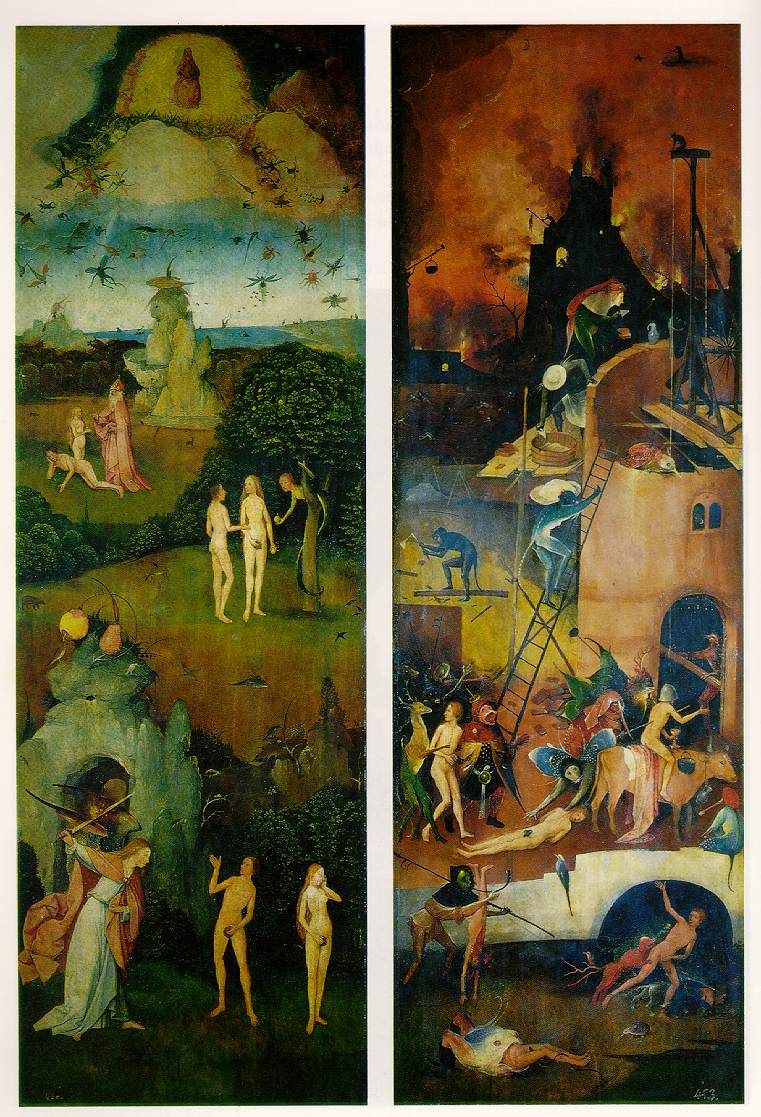
The painting presents an allegorical diptych in which two worlds confront each other directly. On the left, a verdant, watery landscape unfolds, populated by trees, shrubs, birds, small creatures, and numerous groups of nude or partially clothed people. A seated or kneeling figure within a halo occupies the upper area, while a central stone structure brings together plant forms and figures on different levels. On the right, the space becomes reddish, dark, and turbulent: a large, irregular tower dominates the scene amid smoke, fire, scaffolding, ladders, pulleys, and platforms. Men and women work, carry objects, or gather beside pack animals, winged creatures, and a somber stretch of water.
The contrast reflects a longstanding Christian tradition. Paradise is associated with Eden, creation, and an ideal state of abundance and harmony among humanity, nature, and the divine. Hell, by contrast, represents punishment, damnation, and the disruption of order, traditionally associated with fire, darkness, and the presence of demonic beings. In the work of Hieronymus Bosch, these ideas become a visual narrative of extraordinary complexity: the viewer moves from an open, fertile realm to one dominated by confusion, subjugation, and menace.
The iconography reinforces this contrast. The water, vegetation, and gathered figures in the left panel evoke a primordial world, abundant and still in harmony with nature. The sinuous, serpent-like form introduces a tension of temptation and transgression into this Edenic setting. In the right panel, the dark tower, scaffolding, and illuminated openings create an architecture of damnation. The figures working among ropes, materials, and platforms suggest endless toil, while the animals and hybrid beings heighten the sense of disorder. The transition from natural life to a hostile machinery turns the diptych into a meditation on the loss of harmony.
The composition guides the eye through two contrasting rhythms. The left panel is arranged in horizontal layers of sky, water, vegetation, and figures, with a more open, airy flow. Olive greens, golden yellows, and pale blues create a fantastical luminosity that invites the viewer to discover secondary episodes across the entire surface. The right panel concentrates the tower’s vertical lines and the diagonals of stairs, beams, and pulleys; this fragmented network compels the eye to descend among groups of people, animals, and objects. Reds, ochres, blacks, and oranges make the space denser and make the fire and smoke seem to spread through the architecture.
Hieronymus Bosch’s visual language is recognizable in its accumulation of episodes, hybrid imagination, and juxtaposition of the marvelous with moral warning. Each panel functions as a complete world, but meaning emerges above all from the contrast between the two: nature and construction, openness and confinement, abundance and punishment. It is worth observing how the tiny figures, scattered among trees, scaffolding, and dark waters, turn the surface into a multifaceted narrative. In Paradise and Hell, the theme is not limited to a contrast of colors: it is constructed through space, movement, and the transformation of a living landscape into a vision of labor, smoke, and damnation.
Have questions about our oil painting reproductions? See our frequently asked questions.