

Description
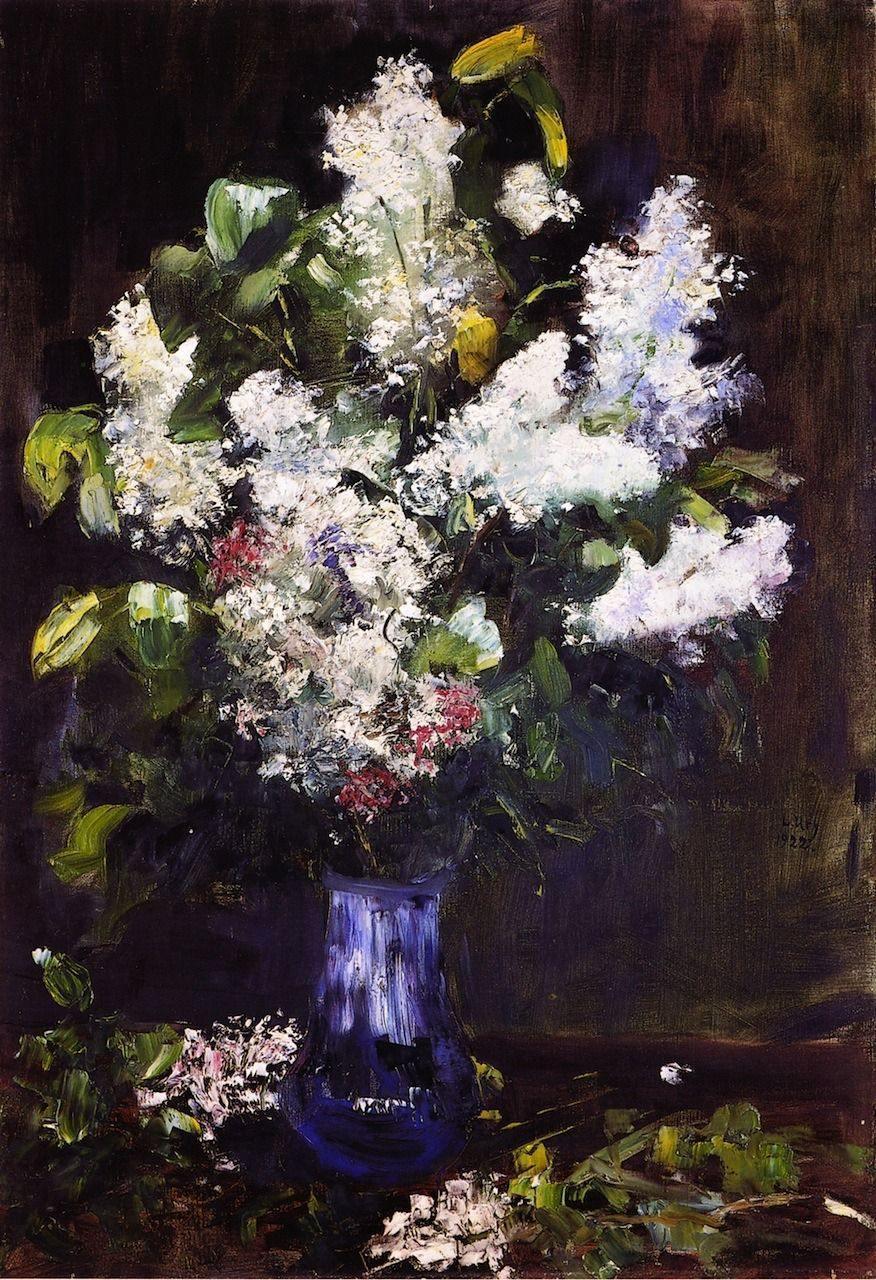
The painting shows an exuberant bouquet arranged in a purplish-blue vase, on a dark surface that extends beneath the composition. The flowers form an abundant, vertical mass: whites and creams occupy much of the center, while lavender, pale blue and reddish-pink tones add variation among the flower heads. The broad, elongated green leaves fan out to the sides and intermingle with the dark stems. Leaves, petals and small plant remnants appear around the base, as if the bouquet’s vitality were overflowing the confines of the vessel. The almost black-brown background closes in the scene and focuses the eye on the luminosity of the flowers.
Lilac Bouquet belongs to the floral still-life genre, a tradition focused on turning everyday objects and natural motifs into an experience of color, material and presence. There is no historical or religious narrative to guide the reading here; interest arises from the relationship between the bouquet, the vessel and the space that contains them. The choice of a dense arrangement transforms a gathering of flowers into an almost theatrical pictorial presence. The work associated with Lesser Ury thus rests on the contemplation of a simple subject, treated with an intensity that sets it apart from mere domestic description.
The concentration of white, cream and lavender flowers acts as a core of light against the shadowy surroundings. The purplish-blue vase bridges the cool tones of the bouquet and the darkness of the base, while visually balancing the weight of the composition. The leaves and scattered remnants around the vessel extend the floral motif beyond the ordered center and create a sense of natural abundance, even of slight overflow. Rather than presenting the bouquet as a perfectly isolated arrangement, the painting allows its secondary elements to take part in the scene and make visible the relationship between beauty, fullness and organic matter.
The vertical structure guides the eye from the lower surface to the top of the bouquet. The vase, narrow at the neck and wider at the body, serves as an anchor; above it, the flowers spread into a triangular shape that broadens toward the sides. The visible brushwork, dense and gestural, keeps each flower from being reduced to a rigid outline: the clusters read as vibrant volumes, built up through touches of color and contrasts in texture. The leaves introduce diagonal rhythms and dark breaks between the lighter areas, while the uniform, deep background eliminates spatial distractions. The result combines limited depth with a strong sense of relief, as if the bouquet were advancing toward the viewer.
The power of Lilac Bouquet lies in its transformation of a floral arrangement into a luminous, almost theatrical apparition. The paint retains the physical energy of the flowers and leaves, while the composition maintains a firm balance thanks to the vase and the horizontal base. In Lesser Ury’s work, as presented here, it is especially worth observing how the lavender tones interact with the whites, and how both gain intensity against the dark brown. The subject needs no external story to hold the viewer’s attention: it is enough to follow the path of light across the flowers, descend toward the vessel, and recognize in the plant remnants on the surface the living abundance that the painting has brought to a standstill.
Have questions about our oil painting reproductions? See our frequently asked questions.